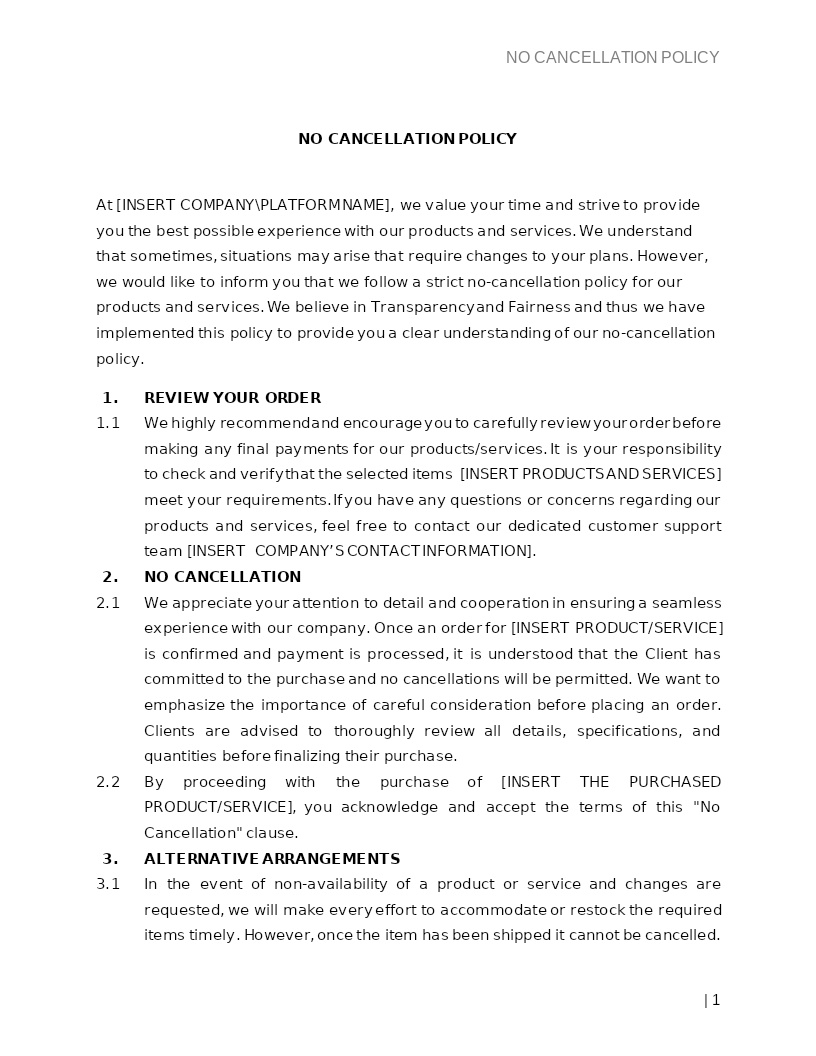
NO CANCELLATION POLICY
How does it work?
1. Choose this template
Start by clicking on "Fill out the template"
2. Complete the document
Answer a few questions and your document is created automatically.
3. Save - Print
Your document is ready! You will receive it in Word and PDF formats. You will be able to modify it.
Understanding a No Cancellation Policy
A No Cancellation Policy is a clear and legally enforceable statement outlining that once a customer places an order, books a service, or enters an agreement, the transaction cannot be canceled, refunded, or reversed under any circumstances except those allowed by law. This policy sets expectations upfront and helps businesses protect operational costs, scheduling commitments, and resource allocation.
In the United States, No Cancellation Policies must comply with state consumer protection laws, Federal Trade Commission (FTC) rules, e-commerce refund disclosure requirements, industry-specific regulations, and contract fairness standards. A properly drafted policy ensures transparency, prevents disputes, and provides customers with a clear understanding of their obligations before making a purchase or booking.
Where No Cancellation Policies Are Commonly Used
No Cancellation Policies apply across numerous industries, particularly where time, resources, or inventory are immediately committed. Common examples include:
- Service-based businesses such as salons, coaching, consulting, or repair services
- Online digital product sales, downloads, and subscription-based content
- Event reservations, travel bookings, and ticketed experiences
- Custom-made or personalized products
- Professional appointments, including medical, legal, or educational services
- Short-notice bookings, rush services, and limited-availability offerings
- Classes, workshops, and online course enrollments
Whenever a customer’s cancellation could cause financial loss or operational disruption, a No Cancellation Policy helps safeguard the business.
Different Types of No Cancellation Policies You May Encounter
- Strict No Cancellation / No Refund Policy: All sales are final and cannot be canceled, modified, or refunded.
- Conditional No Cancellation Policy: Cancellation is only permitted under specific circumstances outlined by the business.
- No Cancellation for Digital Goods: Common for software, e-books, templates, and downloadable content due to instant delivery.
- Appointment-Based No Cancellation Policy: Used by service providers where last-minute cancellations create revenue gaps.
- Customized Order No Cancellation Policy: Applied to personalized items that cannot be resold or reused.
When Legal Guidance Becomes Helpful
Legal assistance is useful when:
- The business operates in a regulated industry with mandatory refund rules
- Customers are located in states with specific “cooling-off” rights
- The policy applies to minors, recurring payments, or long-term commitments
- The business wants to ensure the policy does not violate consumer protection laws
- The policy needs integration into terms of service, contracts, or online checkout flows
- Chargeback prevention and dispute handling language is required
A legally reviewed policy ensures compliance and reduces the risk of disputes or regulatory penalties.
How to Work with This Template
- Clearly state that the transaction cannot be canceled or refunded
- Identify the exceptions, if any, permitted under law or company policy
- Add customer acknowledgment and acceptance language
- Integrate the policy into contracts, order forms, booking pages, or checkout flows
- Include details on rescheduling, substitutions, or credits (if applicable)
- Outline payment responsibility for no-shows, abandoned orders, or unused services
- Choose the governing U.S. state laws
- Provide contact information for questions or clarifications
- Sign electronically or display acceptance confirmation for online transactions
This template follows standard U.S. consumer policy practices and aligns with FTC guidelines for clear and conspicuous disclosure.
Frequently Asked Questions
Q1. What is a No Cancellation Policy and why is it important?
A No Cancellation Policy informs customers that once a transaction is completed, it cannot be canceled or refunded. It is important because it protects businesses from financial losses, scheduling disruptions, and misuse of services or resources.
Q2. Are No Cancellation Policies legally enforceable in the U.S.?
Yes, when clearly disclosed before purchase and compliant with federal and state consumer laws. A well-written policy ensures customers knowingly agree to final sale terms.
Q3. Can a business still offer exceptions under a No Cancellation Policy?
Yes. While the policy is strict, companies may choose to allow exceptions such as medical emergencies, double charges, or legal requirements. Any exceptions must be clearly described.
Q4. Does a No Cancellation Policy apply to digital products?
Often, yes. Digital goods are frequently non-refundable because they are delivered instantly, cannot be returned, and may include protected intellectual property.
Q5. How should customers be informed about a No Cancellation Policy?
It should be displayed clearly before checkout, at booking, and within any contract or service agreement. Visible disclosure strengthens enforceability and reduces disputes.
Q6. Can customers dispute charges under a No Cancellation Policy?
Customers may attempt chargebacks, but clear documentation of acceptance and delivery helps businesses contest disputes successfully.
Q7. Is a No Cancellation Policy suitable for service-based businesses?
Absolutely. Service providers often rely on scheduled appointments, and cancellations result in lost time and revenue. This policy ensures operational stability.
Q8. Can a customer transfer their booking instead of canceling?
Some companies allow transferring a booking to another date or person. If permitted, these rules should be expressly stated in the policy.
Q9. Are electronic acceptances valid for enforcing the policy?
Yes. Under the U.S. ESIGN Act, electronic agreements, checkboxes, and digital acknowledgments are fully enforceable as proof of customer acceptance.
Q10. Does a No Cancellation Policy violate consumer rights?
Not if it is clearly disclosed and compliant with governing laws. Businesses cannot hide the policy or enforce unfair terms, but a properly crafted policy is both lawful and standard.