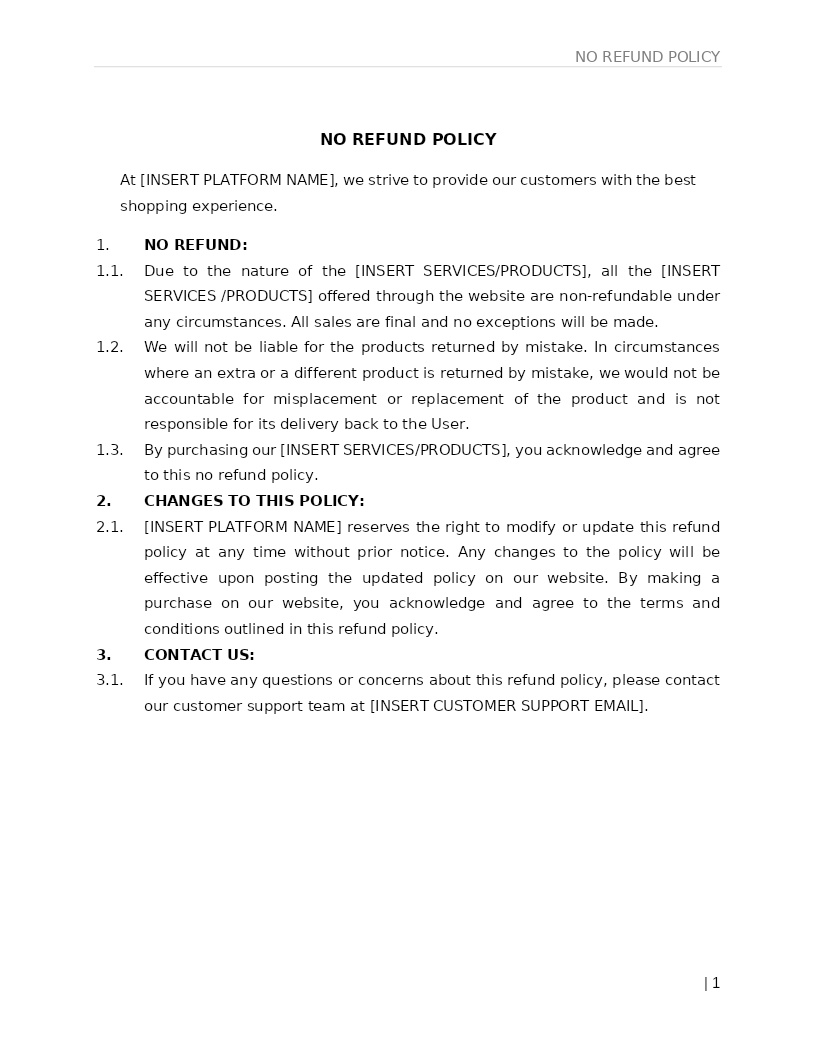
NO REFUND POLICY
How does it work?
1. Choose this template
Start by clicking on "Fill out the template"
2. Complete the document
Answer a few questions and your document is created automatically.
3. Save - Print
Your document is ready! You will receive it in Word and PDF formats. You will be able to modify it.
Understanding No Refund Policy In U.S.
When customers make a purchase on your platform, it is essential to provide clarity on whether refunds are available and under what conditions. A No Refund Policy clearly states that purchases are final and that the business does not offer refunds except where required by U.S. consumer protection laws. This approach sets transparent expectations, minimizes disputes, and helps maintain operational efficiency.
Implementing a No Refund Policy allows your business to confidently conduct transactions while giving customers the information they need to make informed purchasing decisions.
Where No Refund Policies Are Commonly Used
No Refund Policies are standard in various digital and physical commerce situations, including:
• Sales of digital downloads, templates, and online courses
• Subscription-based services or membership platforms
• Customized, made-to-order, or personalized goods
• Clearance or final-sale items
• Access to proprietary dashboards, tools, or restricted platforms
• Event bookings, training sessions, workshops, and webinars
• Software licenses, SaaS platforms, and API-based tools
Any time customers gain immediate access to a non-returnable product or service, a No Refund Policy provides essential legal clarity.
Different Types of No Refund Policies You May Encounter
- Strict No Refund Policy: All sales are final, with no refunds provided under any circumstances except where U.S. law requires (e.g., defective or non-conforming goods).
- Conditional No Refund Policy: Refunds are only allowed under specific scenarios, such as product defects, shipment damage, or technical issues preventing service use.
- Digital Product No Refund Policy: Applied exclusively to digital goods and downloads that cannot be returned once delivered or accessed.
- Service-Based No Refund Policy: Used for coaching, consulting, design services, or booked appointments where time and labor are allocated.
- Event or Ticketing No Refund Policy: Used when payments secure a seat or reservation and cannot be reversed unless the event is canceled.
When Legal Guidance Becomes Helpful
Just like with NDAs, obtaining legal review becomes valuable when:
• You sell goods or services across multiple U.S. states with varying consumer laws
• Your platform serves international customers with additional refund regulations
• Your business handles digital content protected under copyright or licensing
• Your industry imposes strict regulations (finance, health, education, etc.)
• You need customized clauses for high-risk transactions or regulated goods
• You want to ensure your policy remains enforceable under the FTC Act and state consumer laws
Legal advice isn’t mandatory but helps reduce risk when dealing with interstate commerce or complex sales scenarios.
How to Work With This No Refund Policy
• Clearly define what products or services the policy applies to
• Identify exceptions mandated under U.S. law (e.g., defective products)
• Explain what constitutes final sale items
• Outline procedures for reporting defective or damaged goods
• Inform customers before checkout and obtain consent
• Ensure the policy is accessible on your website and order pages
• Review the terms periodically and update as required
A properly implemented No Refund Policy reduces ambiguity and ensures customers are fully informed during the purchasing process.
Frequently Asked Questions
Q1. Are No Refund Policies legal in the United States?
Yes. U.S. law permits No Refund Policies as long as they are clearly disclosed to customers before purchase. However, businesses must still comply with federal and state laws requiring refunds for defective, damaged, or non-conforming goods. A transparent, well-posted policy helps ensure enforceability and consumer trust.
Q2. Can customers request a refund if the product is defective?
Yes. Even with a No Refund Policy, U.S. laws such as the Uniform Commercial Code (UCC) require sellers to replace or remedy defective products. This means customers have a right to a solution if the item received is damaged, faulty, or does not match the description provided at purchase.
Q3. Does the No Refund Policy apply to digital products?
Yes, digital products are typically non-refundable since they cannot be returned once accessed or downloaded. This includes e-books, templates, software, and online courses. Clear disclosure ensures customers understand that all digital purchases are final upon delivery.
Q4. What if a customer wants to cancel their order after payment?
Under a No Refund Policy, cancellations are generally not accepted once an order is placed. However, for pre-order or service-based purchases, businesses may choose to allow limited cancellation windows. Posting your cancellation rules alongside the policy helps avoid misunderstandings.
Q5. Are services covered under a No Refund Policy?
Yes. Service-based businesses, such as coaching, consulting, or design services, can apply a No Refund Policy since time and expertise are allocated upon booking. It is recommended to clearly outline the scope of work and any exceptions to ensure clients understand their commitments.
Q6. Can a No Refund Policy reduce disputes and chargebacks?
Absolutely. A transparent No Refund Policy helps set proper expectations and reduces chargebacks by informing customers of the finality of their purchase. When paired with clear product descriptions and order confirmations, it strengthens your defense in case of disputes.
Q7. How can customers report problems if refunds are not available?
While refunds may not be offered, customers should have a dedicated channel to report defective, damaged, or missing items. Your support team can offer replacements, repairs, or store credit where required by law. Providing alternatives helps maintain customer satisfaction.
Q8. How should a No Refund Policy be displayed on a website?
To remain enforceable, the policy must be prominently displayed on key pages such as the product page, checkout page, footer, and confirmation emails. Customers should be required to accept the policy before completing their purchase to ensure legal validity and transparency.