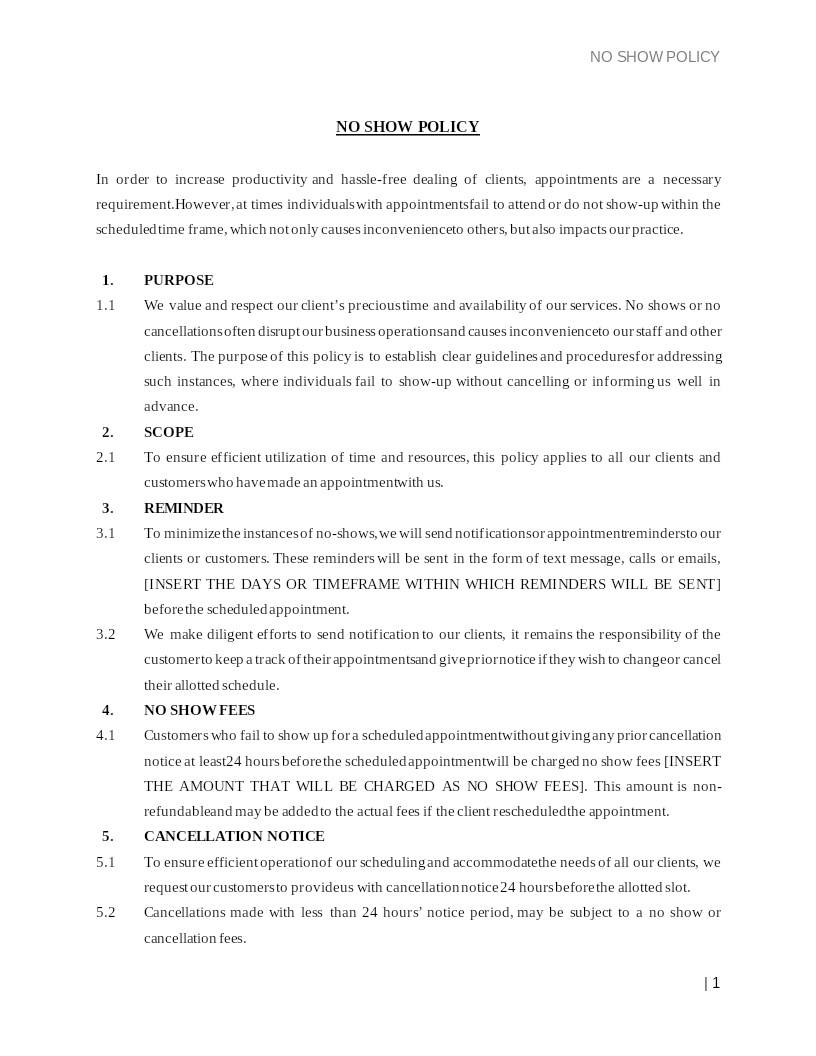
NO-SHOW POLICY
How does it work?
1. Choose this template
Start by clicking on "Fill out the template"
2. Complete the document
Answer a few questions and your document is created automatically.
3. Save - Print
Your document is ready! You will receive it in Word and PDF formats. You will be able to modify it.
Promoting Accountability and Operational Efficiency Through a No Show Policy
A No Show Policy is a formal organizational directive that outlines expectations, procedures, and consequences relating to an employee’s or client’s failure to appear for a scheduled shift, meeting, appointment, or service without proper notice. Developed in alignment with U.S. employment regulations, including the Fair Labor Standards Act (FLSA), state wage-and-hour laws, attendance-related compliance obligations, and industry best practices, this policy provides a fair and consistent framework for managing unexcused absences. It ensures that employees understand their responsibility to provide timely notification when they cannot fulfill a scheduled commitment and establishes clear standards for discipline, documentation, and communication. For service-based businesses, the policy also clarifies expectations for customers or clients who fail to attend scheduled appointments, thereby protecting the organization from operational disruption and financial loss.
A comprehensive No Show Policy defines what constitutes a “no show,” outlines acceptable methods and timelines for notifying supervisors or administrative personnel and specifies the consequences of failing to comply with attendance requirements. It describes procedures for documenting absences, identifying patterns of noncompliance, and escalating corrective action based on severity and frequency. The policy explains how no-show incidents impact scheduling, workflow, productivity, and customer service, and it emphasizes the importance of fairness and nondiscriminatory enforcement pursuant to EEOC standards. Additionally, the policy may outline rules applicable to clients or customers, including cancellation deadlines, deposit forfeitures, rescheduling fees, and exceptions for emergencies. By implementing this policy, organizations strengthen workforce accountability, promote operational continuity, minimize disruption, and safeguard financial and service-delivery obligations.
Where No Show Policies Are Commonly Used
No Show Policies are widely used in industries requiring strict scheduling and reliable attendance, including:
- Healthcare and dental practices managing patient appointments
- Service professionals such as salons, consultants, and therapists
- Retail, hospitality, and food-service industries operating shift-based schedules
- Corporate offices with structured meetings and attendance expectations
- Transportation and logistics organizations managing driver schedules
- Educational institutions overseeing student, staff, or training attendance
- Nonprofits and community organizations providing appointment-based services
- Government contractors requiring documentation and compliance with staffing rules
Any organization impacted by unexpected absences benefits from a clearly written No Show Policy.
Different Types of No Show Policies You May Encounter
1. Employee Attendance No Show Policies: Address unexcused absences or failure to notify a supervisor before missing a scheduled shift.
2. Client or Customer No Show Policies: Apply to service-based businesses and outline cancellation rules, fees, and appointment requirements.
3. Hybrid Organizational No Show Policies: Combine workforce attendance requirements with client appointment standards.
4. Medical or Clinical No Show Policies: Include specialized exceptions for health-related emergencies and compliance with patient-care laws.
5. Shift-Based No Show Policies: Apply to hourly or on-call workers with strict scheduling procedures.
When Legal Guidance Becomes Helpful
Legal consultation is recommended when:
- The policy intersects with wage-payment rules for on-call, reporting-time, or show-up pay
- Attendance issues involve discrimination, disability accommodations, or protected leave status
- Employees request leave under the FMLA or state family-leave programs
- Disciplinary actions may expose the organization to wrongful-termination claims
- Client no-show fees must comply with consumer-protection laws or state billing rules
- The company must document compliance for government contracts or regulatory audits
Legal review ensures the No Show Policy complies with U.S. employment laws, protects employee rights, and remains enforceable and non-discriminatory.
How to Work with This Template
- Define what constitutes a “no show” for employees or clients
- Establish required notification timelines and acceptable communication methods
- Clarify disciplinary steps for unexcused absences or repeated no-show occurrences
- Outline expectations for punctuality, reliability, and schedule adherence
- Provide guidance for documenting absences and identifying attendance patterns
- Include exceptions for emergencies, protected leave, or legally excused absences
- Detail the process for rescheduling appointments or shifts when possible
- Specify client-related penalties, such as cancellation fees or forfeited deposits
- Ensure consistency with wage laws, anti-discrimination rules, and accommodation requirements
- Require employees to acknowledge receipt and understanding of the policy
- Update the policy regularly to reflect employment-law changes and operational needs
This template reflects best practices for managing absenteeism, reducing disruption, and ensuring fairness.
Frequently Asked Questions
Q1. What is a No Show Policy, and why is it important?
A No Show Policy defines rules for handling unexcused absences or missed appointments. It is important because it promotes accountability, reduces operational disruption, and ensures consistent enforcement in compliance with U.S. employment laws.
Q2. Does the policy apply to both employees and clients?
Yes. Many organizations have separate or combined policies addressing employee attendance and client appointment cancellations.
Q3. How much notice must employees give before missing a shift?
Most policies require employees to notify a supervisor as soon as possible often at least several hours before the shift using approved communication channels.
Q4. Can an employee be disciplined for repeated no shows?
Yes. Repeated no-shows may result in progressive discipline, including warnings, suspension, or termination, consistent with employment law and company procedures.
Q5. Are no-show fees allowed for customers or clients?
Yes, but fees must comply with state consumer-protection rules and must be clearly disclosed before the appointment.
Q6. Do emergencies count as no shows?
Most policies provide exceptions for genuine emergencies, medical issues, or protected leave situations.
Q7. Can employees be required to provide documentation for absences?
Yes. Employers may request documentation, such as medical notes, provided the requirement is applied consistently and complies with privacy laws.
Q8. Is advance payment forfeited for client no shows?
In many service industries, deposits may be forfeited when clients fail to appear without notice, provided this is disclosed in advance.
Q9. How does the policy ensure fairness?
By applying the rules uniformly, maintaining documentation, and accommodating legally protected situations such as disability or family-leave rights.
Q10. Should legal counsel review a No Show Policy?
Absolutely. Legal review helps ensure that attendance rules comply with wage laws, anti-discrimination protections, leave requirements, and consumer-protection obligations.