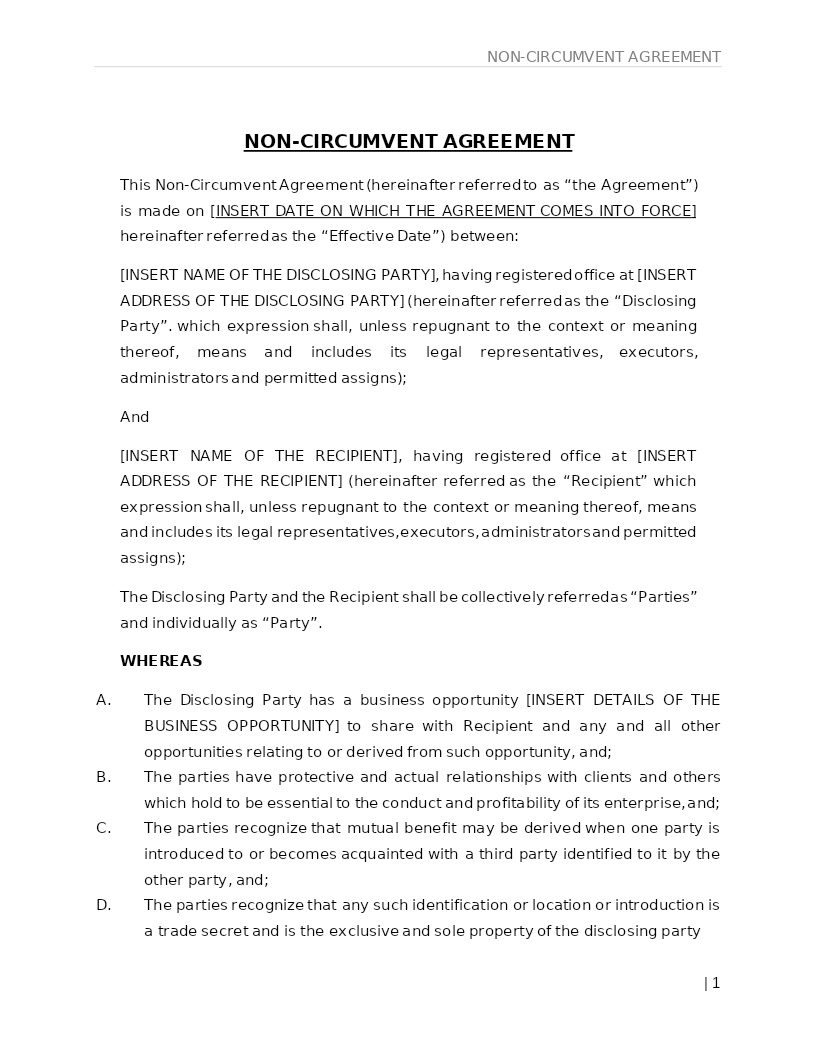
NON-CIRCUMVENT AGREEMENT
How does it work?
1. Choose this template
Start by clicking on "Fill out the template"
2. Complete the document
Answer a few questions and your document is created automatically.
3. Save - Print
Your document is ready! You will receive it in Word and PDF formats. You will be able to modify it.
Understanding Non-Circumvent Agreements in U.S. Business Deals
When you’re facilitating a business introduction, sharing high-value contacts, or opening access to your commercial network, it’s critical to have a legal safeguard that prevents others from bypassing you. A Non-Circumvent Agreement (NCA) creates that protection. It ensures that the party receiving your contacts or opportunities cannot directly approach them behind your back, cut you out of a deal, or profit from your relationships without proper compensation.
A Non-Circumvent Agreement protects relationships, deal flow, commissions, introductions, and business access. It is widely used in U.S. investment transactions, brokerage deals, sourcing arrangements, partnerships, and cross-border commercial operations where introductions carry significant monetary value.
An NCA establishes trust, encourages transparent communication, and reduces the risk of unethical bypassing allowing parties to collaborate without worrying about being excluded from the business opportunity they initiated.
Where Non-Circumvent Agreements Are Commonly Used
Non-Circumvent Agreements are common in U.S. business transactions where introductions create measurable value, including:
- Investor Introductions & Fundraising Rounds – Protecting finders, advisors, and intermediaries who connect startups with capital sources.
- Brokered Deals & Commission-Based Transactions – Ensuring brokers receive their agreed-upon fees.
- Vendor Sourcing, Supply Chain & Procurement – Preventing buyers from bypassing sourcing agents or intermediaries.
- Joint Ventures, Partnerships & Licensing Discussions – Safeguarding relationships shared during commercial evaluations.
- Real Estate & M&A Deals – Protecting consultants and deal-facilitators who bring parties together.
- International Trade & Import/Export Introductions – Ensuring that cross-border suppliers, agents, or distributors aren’t cut out once relationships are established.
Any time a party reveals valuable business contacts or commercial opportunities, an NCA defines the boundaries and protects against circumvention.
Different Types of Non-Circumvent Agreements You May Encounter
- Unilateral Non-Circumvent Agreement: Used when one party is sharing its contacts, leads, or business pipeline for example, a consultant introducing a client to vendors.
- Mutual (Bilateral) Non-Circumvent Agreement: Both sides protect each other’s contacts and networks during discussions, common in joint venture negotiations or co-brokered deals.
- Project-Specific Non-Circumvent Agreement: Narrowly tailored to a single deal, introduction, lead list, or transaction to ensure clarity and enforceability.
- Commission-Protection NCAs: Used when intermediaries rely on referral fees, finder’s fees, or closing commissions and need strong language preventing bypass or underpayment.
- Cross-Border Non-Circumvent Agreements: Designed for international transactions involving multiple jurisdictions, where circumvention risk is high due to fragmented markets and differing local laws.
When Legal Guidance Becomes Helpful
While many business introductions are routine, legal advice becomes especially valuable when:
- You are sharing access to high-value clients, trade partners, suppliers, or investors.
- Multiple brokers, consultants, or intermediaries are involved, increasing circumvention risk.
- Your agreement includes cross-border transactions, tax implications, or multi-state legal issues.
- You want to add supplementary protections like commission structures, non-disclosure clauses, non-solicitation, or exclusivity.
- You are facilitating a deal involving M&A, licensing, import/export, product distribution, or large-scale procurement.
- You need customized risk allocation, indemnification, or remedies for violation.
Legal review ensures the agreement is enforceable under U.S. standards, aligns with industry norms, and protects you against intentional or accidental bypassing.
How to Work with This Non-Circumvent Template
- Identify all parties involved in the introductions or deal opportunities.
- Define what constitutes “circumvention”—direct outreach, indirect communication, or contacting related entities.
- Specify the protected contacts, networks, or opportunities covered by the agreement.
- Detail commission, referral, or finder’s fee structures, if applicable.
- Select the governing state law and specify dispute-resolution methods.
- Outline the duration of protection (often 1–3 years for commercial deals).
- Review terms jointly and adjust based on business needs (optional legal review recommended).
- Execute via e-signature, which is fully enforceable under U.S. law.
Your agreement then serves as a clear record of obligations, restrictions, and protections throughout the transaction.
Frequently Asked Questions
Q1. What does a Non-Circumvent Agreement protect in a U.S. business deal?
An NCA protects your business relationships such as investors, vendors, suppliers, or clients, by preventing the other party from bypassing you and dealing with them directly. In U.S. brokerage, consulting, and fundraising transactions, this ensures that you receive fair compensation for the introductions and opportunities you create.
Q2. Is a Non-Circumvent Agreement legally enforceable in the United States?
Yes. U.S. courts generally enforce NCAs as long as the terms are clear, reasonable in duration, and tied to legitimate business interests. Having a well-drafted agreement strengthens enforceability by defining “circumvention,” outlining remedies, and specifying governing state law.
Q3. How long should a Non-Circumvent Agreement last?
Most NCAs in the U.S. range from 12 months to 3 years, depending on the nature of the transaction. For high-value networks or long sales cycles, parties may opt for longer protection. The key is that the duration must be commercially reasonable and justifiable.
Q4. Can a Non-Circumvent Agreement include confidentiality protections?
Yes. Many NCAs include or are combined with an NDA to protect both business contacts and sensitive information exchanged during discussions. This dual protection is common in investor meetings, supplier negotiations, and deal-sourcing engagements.
Q5. What happens if a party violates a Non-Circumvent Agreement?
A breach may entitle you to several remedies, including:
• Immediate cessation of the improper contact or transaction
• Recovery of lost commissions, referral fees, or profits
• Injunctions preventing further circumvention
• Legal action in the agreed-upon jurisdiction
Well-defined remedies make enforcement significantly easier.
Q6. Do Non-Circumvent Agreements work for international deals?
Yes. NCAs are common in global supply chain, import/export, and cross-border partnership transactions. However, international deals benefit from customized drafting to account for differences in enforcement, governing law, taxation, and local trade regulations.
Q7. Should I consult a lawyer before signing or sharing a Non-Circumvent Agreement?
While templates work for standard situations, U.S. attorneys or in-house counsel add value when the deal involves high-value contacts, commissions, multi-party arrangements, or international elements. They ensure that your rights, compensation, and protections are comprehensive and enforceable.
Q8. Can a Non-Circumvent Agreement be combined with a commission or referral agreement?
Absolutely. Many professionals combine NCAs with referral-fee clauses, finder’s-fee schedules, or revenue-sharing arrangements. This guarantees that if the deal closes, your compensation is clearly defined and contractually protected.