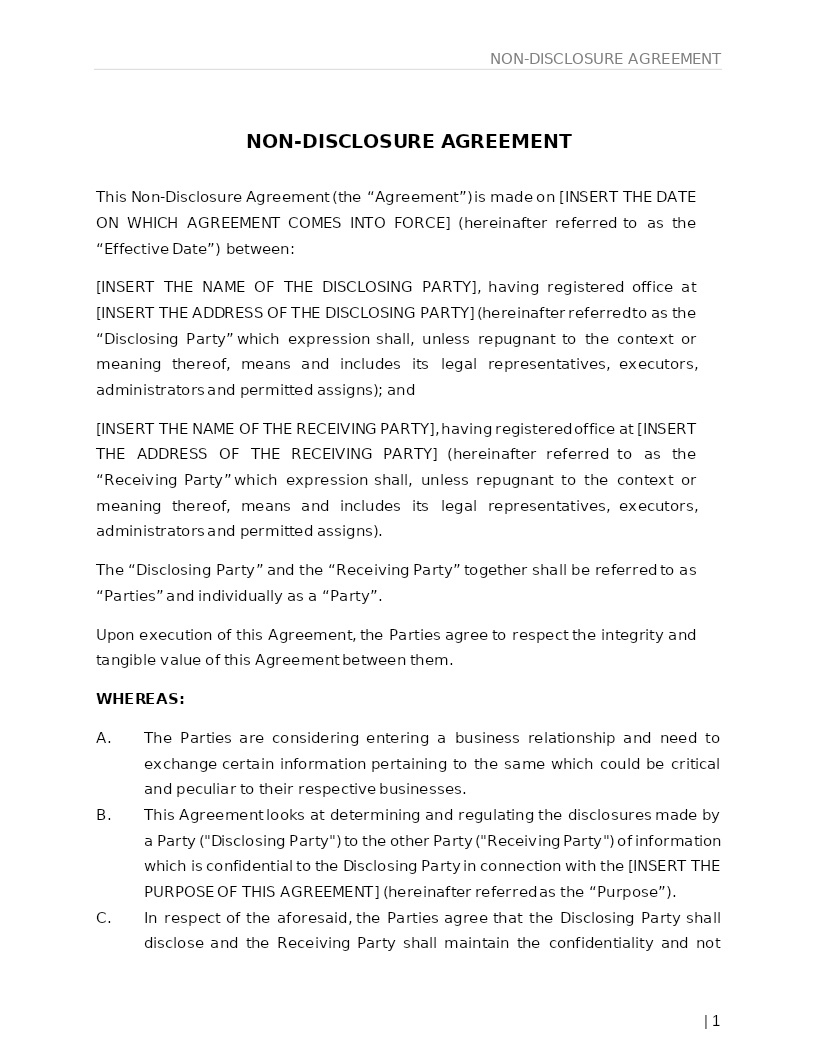
NON-DISCLOSURE AGREEMENT
How does it work?
1. Choose this template
Start by clicking on "Fill out the template"
2. Complete the document
Answer a few questions and your document is created automatically.
3. Save - Print
Your document is ready! You will receive it in Word and PDF formats. You will be able to modify it.
Protecting Confidential Information in Business Discussions
When you’re evaluating a potential transaction, sharing a business concept, or granting someone access to internal operations, it’s important to have a clear framework that governs how sensitive information will be handled. A Non-Disclosure Agreement (NDA) provides that structure. It defines what qualifies as confidential, how it may be used, and what the receiving party is prohibited from doing with it.
Putting an NDA in place creates a level of trust that allows both parties to communicate openly, exchange materials, and assess opportunities without worrying about improper disclosure or misuse.
Where NDAs Are Commonly Used
Confidentiality agreements are standard in a wide range of commercial situations, including:
- Initial conversations with potential investors or during fundraising
- Vendor evaluations, due diligence, and onboarding
- Demonstrations of proprietary tools, prototypes, or restricted systems
- Consulting engagements, outsourcing, and external service relationships
- Joint development discussions or collaboration initiatives
- Recruitment processes and independent contractor arrangements
Whenever information leaves your internal environment, an NDA establishes clear boundaries around what the recipient can and cannot do.
Different Types of NDAs You May Encounter
- Unilateral NDA: Used when only one party discloses confidential information, such as during an investor pitch or when a vendor reviews internal documents.
- Mutual NDA: Used when both parties expect to exchange sensitive information while exploring a potential partnership or project.
- Project-Specific NDA: A narrowly tailored agreement intended for a single initiative or limited information exchange.
- Employee or Contractor NDAs: Used within an organization to protect trade secrets, customer data, proprietary methods, and other sensitive material accessed during work.
When Legal Guidance Becomes Helpful
Most routine disclosures don’t require extensive legal involvement, but professional advice can be valuable when:
- You’re sharing proprietary technology, code, formulas, or trade secrets.
- Multiple jurisdictions or several parties are involved.
- The NDA supports a transaction involving a merger, license, investment, or acquisition.
- The information is part of a regulated industry, such as finance, healthcare, or education.
- You want to include restrictions like non-solicitation or non-compete.
- The value of the relationship hinges on protecting core intellectual property.
Legal review isn’t mandatory, but it reduces risk when sensitive information or complex circumstances are at play.
How to Work with This Template
- Identify the parties who will exchange confidential information.
- Clearly state the purpose of the disclosure.
- Specify what information is protected.
- Select the governing state law.
- Set the duration of confidentiality.
- Review the terms together (legal review is optional).
- Sign electronically or in hard copy
The template is compatible with major e-signature platforms and adheres to contract standards widely recognised throughout the United States.
Frequently Asked Questions
Q1. Why is an NDA important during early business discussions?
An NDA is crucial even in the initial stages because confidential information often surfaces earlier than expected such as financial forecasts, internal workflows, prototypes, or strategic plans. By signing an NDA before deeper discussions begin, both parties can communicate openly without worrying about disclosure or misuse. It sets a professional tone and ensures your proprietary information stays protected if the relationship does not move forward.
Q2. Is a Non-Disclosure Agreement legally enforceable in the U.S.?
Yes. NDAs are enforceable contracts under U.S. law as long as they are clear, reasonable, and voluntarily signed by both parties. Courts enforce NDAs that properly define confidential information, specify permitted use, and outline remedies for breach. Well-drafted NDAs are especially strong when they protect trade secrets, as federal and state laws provide additional protection against unauthorized disclosure.
Q3. Should I use a mutual NDA or a one-way NDA?
It depends on whether both parties will be sharing confidential information. A one-way NDA is appropriate when only one side is disclosing sensitive material, such as an employer interviewing a candidate or a business sharing documents with a vendor. A mutual NDA is ideal for partnerships, joint ventures, or collaborative projects where both sides exchange proprietary information. Choosing the correct structure helps ensure fairness and clear expectations.
Q4. Are electronic signatures accepted for NDAs?
Yes. In the U.S., electronic signatures are fully valid under federal laws like the ESIGN Act. Signing an NDA through platforms such as DocuSign or Adobe Sign is as legally binding as signing a physical document. This makes it easy for remote teams, freelancers, consultants, and multi-state businesses to execute NDAs quickly and efficiently.
Q5. What happens if someone violates the NDA?
If a party breaches the NDA, the non-breaching party can demand immediate action such as stopping further disclosure, returning or deleting confidential materials, or limiting ongoing use. Depending on the severity, you can pursue financial damages or request a court injunction to prevent continued misuse. U.S. law also allows additional remedies when trade secrets are involved, making breaches costly and legally risky.
Q6. How long does an NDA typically last?
Most NDAs set confidentiality obligations for two to five years, which is standard for business negotiations and vendor evaluations. However, certain information such as proprietary formulas, algorithms, or trade secrets, may require indefinite protection. The duration depends on the type of information shared and how long it needs to remain confidential to protect your business interests.
Q7. Does the NDA cover verbal or informal disclosures?
Yes, most NDAs protect information shared verbally, visually, or through presentations, as long as the agreement specifies that oral disclosures are included. To maintain clarity, many businesses follow up with a brief written summary after meetings so there’s a documented record of what was shared. This ensures that even informal conversations are covered under the agreement.
Q8. Can this NDA be used for freelancers, contractors, and agencies?
Absolutely. NDAs are commonly used with freelancers, consultants, marketing agencies, developers, and independent contractors who access internal workflows or client data. Requiring them to sign an NDA ensures your business information remains protected throughout the engagement and after the project ends.
Q9. Will this NDA work when parties are located in different states?
Yes. NDAs are routinely used in cross-state and remote business relationships. You simply choose one state’s laws to govern the agreement such as Delaware, New York, or California. This ensures consistency and avoids conflicts when parties operate from different jurisdictions.
Q10. Can I use the same NDA for future meetings or new projects?
Yes, the template can be reused. However, it’s best practice to revise the purpose and description of the project each time you use it. Updating the context strengthens the NDA’s enforceability and ensures both parties clearly understand what information is being protected in each new engagement.
Related Templates You May Need
• Consulting Services Agreement