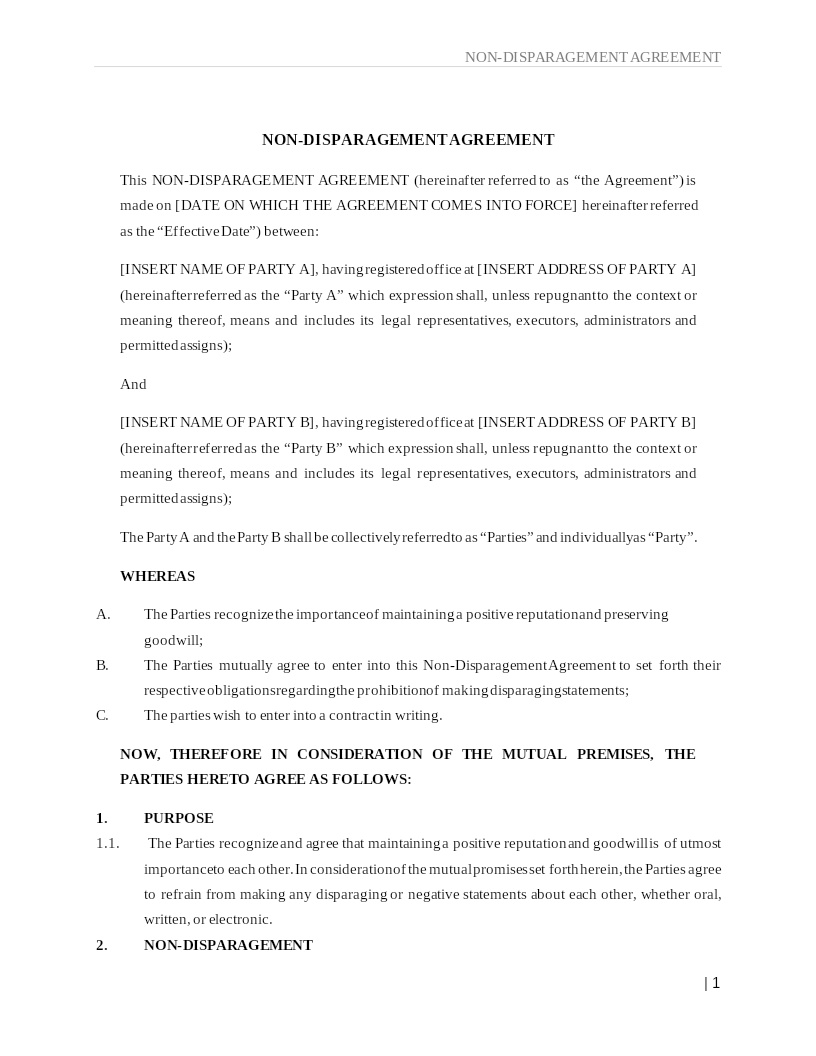
NON-DISPARAGEMENT AGREEMENT
How does it work?
1. Choose this template
Start by clicking on "Fill out the template"
2. Complete the document
Answer a few questions and your document is created automatically.
3. Save - Print
Your document is ready! You will receive it in Word and PDF formats. You will be able to modify it.
Understanding Non-Disparagement Agreements
A Non-Disparagement Agreement is a legally binding contract in which two parties agree not to make negative, harmful, or defamatory statements about each other. These agreements protect business reputations, prevent public disputes, and ensure that past or current relationships such as employment, partnerships, or service arrangements are not damaged by negative comments.
Under U.S. contract law, Non-Disparagement Agreements are commonly used in employment, contractor relationships, business settlements, and partnership dissolutions. The agreement establishes clear expectations regarding acceptable communication and provides a legal remedy if one party engages in reputation-damaging conduct.
Where Non-Disparagement Agreements Are Commonly Used
Non-disparagement clauses appear in many business and workplace relationships, including:
• Employment contracts and termination or severance agreements
• Settlement agreements involving disputes or financial claims
• Service provider and client relationships
• Influencer, brand ambassador, and sponsorship contracts
• Business partnerships and joint venture dissolutions
• Vendor, contractor, or consultant arrangements
• Franchise and distribution relationships
• Intellectual property or licensing agreements
Different Types of Non-Disparagement Agreements You May Encounter
- Mutual non-disparagement: Both parties agree not to make negative statements about each other.
- Employee-Focused Non-Disparagement: Applied to current or former employees as part of employment or severance terms.
- Customer or Client Non-Disparagement: Used when clients have access to inside information or may leave damaging reviews.
- Contractor or Vendor Non-Disparagement: Used to protect companies from negative statements made by external partners.
When Legal Guidance Becomes Helpful
Legal review is particularly valuable when the agreement involves:
• High-stakes business relationships or public-facing brands
• Settlement negotiations or dispute resolution
• Restrictions that must comply with federal labor laws (such as NLRA rules)
• Communication related to regulated industries (healthcare, finance, tech)
• Influencers, social media, or public communication channels
• Clarifying what is considered “disparagement” vs. protected speech
How to Work with This Template
• Identify the parties entering the non-disparagement arrangement
• Define what constitutes “disparaging statements”
• Specify permitted communications (legal disclosures, whistleblower rights, etc.)
• Set a clear duration for non-disparagement obligations
• Choose the governing state law
• Review the obligations together legal review is optional
• Sign electronically or in hard copy
Frequently Asked Questions
Q1. What does a Non-Disparagement Agreement actually prevent?
It prevents either party from making negative, harmful, or defamatory comments publicly or privately—about the other. This includes statements made on social media, online reviews, interviews, emails, or other communication channels.
Q2. Is a Non-Disparagement Agreement enforceable in the U.S.?
Yes. These agreements are enforceable under state contract law when they are reasonable, clear, and do not restrict legally protected rights such as whistleblowing, reporting violations, or participating in legal investigations.
Q3. Does it stop someone from telling the truth?
The agreement restricts negative statements but typically does not prevent required disclosures such as reporting illegal activity, cooperating with authorities, or exercising statutory rights. Many agreements specify these exceptions to remain compliant with U.S. labor laws.
Q4. How is this different from a confidentiality agreement?
A confidentiality agreement protects private information, while a non-disparagement agreement protects reputation. They can be used together for stronger legal protection.
Q5. Can a former employee still discuss their job experience?
Yes, as long as their statements are not disparaging, defamatory, or misleading. The agreement focuses on preventing harmful comments not on restricting general experiences or opinions shared respectfully.
Q6. What happens if someone violates a Non-Disparagement Agreement?
The harmed party may seek legal remedies such as:
• Removal of the disparaging content
• Financial damages
• Injunctive relief to stop further statements
• Enforcement of settlement or severance consequences
Q7. Can this agreement cover social media and online reviews?
Absolutely. Most modern agreements explicitly apply to social media posts, digital content, forums, review sites, videos, and online platforms due to their potential to damage reputation quickly.
Q8. Is a mutual non-disparagement clause better than a one-way clause?
Mutual clauses are common because they protect both sides equally. Using one depends on the nature of the relationship and the level of risk each party faces.
Q9. How long does a non-disparagement obligation last?
Terms vary but often last 1–5 years, or in some cases, indefinitely for high-value settlements or proprietary relationships. Duration should be clearly defined in the agreement.
Q10. Are electronic signatures valid for this agreement?
Yes. Under the U.S. ESIGN Act, electronic signatures are fully enforceable. Most parties sign non-disparagement agreements through secure e-signature platforms for convenience.