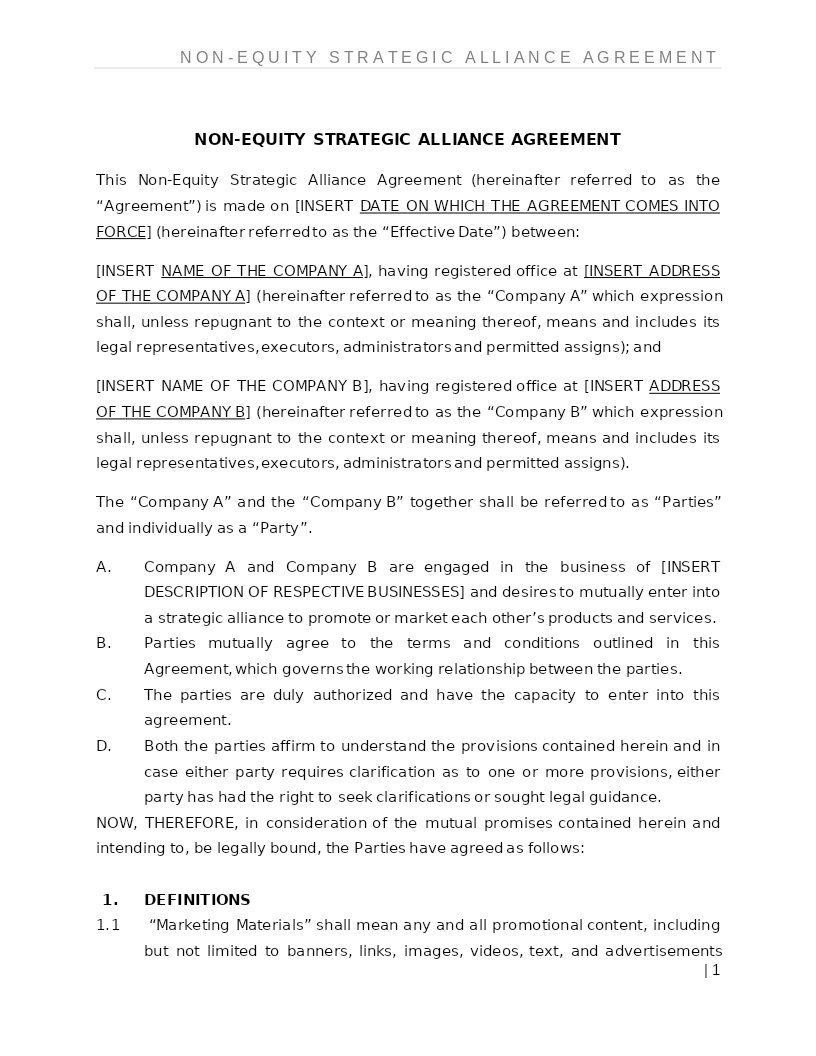
NON-EQUITY STRATEGIC ALLIANCE AGREEMENT
How does it work?
1. Choose this template
Start by clicking on "Fill out the template"
2. Complete the document
Answer a few questions and your document is created automatically.
3. Save - Print
Your document is ready! You will receive it in Word and PDF formats. You will be able to modify it.
Understanding Non-Equity Strategic Alliance Agreements
A Non-Equity Strategic Alliance Agreement is a collaborative arrangement between two or more independent organizations that want to work together without forming a joint venture or exchanging ownership stakes. Instead of sharing equity, each party contributes its resources, expertise, technology, distribution channels, or market access to advance shared goals while remaining separate legal entities.
In the United States, these agreements operate under state contract law, federal competition regulations, intellectual property rules, confidentiality obligations, and industry - specific compliance standards. A written agreement helps define expectations, protect proprietary information, and outline each party’s commitments ensuring the alliance delivers mutual value without creating unintended legal or financial obligations.
Where Non-Equity Strategic Alliance Agreements Are Commonly Used
Non-equity alliances are widely used in industries where collaboration offers mutual growth, including:
- Technology companies partnering on development or integration
- Pharmaceutical or biotech firms collaborating on research
- Manufacturers and distributors expanding market access
- Educational institutions and private companies working on research initiatives
- Consulting firms and software providers offering combined solutions
- Startups partnering with established brands for co-marketing
- Global companies working together to enter new markets
Anytime organizations want to cooperate without forming a shared entity, a non-equity alliance provides structure and clarity.
Different Types of Non-Equity Strategic Alliances You May Encounter
- Co-Marketing or Co-Branding Alliances: Partners jointly promote goods or services while retaining independent operations.
- Technology Integration Alliances: Companies combine software, platforms, or tools to create enhanced solutions.
- Research & Development Alliances: Organizations collaborate on innovation while protecting IP ownership.
- Distribution or Channel Alliances: One partner provides market access, while the other contributes products or expertise.
- Service Collaboration Alliances: Providers work together to deliver combined or complementary services.
When Legal Guidance Becomes Helpful
Professional guidance is valuable when:
- Intellectual property or proprietary technology may be shared
- The alliance involves regulated industries, such as healthcare or financial services
- Revenue-sharing, licensing, or co-branding terms require clarity
- The collaboration spans multiple states or international jurisdictions
- The alliance impacts competition or antitrust laws
- Confidential information or trade secrets are exchanged
- The parties want a clear exit process or dispute-handling structure
How to Work with This Template
- Identify all alliance partners and define the purpose of the collaboration
- Clearly describe each party’s contributions, responsibilities, and deliverables
- Specify any shared resources, IP arrangements, and confidentiality obligations
- Outline governance, decision-making roles, and communication processes
- Select a governing U.S. state law
- Set the timeline, renewal terms, and exit provisions
- Review terms together and sign electronically or in hard copy
Frequently Asked Questions
1. What is a Non-Equity Strategic Alliance Agreement?
It is a collaborative contract where organizations work together toward shared goals without exchanging equity or forming a joint venture. This allows each party to remain fully independent while still benefiting from combined strengths, expertise, or market access.
2. Why choose a non-equity alliance instead of a joint venture?
Non-equity alliances offer flexibility, lower risk, and faster implementation. Unlike joint ventures, they do not require forming a new legal entity, sharing ownership, or combining finances making them ideal for short-term or exploratory collaborations.
3. What should be included in a Non-Equity Strategic Alliance Agreement?
Key elements include project objectives, responsibilities, contributions, IP rights, confidentiality, performance obligations, governance structure, and termination terms. These details ensure the alliance functions smoothly and avoids ambiguity.
4. Are non-equity alliances legally enforceable in the U.S.?
Yes. These agreements are enforceable under state contract laws. Clear written terms help both parties understand their obligations and provide legal protection if disputes arise during the collaboration.
5. How is intellectual property handled in a strategic alliance?
Each party typically retains ownership of its pre-existing IP. New jointly created IP may be subject to shared rights, licensing terms, or ownership rules outlined in the agreement. Strong IP clauses prevent misuse or disputes.
6. Do these alliances involve sharing financial risk?
Generally, no. Because there is no equity exchange, each party bears its own financial obligations unless otherwise defined. Some alliances may include cost-sharing or revenue-sharing, but this is governed by contract terms.
7. Can a non-equity alliance be terminated early?
Yes. Most agreements include termination clauses for breach, non-performance, strategic changes, or mutual consent. Clear exit procedures allow both parties to disengage without disrupting operations.
8. Are confidentiality obligations included?
Always. Because partners often exchange sensitive information, the agreement includes confidentiality, data-protection, and non-disclosure requirements to safeguard proprietary assets and trade secrets.
9. Can a business enter multiple non-equity alliances at once?
Yes, unless the agreement includes exclusivity clauses. Many companies maintain multiple alliances simultaneously to enhance innovation, market expansion, or product development.
10. Is a Non-Equity Strategic Alliance Agreement suitable for startups?
Absolutely. Startups frequently use these alliances to gain exposure, access technology, enter new markets, and build credibility all without giving up ownership or equity.