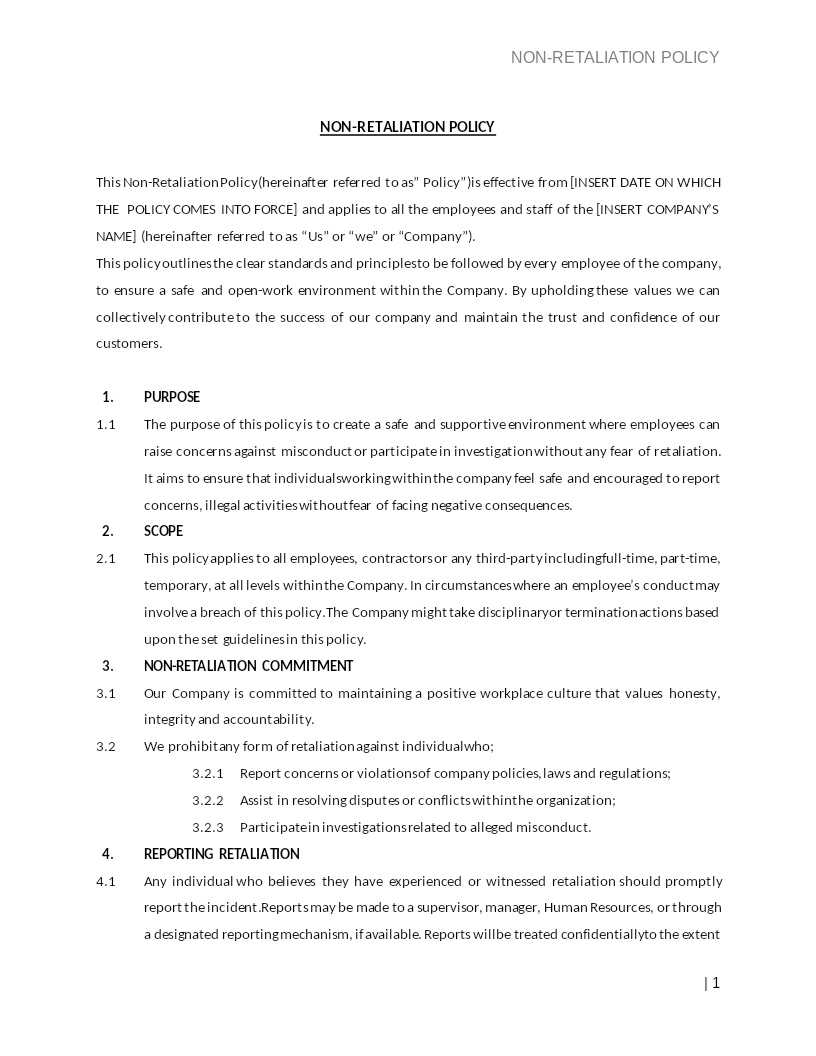
NON-RETALIATION POLICY
How does it work?
1. Choose this template
Start by clicking on "Fill out the template"
2. Complete the document
Answer a few questions and your document is created automatically.
3. Save - Print
Your document is ready! You will receive it in Word and PDF formats. You will be able to modify it.
Promoting Workplace Integrity and Legal Compliance Through a Non-Retaliation Policy
A Non-Retaliation Policy is a formal organizational commitment to ensuring that employees, contractors, and other covered individuals can report concerns, misconduct, violations of law, or unethical behavior without fear of reprisal. Drafted in accordance with U.S. federal and state employment laws, including the Equal Employment Opportunity Commission (EEOC) regulations, the Occupational Safety and Health Act (OSHA), the Sarbanes-Oxley Act (SOX), the Whistleblower Protection Act, the False Claims Act, and various state whistleblower statutes, this policy clearly prohibits any form of retaliation against individuals who make good-faith reports or who participate in investigations or audits.
A comprehensive Non-Retaliation Policy establishes the organization's expectation of open communication, ethical conduct, and lawful compliance. It defines prohibited retaliatory acts including termination, discipline, demotion, harassment, intimidation, pay reduction, or hostile treatment and outlines the procedures for reporting concerns, requesting support, and seeking protection. By implementing this policy, an organization strengthens its compliance culture, reduces legal risk, promotes accountability, and fosters a work environment in which individuals can raise concerns safely and responsibly. The policy serves as a safeguard that ensures that reporting misconduct is valued rather than penalized.
Where Non-Retaliation Policies Are Commonly Used
Non-Retaliation Policies are essential in virtually all workplaces, including:
- Corporate environments with internal compliance programs, ethics hotlines, or audit functions
- Healthcare facilities subject to HIPAA, patient-safety rules, and mandatory reporting requirements
- Government contractors and regulated industries with whistleblower protections
- Financial institutions governed by SOX, SEC, and anti-fraud regulations
- Manufacturing and industrial sectors regulated by OSHA safety standards
- Educational institutions handling student safety, Title IX compliance, or misconduct reporting
- Nonprofits and advocacy organizations encouraging ethical conduct and transparency
- Technology companies addressing data-security concerns, harassment claims, or intellectual-property violations
Any organization that values accountability and legal compliance should adopt a strong Non-Retaliation Policy.
Different Types of Non-Retaliation Policies You May Encounter
1. General Workplace Non-Retaliation Policies: Prohibit retaliation against employees for reporting workplace misconduct or participating in investigations.
2. Whistleblower-Specific Policies: Protect individuals who disclose fraud, safety violations, financial misconduct, or regulatory breaches.
3. Compliance and Ethics Reporting Policies: Encourage internal reporting through compliance officers or anonymous hotlines.
4. Anti-Harassment and Anti-Discrimination Non-Retaliation Policies: Ensure that employees who raise concerns under EEOC laws are shielded from reprisal.
5. Government-Contractor Non-Retaliation Policies: Required for federal contractors under statutes protecting reports of waste, abuse, or violations.
When Legal Guidance Becomes Helpful
Legal counsel may be necessary when:
- The organization receives reports alleging discrimination, harassment, safety hazards, or financial misconduct
- Whistleblower complaints involve SOX, OSHA, SEC, or federal contractor requirements
- An employee alleges retaliation, constructive discharge, or adverse workplace treatment
- The business must implement formal investigation procedures or corrective-action responses
- Retaliation claims intersect with union rules, labor laws, or protected concerted activity under the NLRA
- The organization must revise employment agreements, handbooks, or confidentiality policies
- Reports involve privacy-sensitive material or require legal restrictions on disclosure
- State whistleblower laws impose additional protection or reporting standards
Legal review ensures compliance with U.S. employment, safety, and whistleblower laws, strengthening the organization’s compliance structure.
How to Work with This Template
- Clearly define retaliation, prohibited conduct, and protected activities
- Outline reporting channels, including direct supervisors, HR personnel, compliance officers, or anonymous hotlines
- Describe procedures for investigating reported concerns fairly, promptly, and confidentially
- Establish documentation requirements and internal reporting structures
- Provide assurances that good-faith reports will not result in adverse employment action
- Clarify disciplinary actions for individuals who engage in retaliation
- Incorporate training requirements and communication strategies for employees
- Ensure alignment with federal, state, and industry-specific whistleblower protections
- Require acknowledgment from employees through written or electronic means
- Review and update the policy regularly to reflect evolving laws or organizational needs
This template reflects widely recognized U.S. compliance and workplace-governance standards.
Frequently Asked Questions
Q1. What is a Non-Retaliation Policy, and why is it important?
A Non-Retaliation Policy protects employees and others who report misconduct or participate in investigations from adverse treatment. It is important because it promotes ethical behavior, ensures legal compliance, and encourages transparent reporting.
Q2. Who is protected under a Non-Retaliation Policy?
Employees, contractors, job applicants, and, in many cases, interns and volunteers are protected when they make good-faith reports of misconduct, discrimination, safety violations, or legal concerns.
Q3. What actions qualify as retaliation?
Retaliation may include termination, demotion, harassment, intimidation, negative performance evaluations, reduced compensation, exclusion from opportunities, or any adverse workplace action taken because of a protected report.
Q4. Are anonymous reports protected?
Yes. Anonymous good-faith reports are generally protected, and organizations must take steps to ensure confidentiality throughout the investigation process.
Q5. Can an employee be disciplined for knowingly false reports?
Yes. While good-faith reports are protected, intentionally false, malicious, or bad-faith allegations may result in disciplinary action.
Q6. Does the policy apply to harassment and discrimination complaints?
Absolutely. Retaliation for reporting discrimination or harassment is prohibited under EEOC laws and must be addressed through the policy.
Q7. Are whistleblowers legally protected under U.S. law?
Yes. Many federal and state laws including SOX, OSHA, and the False Claims Act provide explicit protections for whistleblowers.
Q8. Should employees receive training on this policy?
Yes. Training ensures employees understand their rights, know how to report concerns, and are aware of consequences for retaliatory behavior.
Q9. Can the organization terminate an employee for reasons unrelated to their report?
Yes, but employers must document legitimate, non-retaliatory grounds to avoid legal exposure. Timing and documentation are crucial.
Q10. Should legal counsel review a Non-Retaliation Policy?
Yes. Legal review ensures that the policy complies with federal and state whistleblower laws and protects the organization against litigation risks.