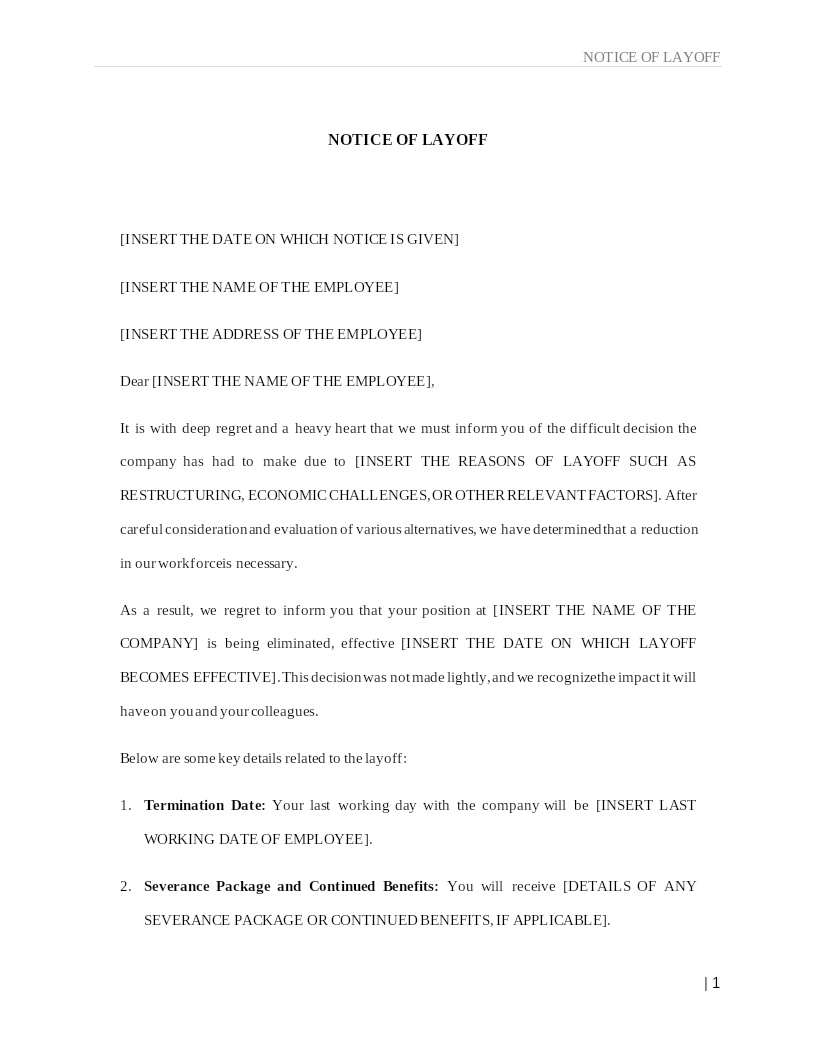
NOTICE OF LAYOFF
How does it work?
1. Choose this template
Start by clicking on "Fill out the template"
2. Complete the document
Answer a few questions and your document is created automatically.
3. Save - Print
Your document is ready! You will receive it in Word and PDF formats. You will be able to modify it.
Understanding the Purpose of a Notice of Layoff
When a business undergoes financial strain, restructuring, downsizing, or operational changes, it becomes important to have a clear framework for informing employees about employment termination. A Notice of Layoff provides that structure. It outlines the reason for the layoff, effective dates, severance details, benefits continuation, and any reemployment options being offered.
Issuing a formal notice creates clarity and transparency. It allows employers to communicate respectfully, maintain compliance with labor regulations, and reduce confusion during workforce transitions.
Where a Notice of Layoff Is Commonly Used
Layoff notices are used across various industries and situations involving workforce reduction, such as:
- Company restructuring, mergers, or departmental consolidation
- Downsizing due to financial hardship or reduced demand
- Plant closures, branch shutdowns, or relocation of operations
- Suspension of projects or cancellation of contracts
- Seasonal slowdowns or temporary business interruptions
- Industry-wide downturns or long-term strategic reorganization
Any time a business must temporarily or permanently eliminate positions, the notice sets clear communication boundaries and informs employees of their rights and next steps.
Different Types of Layoff Notices You May Encounter
- Temporary Layoff Notice: Used when the employer expects to recall employees within a specific time period, often tied to market conditions, seasonal cycles, or project restarts.
- Permanent Layoff Notice: Issued when positions are eliminated indefinitely and no recall is anticipated, often due to structural or financial decisions.
- Mass Layoff or Plant Closure Notice: Required when larger workforce reductions occur, especially under laws like the federal WARN Act or state-specific notice statutes.
- Position-Specific or Departmental Layoff Notices: Used when only certain roles, departments, or functions are being discontinued.
- Reduction-in-Force (RIF) Notice: Applied during strategic reorganizations where job duties are redistributed or eliminated for long-term operational reasons.
When Legal Guidance Becomes Helpful
Most employers can issue standard layoff notices using internal HR protocols, but legal counsel becomes valuable when:
- The business is subject to federal or state WARN Act requirements
- Multiple jurisdictions or remote employees are involved
- Severance packages, release agreements, or waivers are included
- The company fears claims related to discrimination, retaliation, or wrongful termination
- The layoff affects protected classes, union employees, or contracted workers
- The reorganization involves complex restructuring or job reassignments
- Benefits continuation, COBRA, or pension issues must be accurately communicated
Legal review ensures compliance, reduces risk, and provides peace of mind during sensitive transitions.
How to Work with This Template
- Identify the employee(s) affected and specify the reason for the layoff
- Clearly state the effective date and whether it is temporary or permanent
- Outline severance pay, benefits continuation, and COBRA information
- Specify any reemployment assistance or recall rights
- Include company policies and any required federal or state notices
- Review internally and issue the notice in writing—electronic or physical delivery accepted
This template aligns with commonly recognized U.S. employment-law standards and can be adapted to meet company-specific protocols.
Frequently Asked Questions
Q1. What is a Notice of Layoff and why is it issued?
A Notice of Layoff is a formal written communication that informs an employee that their position is being temporarily or permanently discontinued. Employers issue it to ensure compliance with labor laws and to provide employees clarity on the reasons for the separation. It outlines benefits, severance, and final-pay details. This structured approach helps maintain transparency and fairness during organizational changes.
Q2. Does a Notice of Layoff help employers comply with U.S. labor regulations?
Yes. U.S. laws such as the WARN Act require employers to provide advance notice during certain large-scale layoffs or closures. Even in smaller reductions, documented notice helps demonstrate compliance with labor obligations. Providing written communication reduces liability and prevents allegations of sudden or improper termination. It also ensures employees receive mandated information regarding benefits and rights.
Q3. How does a Notice of Layoff support employees during transitions?
The notice provides employees with critical details about severance, healthcare continuation, unemployment eligibility, and reemployment assistance. This ensures they can plan financially and explore job opportunities without last-minute disruption. Clear instructions on final pay and benefits reduce stress and uncertainty. A well-drafted notice demonstrates respect and professionalism.
Q4. Can a Notice of Layoff prevent legal disputes or wrongful-termination claims?
Yes. By documenting business-related reasons for layoffs and following a consistent process, employers significantly reduce the risk of legal challenges. Written notices confirm that decisions are not based on discriminatory or retaliatory motives. They establish a clear timeline and record of communications. This transparency helps avoid misunderstandings that could lead to costly disputes.
Q5. Are employees entitled to severance pay when they receive a layoff notice?
Severance is not automatically required under federal law, but many employers choose to offer it as part of their policy or to support employees during transition. A Notice of Layoff outlines any severance provided, including eligibility and payment structure. Transparent severance terms build goodwill and ensure employees understand what they will receive. Some states may have additional requirements for final-pay timelines.
Q6. Does the Notice of Layoff address healthcare or benefits continuation?
Yes. A comprehensive notice typically explains how employees can continue group health coverage under COBRA or any state-specific continuation programs. It also covers unused PTO, retirement plans, disability insurance, and other benefits. This information helps employees make informed decisions about their next steps. Benefit clarity is crucial during employment transitions.
Q7. Can the notice be used for temporary layoffs or recall situations?
Absolutely. Temporary layoffs often require clear communication about expected recall dates, reinstatement rights, and conditions for returning to work. The notice ensures employees understand whether the layoff is short-term or indefinite. It also outlines how they will be contacted for rehire. This prevents confusion and helps maintain workforce readiness.
Q8. Is it advisable to customize the Notice of Layoff for different states or industries?
Yes. State laws vary significantly regarding notice periods, final paycheck deadlines, WARN thresholds, and benefit disclosures. Industries with union contracts or regulated positions may have additional requirements. Customizing the notice helps ensure compliance and reduces risk. Legal review is recommended when dealing with multi-state or specialized workforce situations.