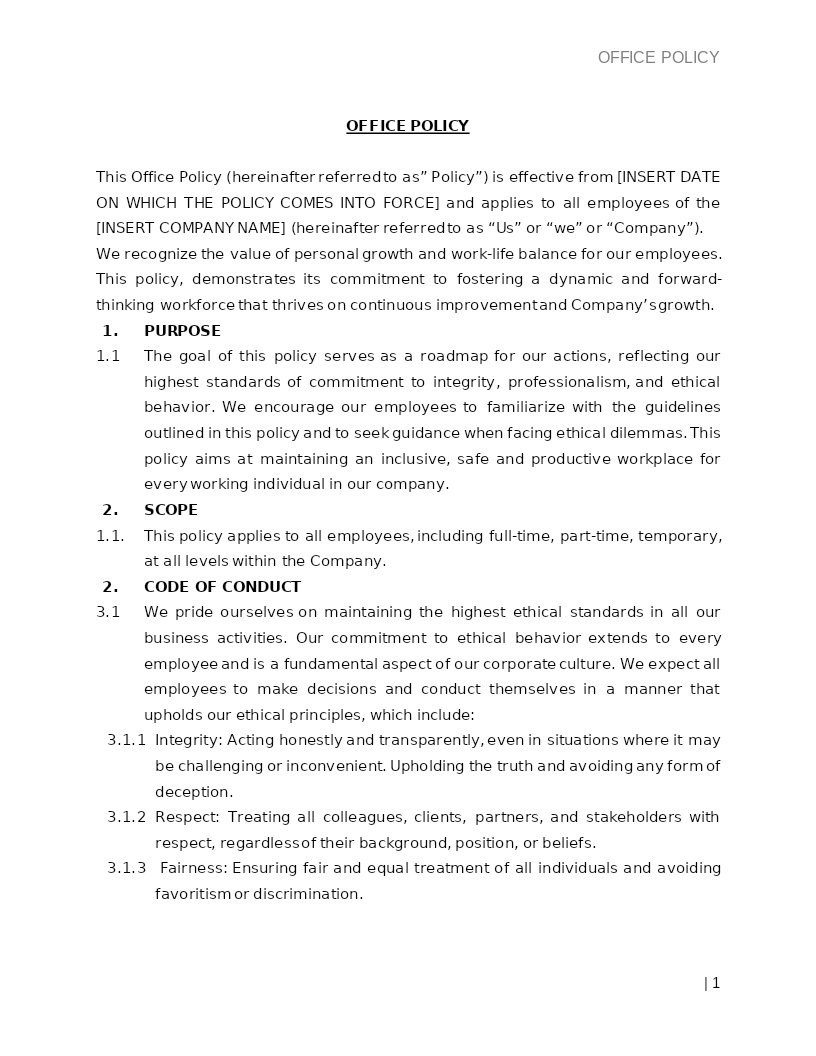
OFFICE POLICY
How does it work?
1. Choose this template
Start by clicking on "Fill out the template"
2. Complete the document
Answer a few questions and your document is created automatically.
3. Save - Print
Your document is ready! You will receive it in Word and PDF formats. You will be able to modify it.
Understanding the Purpose of an Office Policy
When employees work together in a shared environment, it is essential to have a clear framework that governs behavior, expectations, and daily operations. An Office Policy provides that structure. It outlines workplace standards, conduct guidelines, communication rules, safety procedures, and operational requirements that employees are expected to follow.
Having an office policy in place creates consistency, reduces misunderstandings, and ensures that all employees understand what is acceptable at work. It supports a respectful, organized, and legally compliant work environment, helping both employers and employees operate smoothly.
Where Office Policies Are Commonly Used
Office policies are standard in a wide range of workplace settings, including:
- Corporate offices, administrative centers, and professional firms
- Healthcare, education, retail, and hospitality workplaces
- Startups, hybrid teams, and remote-work environments
- Manufacturing units and industrial facilities with operating guidelines
- Nonprofits and government offices with strict compliance needs
- Any organization requiring uniform rules for conduct, attendance, and safety
Any time employees work under one organizational structure, an office policy sets consistent expectations for workplace behavior and performance.
Different Types of Office Policies You May Encounter
- General Workplace Conduct Policy: Defines behavior expectations, professional communication standards, and rules promoting respect and inclusivity.
- Attendance and Work-Hours Policy: Covers work schedules, attendance requirements, timekeeping, and leave procedures.
- Dress Code Policy: Outlines acceptable attire based on company culture, client interaction, or safety needs.
- Safety and Emergency Policy: Details safety rules, evacuation protocols, and compliance with OSHA and workplace health standards.
- Technology and Communication Policy: Regulates email usage, device security, data protection, and access to company systems.
When Legal Guidance Becomes Helpful
Although many policy elements are straightforward, legal input becomes helpful when:
- Policies intersect with federal or state labor laws, wage-and-hour rules, or overtime classifications
- The workplace includes sensitive data governed by privacy regulations
- Policies involve discrimination, harassment prevention, ADA accommodations, or equality protections
- Safety rules must comply with OSHA or industry-specific standards
- Remote-work and monitoring policies raise privacy or compliance concerns
- Disciplinary actions or termination processes require legally enforceable wording
- Employee rights, confidentiality rules, or intellectual-property protections are involved
Legal review ensures the policy is compliant, enforceable, and appropriately tailored for the organization’s operational and regulatory needs.
How to Work with This Template
- Identify the office environment, operational requirements, and employee expectations
- Customize sections such as conduct, communication, scheduling, and safety rules
- Specify disciplinary procedures, reporting processes, and workplace rights
- Align the policy with state and federal labor standards
- Review the document with HR and legal teams before distribution
- Communicate the policy clearly and require employee acknowledgment
This template follows widely recognized U.S. workplace standards and can be adapted for organizations of any size or industry.
Frequently Asked Questions
Q1. What is an Office Policy and why is it important?
An Office Policy is a written document that outlines workplace expectations, rules, and procedures. It provides clarity on behavior, communication, attendance, and safety. Effective policies create consistency and help employees understand their responsibilities. This improves professionalism and reduces workplace confusion.
Q2. How does an Office Policy help maintain fairness in the workplace?
A well-defined policy ensures that all employees are held to the same standards. Clear rules prevent favoritism and bias in decision-making. Employees know exactly what is expected, which promotes equitable treatment. This consistency builds trust and strengthens workplace culture.
Q3. Can an Office Policy increase productivity and efficiency?
Yes. Office policies outline work processes, deadlines, attendance expectations, and communication protocols. These guidelines help employees stay organized and aligned with company goals. When instructions are clear, workplace efficiency naturally improves. Structured policies also reduce time spent resolving misunderstandings.
Q4. What areas should a comprehensive Office Policy cover?
A complete policy typically includes conduct guidelines, attendance and leave rules, dress code expectations, communication standards, safety procedures, and disciplinary processes. It may also cover technology usage, harassment prevention, and confidentiality requirements. Tailoring sections ensures the policy fits the unique needs of the organization.
Q5. Does an Office Policy need legal review before implementation?
Legal review is recommended, especially when policies address labor laws, employee rights, safety rules, or data-privacy requirements. Lawyers ensure the policy complies with federal and state regulations. This protects the organization from liability. Proper legal wording also prevents misinterpretation and future disputes.
Q6. Can the Office Policy be adapted for hybrid or remote-work environments?
Absolutely. Modern policies often include remote-work rules, digital communication guidelines, cybersecurity practices, and expectations for virtual meetings. These adaptations help ensure consistency for employees working outside the office. Tailoring policies for remote teams promotes clarity and maintains productivity.
Q7. How does an Office Policy support a positive work environment?
Policies promoting respect, inclusivity, and professionalism strengthen workplace morale. Clear rules help prevent misconduct, harassment, and miscommunication. Employees feel secure when they understand boundaries and reporting processes. A positive environment enhances collaboration and long-term employee retention.
Q8. How often should an Office Policy be updated?
Policies should be reviewed annually or whenever workplace procedures, laws, or technologies change. Regular updates ensure compliance with new regulations and evolving operational needs. Modernized policies keep employees informed and reduce outdated practices. Continuous review maintains clarity and effectiveness.