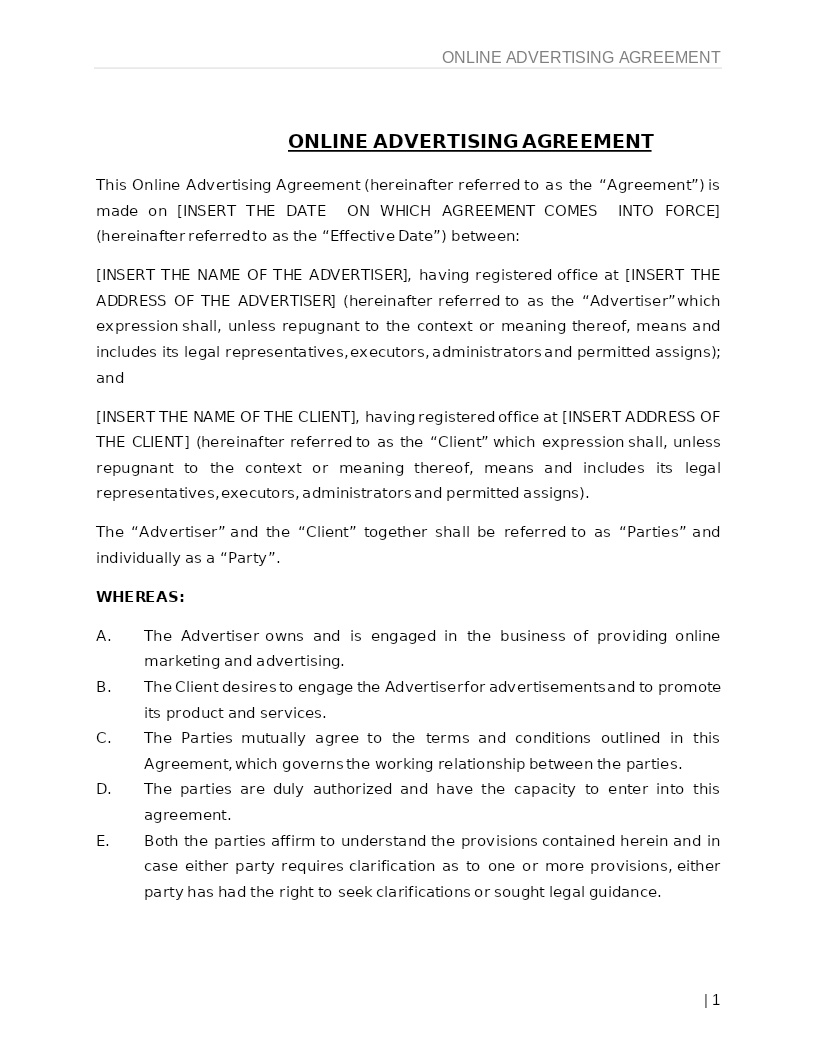
ONLINE ADVERTISING AGREEMENT
How does it work?
1. Choose this template
Start by clicking on "Fill out the template"
2. Complete the document
Answer a few questions and your document is created automatically.
3. Save - Print
Your document is ready! You will receive it in Word and PDF formats. You will be able to modify it.
Providing Structure and Legal Protection for Online Advertising Services in the United States
Businesses across the U.S. increasingly rely on digital advertising partners, agencies, publishers, influencers, and media platforms to promote products and services. To ensure that advertising campaigns comply with U.S. laws, maintain brand integrity, protect proprietary content, and meet commercial objectives, parties use an Online Advertising Agreement.
An Online Advertising Agreement defines the terms under which online advertisements will be created, placed, managed, monitored, or distributed across digital channels. It establishes the obligations of advertisers, publishers, and agencies regarding ad content, targeting practices, intellectual property rights, data collection, billing, performance metrics, regulatory compliance, and termination rights.
This Agreement also protects the parties from legal and operational risks by addressing U.S. advertising regulations, including FTC (Federal Trade Commission) advertising standards, truth-in-advertising requirements, digital privacy laws, consumer protection laws, and platform-specific compliance. It provides clarity and confidence that the advertising activities will follow lawful, transparent, and mutually agreed standards.
Where Online Advertising Agreements Are Commonly Used
Online Advertising Agreements are widely used throughout the United States for digital marketing services, including:
- Social media advertising (Facebook, Instagram, TikTok, LinkedIn)
- Google Ads, paid search campaigns, and retargeting ads
- Display advertising, programmatic buying, and native ad placements
- Influencer or creator promotions and sponsored posts
- Affiliate marketing campaigns and referral programs
- Video advertising on YouTube, streaming platforms, or OTT services
- Email marketing services and newsletter sponsorship placements
- Website banner ads and in-app advertising
- Marketplace advertising on Amazon, Walmart, or Etsy
Any time a business pays for online promotional services, whether through an agency, a contractor, a publisher, or a creator, a written Online Advertising Agreement ensures clarity, accountability, and compliance.
Different Types of Online Advertising Agreements You May Encounter
- Digital Advertising Services Agreement: For agencies providing multi-platform marketing and ad management services.
- Publisher Advertising Agreement: For ad placements on websites, apps, newsletters, or media networks.
- Influencer Advertising Agreement: For sponsored content governed by FTC Endorsement Guidelines.
- Affiliate Marketing or Referral Agreement: For commission-based online sales and traffic generation.
- Performance-Based Advertising Agreement: For CPC, CPM, CPA, or ROI-driven engagements.
- Content Licensing & Ad Creative Production Agreement: For producing visuals, videos, and copy used in advertisements.
When Legal Guidance Becomes Helpful
You should seek legal guidance when:
• The advertising includes health claims, financial claims, or regulated industries
• The advertiser collects personal data from U.S. consumers (CCPA, COPPA, state privacy laws)
• Influencer content requires FTC-compliant disclosures (#ad, #sponsored)
• Advertisements target children or sensitive demographic groups
• Programmatic or AI-driven advertising is used
• Ownership of ad creative, audiences, or analytics is unclear
• Large budgets or performance guarantees are involved
• The parties want indemnification for misleading or unlawful advertisements
A legally reviewed advertising agreement protects against fines, platform penalties, and reputational harm.
How to Work With This Template
• Identify the advertiser, publisher, agency, or influencer
• Describe the advertising services, campaign goals, and deliverables
• Specify budget, billing model (CPM/CPC/CPA), and payment terms
• Address data privacy, analytics access, and compliance with U.S. laws
• Clarify ownership and permissible use of ad creative and campaign assets
• Include performance metrics, reporting requirements, and optimization obligations
• Outline termination rights and dispute resolution under U.S. law
• Execute electronically valid under the ESIGN Act
This structure aligns with modern digital advertising laws and industry-standard practices across the U.S.
Frequently Asked Questions
Q1. What is an online advertising agreement in the United States?
An Online Advertising Agreement is a legally enforceable contract outlining the terms under which online ads will be created, managed, or placed across digital platforms. It governs campaign scope, fees, platforms used, creative approvals, data usage, regulatory compliance, and performance obligations. This Agreement ensures that both parties follow U.S. advertising laws, including FTC truth-in-advertising rules, anti-spam laws, and digital privacy requirements.
Q2. Why is a written advertising agreement important?
A written agreement protects both parties by defining clear performance expectations, creative approval rights, acceptable advertising practices, billing and payment schedules, data security standards, and rights to terminate or modify campaigns. It also reduces legal risk by ensuring the campaign complies with FTC, FCC, and state consumer protection laws.
Q3. Who owns the ad creative under an Online Advertising Agreement?
Ownership depends on the contract. If it is created by the advertiser, ownership typically remains with the advertiser. If it is created by the agency, ownership may remain with the agency unless assigned. Influencers may own their original content but license it to the advertiser. The Agreement should specify whether the advertiser receives a license, full ownership, or limited use rights.
Q4. Are online advertisements regulated in the U.S.?
Yes. Online ads are regulated by multiple U.S. authorities and laws, including FTC Act (truth-in-advertising rules), FTC Endorsement Guidelines (for influencers), CAN-SPAM Act (email advertising), COPPA (ads targeting children), CCPA and state privacy laws (data collection and retargeting) and TCPA (text message marketing). The Agreement should require compliance with all applicable laws to avoid fines and platform penalties.
Q5. What payment models are used in Online Advertising Agreements?
U.S. advertising contracts typically use CPM (cost per thousand impressions), CPC (cost per click), CPA (cost per acquisition), Fixed monthly retainer and hybrid models with performance incentives. The Agreement should specify billing frequency, reporting obligations, and refund or credit policies.
Q6. How does the Agreement address data privacy?
The contract should include provisions ensuring compliance with CCPA/CPRA (California privacy laws), Virginia, Colorado, Connecticut, and Utah privacy statutes, FTC data protection requirements and Platform rules (Meta, Google, TikTok ad policies).
The Agreement may restrict the sharing, selling, or improper use of customer data collected through advertising campaigns.
Q7. What happens if an advertisement is misleading or violates FTC rules?
The advertiser not the agency often bears primary liability for misleading claims.
However, agencies and influencers can also be liable if they knew the claims were deceptive, participated in creating unlawful content, or failed to include required endorsements or disclosures. The Agreement should include indemnification, content warranties, and compliance clauses.
Q8. Can either party terminate the advertising agreement early?
Yes. Most U.S. contracts allow termination:
· for cause (breach or non-performance) and for convenience (with notice),
· if a platform suspends or bans the advertising account,
· if ads violate laws or platform policies.
Termination clauses protect both sides during disputes or operational issues.
Q9. Are online advertising agreements enforceable if signed electronically?
Yes. Under the ESIGN Act and UETA, electronic signatures are fully enforceable across the United States. Digital advertising contracts are commonly executed through DocuSign, Adobe Sign, or similar platforms.
Q10. What platforms require compliance under these agreements?
Advertisers must comply not only with U.S. laws but also with platform-specific rules on Google Ads, Meta Ads (Facebook/Instagram), TikTok Ads, LinkedIn Ads, YouTube, Amazon Sponsored Ads, Pinterest Ads. The Agreement may incorporate or reference platform advertising policies to ensure full compliance.