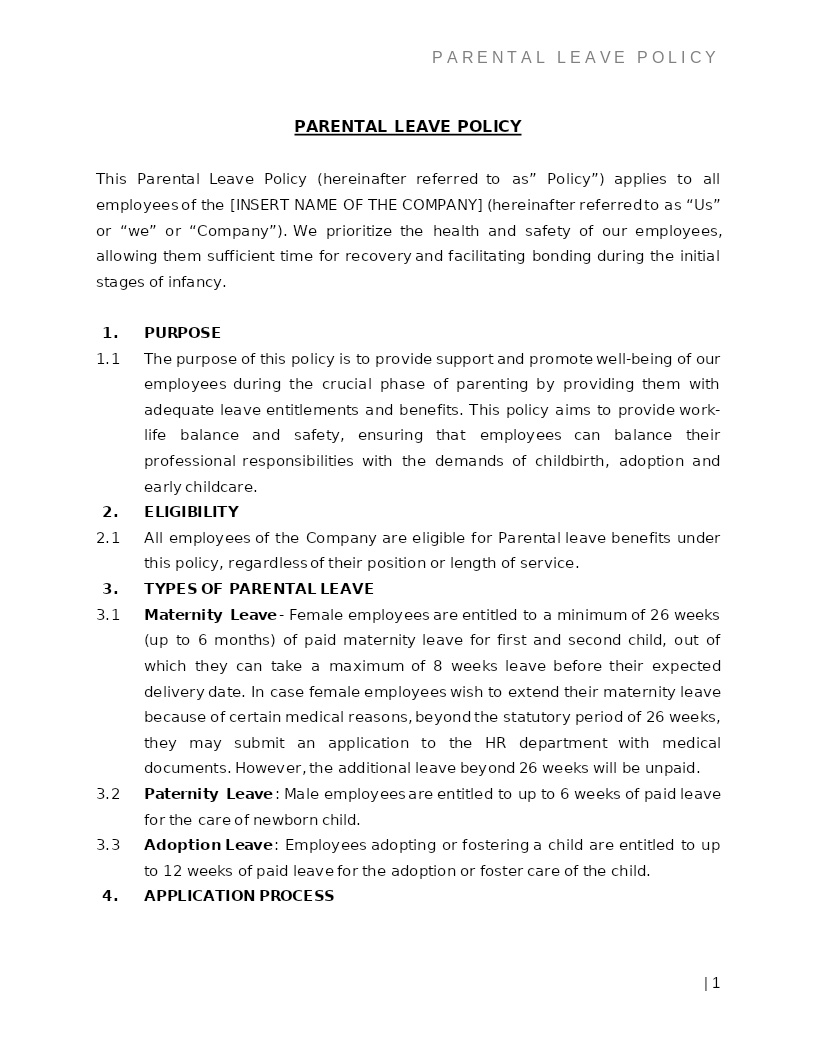
PARENTAL LEAVE POLICY
How does it work?
1. Choose this template
Start by clicking on "Fill out the template"
2. Complete the document
Answer a few questions and your document is created automatically.
3. Save - Print
Your document is ready! You will receive it in Word and PDF formats. You will be able to modify it.
Establishing Family Leave Rights in Workplace Employment Policies
Employers increasingly recognize the importance of providing structured time away from work for employees welcoming a new child. To ensure clarity and compliance, organizations must adopt a policy that defines the rights, procedures, and benefits associated with such leave. A Parental Leave Policy fulfills this function. It outlines the terms under which eligible employees may take leave for childbirth, adoption, foster placement, or the arrival of a new dependent child, in accordance with U.S. federal employment laws, state-specific family leave statutes, and applicable workplace regulations.
By implementing a Parental Leave Policy, employers create a transparent and legally consistent framework that governs the duration of leave, pay entitlements, job-protection standards, notice requirements, benefit continuation, and employee obligations. This ensures a uniform and compliant process for both the employer and employees during significant family-related events.
Where Parental Leave Policies Are Commonly Used
Parental Leave Policies are utilized in a wide range of employment settings and organizational structures, including:
- Private-sector companies, corporations, and startups
- Government agencies and public institutions
- Nonprofit organizations and educational institutions
- Remote, hybrid, and distributed workforces
- Union and non-union workplaces
- Businesses subject to federal FMLA requirements
- Companies offering paid parental leave benefits
- Organizations integrating short-term disability or supplemental leave programs
Any workplace that provides employees with leave related to the birth or placement of a child should maintain a Parental Leave Policy to ensure legal compliance and consistent application.
Different Types of Parental Leave Policies You May Encounter
1. FMLA-Based Leave Policies: Provide job-protected unpaid leave in accordance with the federal Family and Medical Leave Act.
2. Paid Parental Leave Policies: Offer employer-funded paid time off for bonding with a new child.
3. State-Mandated Paid Family Leave Policies: Apply in states that require paid family leave benefits (e.g., CA, NY, MA, WA, NJ).
4. Maternity and Paternity Leave Policies: Provide gender-specific or role-specific parental leave options.
5. Adoption and Foster Placement Leave Policies: Cover non-biological parents, adoptive parents, and foster placements.
When Legal Guidance Becomes Helpful
Legal counsel may be advisable when:
- The employer operates in multiple states with differing leave laws
- The policy interacts with FMLA, state paid family leave, or short-term disability
- Union contracts or collective bargaining agreements apply
- The policy includes enhanced employer-funded benefits
- The workplace includes remote employees across various jurisdictions
- Compliance concerns arise regarding job protection, reinstatement, or discrimination claims
Legal review ensures that the policy complies with federal and state requirements and avoids potential employment-law disputes.
How to Work With This Template
• Identify which employees are eligible for parental leave
• Specify the duration, type, and structure of leave (paid, unpaid, or combined)
• Outline procedures for requesting leave and providing notice
• Clarify job-protection rights and reinstatement obligations
• Address continuation of benefits such as health insurance during leave
• Describe documentation, certification, or verification requirements
• Select governing federal and state laws
• Execute and distribute the policy as part of the employer’s handbook or onboarding materials
This template follows widely recognized U.S. employment-law practices and is compatible with digital distribution and HR policy management platforms.
Frequently Asked Questions
1. What is a Parental Leave Policy, and why is it important?
A Parental Leave Policy is an employer-issued set of rules governing time off for childbirth, adoption, or foster placement. It is important because it provides employees with clarity on their rights, ensures compliance with U.S. employment laws, and promotes consistent, fair treatment during family-related absences.
2. Does federal law require employers to offer parental leave?
The federal Family and Medical Leave Act (FMLA) requires eligible employers to provide up to 12 weeks of unpaid, job-protected leave for qualifying family events. Some states, however, require paid parental leave or additional protections.
3. Are employees paid during parental leave?
Payment depends on the employer’s policy and state law. Employers may offer paid leave, while some states mandate paid family leave insurance programs. Many employees also use accrued PTO or short-term disability benefits.
4. Who is eligible for parental leave?
Eligibility typically depends on employment status, hours worked, and length of service. Under FMLA, employees must meet specific criteria, including working 1,250 hours in the prior year and being employed at a covered worksite.
5. Are adoptive and foster parents covered?
Yes. Most well-structured Parental Leave Policies—and many state laws—extend benefits to adoptive and foster parents on the same basis as biological parents.
6. Can an employer request documentation for parental leave?
Yes. Employers may require reasonable documentation, such as birth records, adoption papers, or placement notices, as permitted by law.
7. Are employees guaranteed their job after parental leave?
Under FMLA and many state laws, eligible employees are entitled to job restoration to the same or an equivalent position upon return. Employer-specific paid leave benefits may also include similar protections.
8. Can parental leave be taken intermittently?
Intermittent leave is generally permitted under FMLA for qualifying medical reasons, though bonding leave may require employer approval unless state law provides otherwise.
9. Are electronic signatures valid for parental leave requests or forms?
Yes. Under the ESIGN Act, electronic signatures are legally valid, and many employers use digital HR systems for leave processing.
10. What happens if state and federal laws differ?
Employees typically receive the level of protection most favorable to them. Employers must comply with the highest applicable standard, whether federal, state, or local.
11. Can an employer deny parental leave?
Employers may not deny legally protected leave under FMLA or applicable state laws if the employee qualifies. Denials are allowed only when the employee does not meet eligibility or notice requirements.