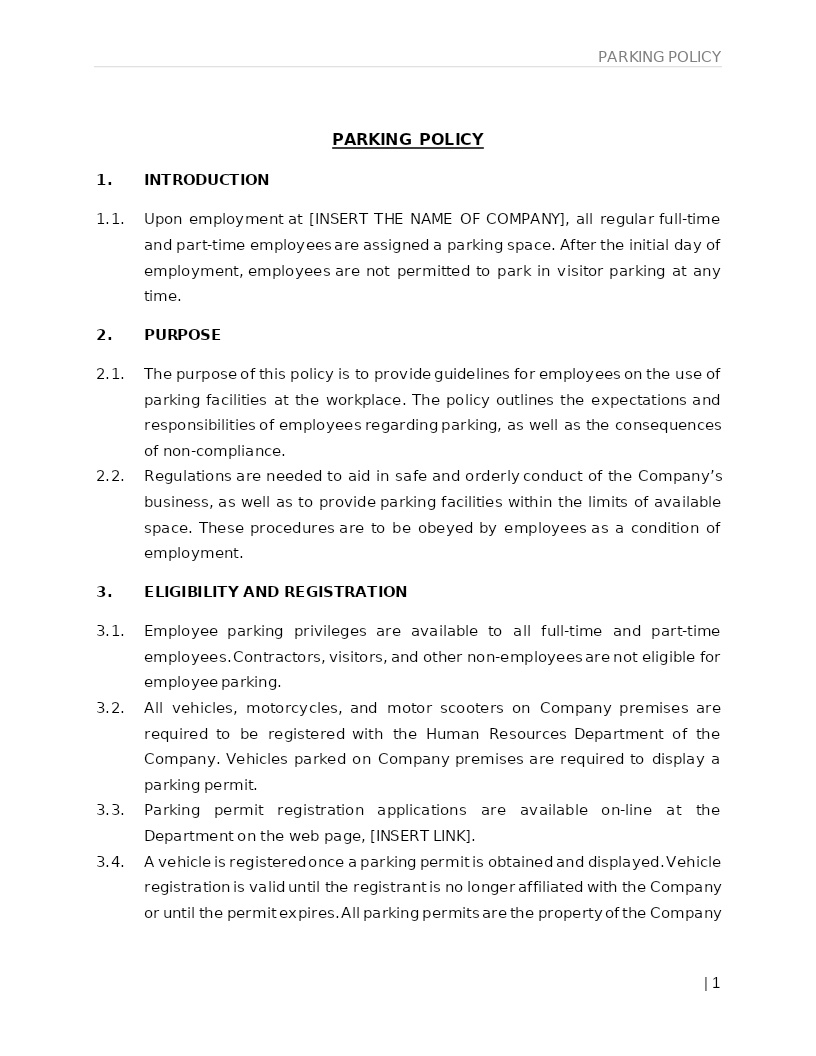
PARKING POLICY
How does it work?
1. Choose this template
Start by clicking on "Fill out the template"
2. Complete the document
Answer a few questions and your document is created automatically.
3. Save - Print
Your document is ready! You will receive it in Word and PDF formats. You will be able to modify it.
Promoting Order, Safety, and Accessibility Through a Parking Policy
A Parking Policy is an organizational directive that establishes the rules, responsibilities, and operational standards governing the use of parking spaces and parking facilities controlled, leased, or managed by the organization. Developed in accordance with U.S. federal and state laws, including the Americans with Disabilities Act (ADA) accessibility requirements, local parking regulations, property-usage ordinances, and applicable workplace safety laws, this policy ensures orderly, safe, and equitable use of parking areas by employees, contractors, visitors, and authorized vendors. The policy sets forth expectations regarding parking permits, enforcement procedures, assigned parking areas, vehicle registration, speed limits, and restrictions intended to protect pedestrians, avoid congestion, safeguard company property, and support compliance with accessibility standards. It also outlines the organization’s authority to regulate parking behavior, impose penalties for violations, and manage parking operations consistent with legal obligations and liability protections.
A comprehensive Parking Policy details the procedures for obtaining parking access, issuing permits, and managing designated or reserved spaces such as ADA-accessible parking, visitor parking, executive or fleet-vehicle parking, and loading zones. It clarifies employee responsibilities regarding safe vehicle operation, proper use of designated spaces, adherence to posted signage, and reporting unsafe conditions or misuse of parking facilities. The policy also describes enforcement mechanisms including citations, towing, revocation of parking privileges, and disciplinary measures and the circumstances under which the organization may take corrective action. Additionally, it outlines the company’s disclaimers regarding liability for theft, vandalism, weather-related damage, or accidents occurring in the parking facility, consistent with U.S. property and tort law principles. By implementing this policy, organizations maintain operational efficiency, support accessibility compliance, enhance safety, and limit liability exposure.
Where Parking Policies Are Commonly Used
Parking Policies are implemented across diverse sectors, such as:
- Corporate campuses and office buildings with employee parking lots
- Retail and hospitality businesses offering customer parking
- Healthcare institutions providing patient, visitor, and emergency-vehicle parking
- Educational institutions with student and staff parking facilities
- Manufacturing plants and distribution centers with fleet or loading areas
- Government agencies and municipal facilities subject to public-access rules
- Nonprofits and community organizations managing shared or limited parking resources
Any organization responsible for regulating or providing parking benefits from a formal Parking Policy.
Different Types of Parking Policies You May Encounter
1. Employee Parking Policies: Regulate workplace parking assignments and employee responsibilities.
2. Visitor and Contractor Parking Policies: Provide rules for short-term or temporary parking needs.
3. Reserved or Assigned Parking Policies: Designate parking for leadership, emergency responders, or specialized vehicles.
4. ADA Compliance Parking Policies: Ensure accessible parking spaces meet federal accessibility requirements.
5. Fleet and Commercial Vehicle Parking Policies: Address storage and usage of company-owned vehicles and equipment.
When Legal Guidance Becomes Helpful
Legal review is recommended when:
- ADA-compliant parking, signage, and accessibility accommodations must be implemented
- The organization must comply with municipal parking rules or zoning requirements
- Parking violations or accidents may expose the company to liability
- Enforcement measures (e.g., towing or fines) could trigger legal disputes
- The company leases parking from a third-party property owner with contractual obligations
- Workplace issues involve discrimination or accommodation requests related to parking
- The company installs surveillance, license plate readers, or other monitoring tools
Legal counsel helps ensure the Parking Policy aligns with property law, accessibility requirements, and employment regulations.
How to Work with This Template
- Define eligibility requirements and procedures for obtaining parking access
- Establish rules for designated spaces, ADA parking, and visitor or contractor use
- Outline speed limits, traffic-flow patterns, and vehicle-operation standards
- Clarify parking-permit requirements, renewal procedures, and revocation policies
- Identify enforcement actions for noncompliance, including towing and discipline
- Address employer liability limitations for vehicle theft or damage
- Include safety measures such as lighting, signage, and pedestrian walkways
- Provide instructions for reporting hazards, accidents, or misuse of parking areas
- Establish rules for fleet vehicles, motorcycles, bicycles, and electric-charging spaces
- Require periodic updates to reflect property changes, legal standards, or safety needs
This template reflects best practices for parking management, safety compliance, and operational efficiency.
Frequently Asked Questions
Q1. What is a Parking Policy, and why is it important?
A Parking Policy sets rules for using company-controlled parking areas. It is important because it promotes safety, order, ADA compliance, and fair access for employees and visitors.
Q2. Does the policy apply to all employees?
Yes. All employees, contractors, and visitors must follow the organization’s parking rules when using company-managed parking facilities.
Q3. Does the policy address ADA-accessible parking?
Absolutely. The policy ensures ADA-compliant spaces are properly designated, reserved, and enforced in accordance with federal accessibility laws.
Q4. Can employees lose their parking privileges?
Yes. Parking privileges may be revoked for repeated violations, unsafe driving, misuse of spaces, or failure to follow policy rules.
Q5. Who is responsible for vehicle damage in the parking lot?
Generally, the organization disclaims liability for theft, vandalism, or damage except in cases where negligence can be legally established.
Q6. Are parking permits required?
Many organizations require permits or registration to manage limited parking resources and maintain security.
Q7. Does the policy address visitor or contractor parking?
Yes. The policy outlines designated spaces and temporary permit processes for short-term guests and contractors.
Q8. What happens if someone parks in a restricted or reserved space?
Vehicles may be ticketed, towed, or otherwise subject to enforcement actions as outlined in the policy.
Q9. Can the company monitor parking areas?
Yes. Parking lots may be monitored through cameras or security personnel, subject to applicable privacy laws.
Q10. Should legal counsel review a Parking Policy?
Yes. Legal review helps ensure compliance with ADA standards, local ordinances, property law, and workplace regulations.