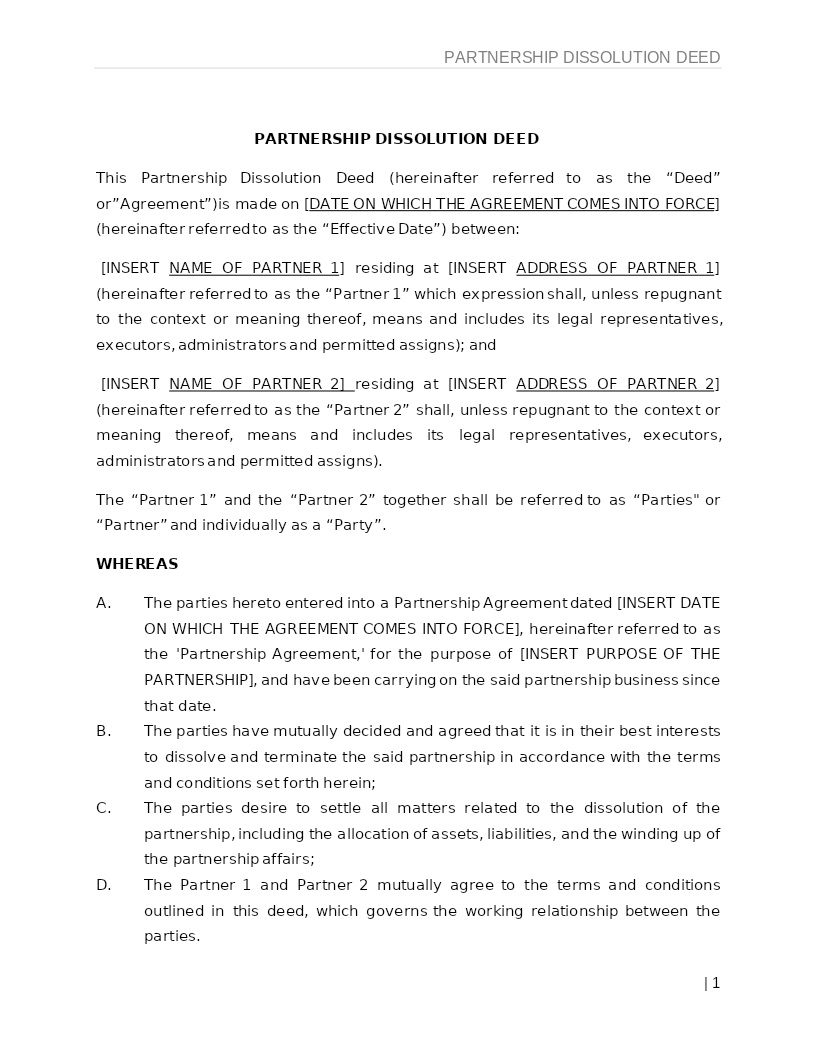
PARTNERSHIP DISSOLUTION DEED
How does it work?
1. Choose this template
Start by clicking on "Fill out the template"
2. Complete the document
Answer a few questions and your document is created automatically.
3. Save - Print
Your document is ready! You will receive it in Word and PDF formats. You will be able to modify it.
Understanding Partnership Dissolution Agreements
When business partners decide to end their partnership whether due to retirement, strategic changes, financial restructuring, or mutual decision it is essential to have a clear legal framework that outlines how the separation will occur. A Partnership Dissolution Agreement provides that structure. It defines how assets will be divided, how liabilities will be settled, how operations will wind down, and how each partner’s rights and responsibilities will conclude.
Putting this agreement in place protects all parties by preventing confusion, reducing conflict, and ensuring that the dissolution happens in a fair, orderly, and legally compliant manner. It allows partners to finalize their business relationship while safeguarding personal interests and ensuring compliance with U.S. partnership laws.
Where Partnership Dissolution Agreements Are Commonly Used
These agreements are standard in many business scenarios, including:
• When partners mutually agree to close the partnership
• Exit of a partner while the business continues under new ownership
• Retirement or death of a partner
• Buyouts, mergers, or restructuring of the business
• Financial disputes or strategic disagreements
• Conversion to a new business structure (LLC, corporation, etc.)
• Voluntary or involuntary dissolution of a partnership
Different Types of Partnership Dissolutions You May Encounter
- Voluntary Dissolution: Partners mutually agree to terminate the business.
- Involuntary Dissolution: Triggered by death, incapacity, bankruptcy, or breach of agreement.
- Buyout Dissolution: One partner purchases another partner’s ownership interest.
- Administrative or Legal Dissolution: Occurs due to regulatory non-compliance or court intervention.
- Partial Dissolution: One partner departs, but the partnership continues with remaining partners.
When Legal Guidance Becomes Helpful
Most partnership dissolutions benefit from legal review, but it becomes especially valuable when:
• The business owns significant assets, real estate, or intellectual property
• There are outstanding debts, liabilities, or tax concerns
• Disputes exist regarding ownership, profits, or responsibilities
• The partnership agreement is outdated or unclear
• The dissolution involves buyouts, non-compete terms, or transfer of licenses
• Multiple partners or jurisdictions are involved
• The business has employees, contractors, or ongoing client obligations
How to Work with This Template
• Identify the partners involved and the effective dissolution date
• Clearly describe how assets, accounts, and property will be divided
• Detail responsibilities for debts, expenses, and contractual obligations
• Specify rights to continuing business activities, clients, or goodwill
• Address tax filings, records retention, and final accounting
• Select the governing U.S. state law
• Review the terms collectively (legal review is optional)
• Sign electronically or in hard copy
Frequently Asked Questions
Q1. Why is a Partnership Dissolution Agreement necessary?
It ensures that partners formally end their business relationship with clear terms for dividing assets, settling debts, and handling ongoing obligations. This prevents disagreements and protects everyone’s rights.
Q2. Does the agreement need to match the original partnership agreement?
Not exactly, but it should align with any dissolution procedures outlined in the partnership contract. If the original agreement is silent or unclear, this document will serve as the controlling legal framework.
Q3. Can partners dissolve a business without an attorney?
Yes. Many dissolutions are straightforward and handled using a clear written agreement. However, legal advice is helpful when substantial assets, disputes, or tax issues are involved.
Q4. How are debts handled during dissolution?
The agreement specifies which partner is responsible for outstanding debts, how final bills are paid, and whether liabilities are shared. Clear debt allocation helps prevent future claims.
Q5. What happens to partnership assets?
Assets may be sold, divided, or transferred based on mutual agreement. The dissolution document outlines this process, including bank accounts, equipment, intellectual property, and client contracts.
Q6. Can one partner continue the business after dissolution?
Yes. Many agreements outline a buyout or transfer process that allows one partner to continue operations independently, while others relinquish their rights.
Q7. Is state filing required?
Some states require filing dissolution documents with the Secretary of State. The agreement may reference required filings to ensure full compliance and protect partners from future liabilities.
Q8. What if a partner refuses to cooperate?
The agreement can reference remedies, including mediation, arbitration, or legal enforcement. State partnership laws also provide rights and procedures for non-cooperative partners.
Q9. What records should be kept after dissolution?
Financial statements, tax documents, contracts, and dissolution filings should be retained for several years to address audits, legal inquiries, or administrative needs.
Q10. Are electronic signatures valid for this agreement?
Yes. Under U.S. e-signature laws (ESIGN Act and state equivalents), electronic signatures are fully enforceable once both parties consent to digital signing.