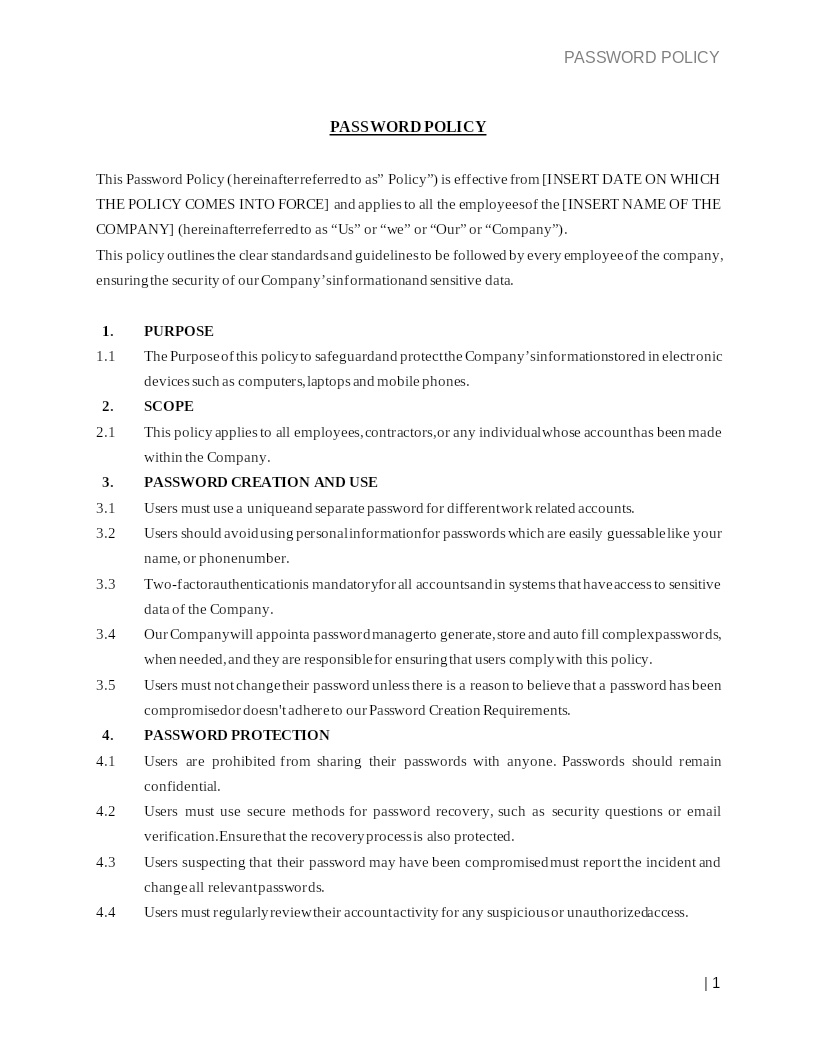
PASSWORD POLICY
How does it work?
1. Choose this template
Start by clicking on "Fill out the template"
2. Complete the document
Answer a few questions and your document is created automatically.
3. Save - Print
Your document is ready! You will receive it in Word and PDF formats. You will be able to modify it.
Understanding Password Policy in U.S.
A Password Policy establishes the rules and best practices for creating, managing, and protecting passwords within an organization. It outlines requirements for password complexity, rotation, storage, and usage to ensure that user credentials remain secure. This policy reduces the risk of unauthorized access, supports cybersecurity efforts, and safeguards sensitive information stored in organizational systems.
By aligning with U.S. data protection laws, cybersecurity standards, and industry-leading frameworks, a Password Policy helps organizations maintain strong digital security and prevent breaches caused by weak or compromised passwords.
Where Password Policies Are Commonly Used
Password Policies are essential across all industries and environments where digital systems, user accounts, or confidential information are used. These policies are widely implemented in:
• Corporate offices, SMBs, and enterprise IT environments
• Healthcare organizations governed by HIPAA
• Financial institutions subject to GLBA, PCI-DSS, and SEC regulations
• Government agencies and public-sector entities
• Technology, SaaS, and cloud-based platforms
• Retail, e-commerce, and customer data–driven businesses
• Remote, hybrid, and distributed workforce systems
Any organization using digital accounts, databases, or online platforms benefits from a strong Password Policy.
Different Types of Password Requirements You May Encounter
- Password Complexity Rules: Establish guidelines for minimum length, uppercase/lowercase letters, numbers, and special characters to ensure stronger passwords.
- Password Expiration and Rotation: Define how often users must change passwords to reduce the risk of credential compromise.
- Multi-Factor Authentication (MFA) Integration: Require additional verification methods, such as OTPs, mobile tokens, or biometric checks, to enhance security.
- Password History Restrictions: Prevent users from reusing old passwords, reducing exposure from past breaches.
- Account Lockout and Monitoring Controls: Protect against brute-force attacks by restricting failed login attempts and enabling logging alerts.
When Legal Guidance Becomes Helpful
Legal consultation is essential when establishing a Password Policy because:
• U.S. laws, such as HIPAA, SOX, GLBA, CCPA/CPRA, and industry standards, impose cybersecurity and access control requirements.
• Lawyers ensure the policy does not violate employee rights or privacy regulations concerning account monitoring.
• Multi-state organizations face varying compliance requirements for authentication, encryption, and data security.
• Counsel helps align password practices with contractual obligations, audit requirements, and vendor security frameworks.
• Legal experts ensure the policy is enforceable, clearly communicated, and aligned with internal governance systems.
Proper legal oversight ensures a Password Policy meets regulatory standards and reduces risk exposure.
How to Work With This Policy Template
• Define password complexity, expiration, and MFA requirements.
• Establish clear rules for password creation, storage, and sharing.
• Implement account lockout thresholds and monitoring procedures.
• Ensure compliance with U.S. cybersecurity laws and industry regulations.
• Train employees on secure password practices and phishing prevention.
• Integrate password rules into onboarding, authentication systems, and access control layers.
• Review and update the policy regularly to address evolving cyber threats.
Frequently Asked Questions
Q1. Why is a Password Policy important for cybersecurity?
A Password Policy ensures users create strong, unique, and secure passwords that reduce the risk of unauthorized access. Weak passwords are among the top causes of cyber breaches. This policy strengthens the organization's overall security posture and protects sensitive information.
Q2. Does this policy help with compliance requirements?
Yes. Strong password standards are required by laws such as HIPAA, GLBA, SOX, CCPA/CPRA, and frameworks like NIST and PCI-DSS. A compliant Password Policy reduces the likelihood of violations, penalties, or security incidents related to poor credential management.
Q3. What are typical password requirements included in this policy?
Typical requirements include minimum password length, use of uppercase/lowercase letters, special characters, and numbers. Additional rules may involve MFA, password expiration, account lockout thresholds, and restrictions on password reuse.
Q4. How often should employees change their passwords?
Many organizations require periodic password updates, such as every 60–90 days, depending on industry standards and risk level. Regular rotation reduces long-term exposure from compromised credentials and maintains stronger account security.
Q5. Does the policy apply to all employees and systems?
Yes. The policy applies to all staff, contractors, remote workers, and anyone accessing organizational systems. It covers workstations, servers, databases, cloud services, and any application requiring authentication.
Q6. How does password management help prevent cyberattacks?
By enforcing strong password practices, the policy helps reduce risks from phishing, brute-force attacks, credential stuffing, and unauthorized access attempts. It also supports monitoring and alerting systems to detect suspicious login behavior.
Q7. Can users share passwords under any circumstances?
No. Password sharing is strictly prohibited, as it compromises accountability and increases the risk of unauthorized access. Each user must maintain their own unique credentials to ensure proper traceability and system security.
Q8. Is a Password Policy beneficial for small businesses as well?
Absolutely. Small businesses are frequently targeted by cybercriminals and often lack large-scale IT resources. A strong Password Policy provides essential protection, reinforces best practices, and reduces the risk of costly data breaches.