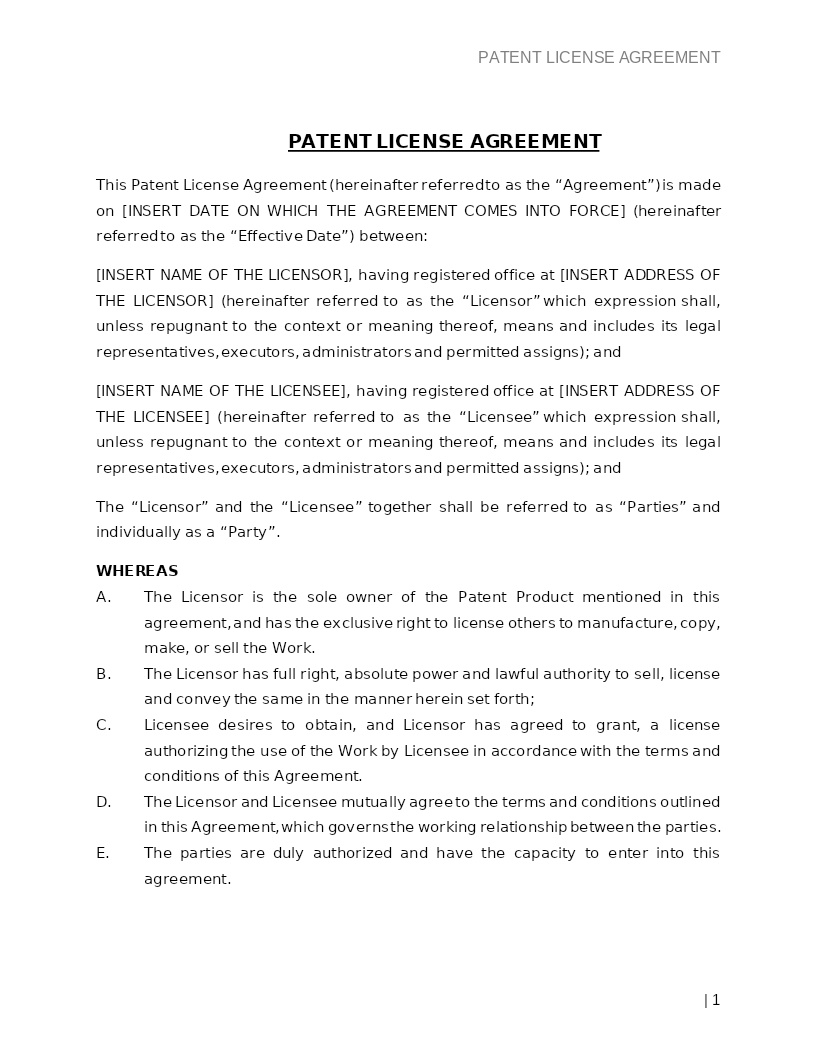
PATENT LICENSE AGREEMENT
How does it work?
1. Choose this template
Start by clicking on "Fill out the template"
2. Complete the document
Answer a few questions and your document is created automatically.
3. Save - Print
Your document is ready! You will receive it in Word and PDF formats. You will be able to modify it.
Understanding Patent License Agreements
When a patent owner decides to allow another party to use, manufacture, distribute, or commercialize a patented invention, it is essential to establish a clear framework that governs how those rights may be exercised. A Patent License Agreement provides that structure. It sets the terms under which the licensee may access and utilize the patented technology, defines royalty payments or other compensation, and outlines quality standards, restrictions, and responsibilities for both parties.
Putting a Patent License Agreement in place creates transparency and protection. It allows innovators to commercialize their patented technology without losing ownership while giving licensees lawful access to valuable intellectual property. The agreement ensures that both sides understand the permitted uses, financial obligations, compliance expectations, and legal boundaries that govern the patent’s exploitation.
Where Patent License Agreements Are Commonly Used
Patent License Agreements are widely used across U.S. industries where innovation and proprietary technology drive commercial activity, including:
- Technology companies licensing software, systems, or hardware innovations
- Pharmaceutical and biotech companies distributing patented drugs, devices, or formulations
- Manufacturing companies producing patented machinery, designs, or components
- Universities and research institutions licensing breakthrough research to commercial partners
- Startups monetizing early-stage inventions through partnerships or incubators
- Engineering firms licensing patented processes or industrial solutions
- Consumer product companies licensing patented designs or product features
Any time a patented invention is commercialized or transferred for use, a Patent License Agreement sets the terms for lawful and profitable collaboration.
Different Types of Patent License Agreements You May Encounter
- Exclusive License Agreement: Gives the licensee the sole right to use, manufacture, or sell the patented invention within a defined territory or industry. The licensor cannot license the patent to anyone else during the term.
- Non-Exclusive License Agreement: Allows multiple licensees to use the patented invention simultaneously. Common in technology and software sectors where broad distribution is beneficial.
- Sole License Agreement: Similar to exclusive rights but allows the patent owner to also use the invention while preventing other licensees from accessing it.
- Cross-License Agreement: Used when two parties license patents to each other, often in complex tech industries requiring shared innovation.
- Field-of-Use or Territory-Specific License: Grants the licensee rights to use the patent only within a specific industry, market segment, or geographic location.
- Patent Portfolio License: A broader agreement covering multiple related patents or patent families typical for R&D-heavy industries such as biotech or semiconductors.
Why Businesses Need a Patent License Agreement
Patent licensing involves significant financial, technical, and legal considerations. A Patent License Agreement clarifies the rights being transferred, prevents unauthorized use, outlines compensation structures, and ensures the patent owner’s intellectual property remains legally protected. The agreement guides manufacturing standards, quality control, sublicensing permissions, and compliance with U.S. patent laws. It also establishes mechanisms for resolving disputes, handling improvements or derivative inventions, and addressing infringement risks.
For innovation-driven businesses, this agreement serves as a strategic tool enabling revenue generation, market expansion, technological collaboration, and controlled commercialization of valuable patented assets.
When Legal Guidance Becomes Helpful
While some standard licenses begin with a template, legal expertise becomes invaluable when:
- The patent is highly valuable, industry-disrupting, or part of a complex portfolio
- The parties negotiate royalty structures, milestone payments, or sublicensing rights
- Improvements, derivative works, or future patents may emerge during the partnership
- Multiple jurisdictions, international markets, or foreign patent rights are involved
- The license supports regulated industries such as pharmaceuticals, medical devices, aerospace, or defense
- The agreement includes exclusivity, quality control provisions, or performance obligations
- Potential infringement risks, indemnities, or enforcement mechanisms are significant
- The license forms part of an investment, merger, or technology transfer transaction
Legal review ensures the agreement complies with U.S. patent law, protects ownership rights, and reduces long-term risk for both parties.
How to Work with This Template
- Identify the licensor (patent holder) and licensee (recipient of rights)
- Describe the licensed patent(s) with reference to issued numbers and filings
- Define the scope of rights manufacture, use, sale, distribution, or combination
- Set payment terms including royalties, audits, milestone payments, or minimum guarantees
- Outline performance obligations, technical standards, and reporting requirements
- Clarify ownership of improvements, modifications, or jointly developed technology
- Establish territorial limits, field-of-use restrictions, and sublicensing rights
- Set dispute resolution terms and select the governing state law
- Include termination rights, renewal options, and post-termination obligations
- Review the terms together; legal review is optional but recommended
- Sign electronically or in hard copy; both are enforceable throughout the United States
This template follows standards recognized in U.S. licensing, technology transfer, and intellectual property commercialization practices.
Frequently Asked Questions
Q1. What is a Patent License Agreement?
A Patent License Agreement is a legally binding contract that allows a patent owner to grant another party permission to use, manufacture, or commercialize a patented invention. It outlines the rights provided, payment terms, restrictions, and responsibilities to ensure that the licensee uses the patented technology lawfully and that the inventor’s intellectual property remains protected.
Q2. Why do patent owners need a license agreement instead of just allowing use?
Without a formal agreement, patent owners risk losing control over their invention, facing unauthorized use, or being unable to enforce their patent rights. A well-drafted license agreement defines the boundaries of permitted use, ensures proper compensation, and protects against infringement or misuse. It also ensures compliance with U.S. patent laws and helps avoid costly disputes.
Q3. What types of compensation are included in a Patent License Agreement?
Compensation may include royalties based on sales, upfront lump-sum payments, milestone-based payments, or annual maintenance fees. The agreement may also outline audit rights to verify sales data and ensure accurate reporting. Clear payment terms provide financial transparency and help both parties plan revenue projections.
Q4. Who owns improvements or new inventions created during the licensing relationship?
Ownership depends on the terms of the agreement. Some contracts assign improvements to the patent owner, others to the licensee, and some designate shared ownership. Because improvements often add value to the original invention, defining ownership early helps prevent disputes and ensures clarity on commercialization rights.
Q5. Can a Patent License Agreement restrict where or how the invention is used?
Yes. Agreements often include territorial restrictions (e.g., U.S. only) or field-of-use limitations (e.g., medical applications only). These restrictions allow patent owners to segment markets, maintain control, and maximize licensing opportunities across industries or geographic regions.
Q6. Is a Patent License Agreement enforceable in all U.S. states?
Yes. Patent rights are governed by federal law, while contract terms fall under state law. By selecting a governing state in the agreement and ensuring compliance with U.S. patent statutes, the license remains enforceable across all states. Electronic signatures are also valid under federal e-signature laws.
Q7. Does a Patent License Agreement protect against infringement by third parties?
The agreement typically includes provisions requiring the licensee to report suspected infringement and sometimes to assist in enforcement efforts. However, the patent owner generally retains the right to take legal action. Clear enforcement terms help protect the patent’s commercial value.
Q8. Do businesses need a lawyer to draft or customize a Patent License Agreement?
Given the technical and legal complexities of patent rights especially regarding royalties, improvements, territorial divisions, and infringement risks legal guidance is highly recommended. Lawyers ensure that every clause is enforceable, tailored to the parties’ objectives, and structured to protect long-term intellectual property value.