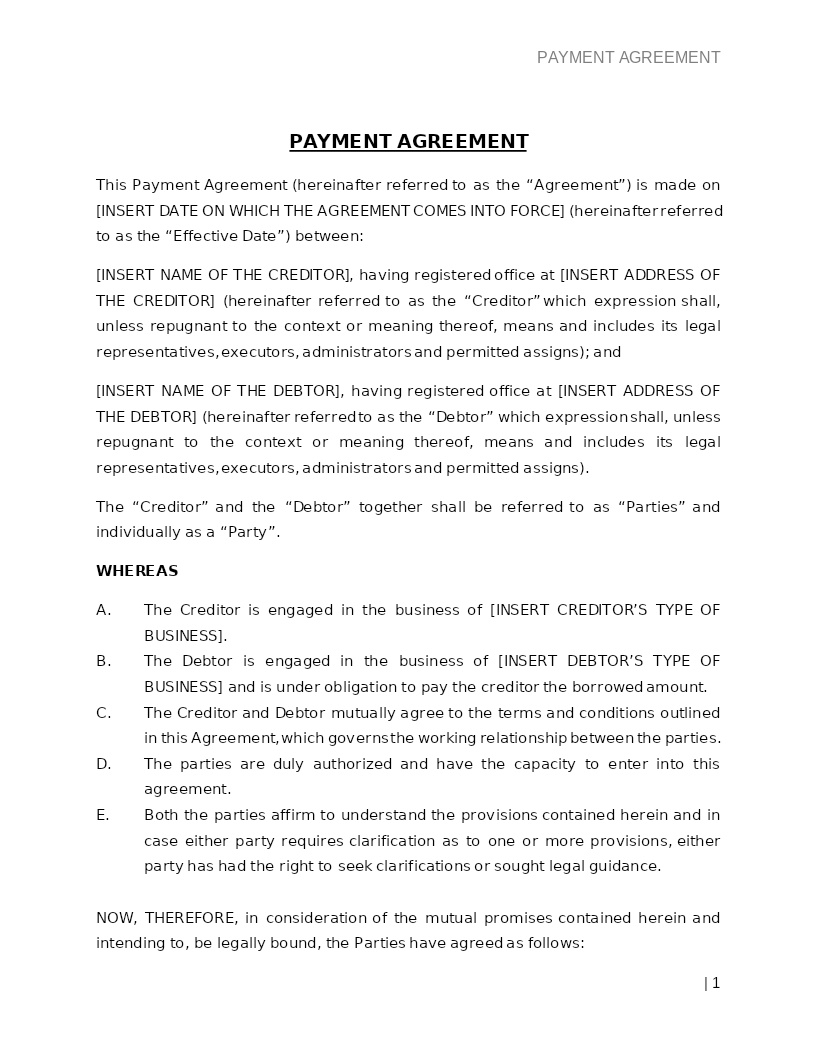
PAYMENT AGREEMENT
How does it work?
1. Choose this template
Start by clicking on "Fill out the template"
2. Complete the document
Answer a few questions and your document is created automatically.
3. Save - Print
Your document is ready! You will receive it in Word and PDF formats. You will be able to modify it.
Understanding Payment Agreements
A Payment Agreement is a legally binding contract that outlines the terms under which one party (the “Debtor”) agrees to repay money owed to another party (the “Creditor”). It establishes payment schedules, installment amounts, interest rates (if applicable), late fees, repayment methods, consequences of default, and governing law. Payment Agreements are used to formalize financial arrangements and protect both parties by clearly defining repayment expectations.
In the United States, Payment Agreements operate under state contract laws, federal lending regulations, fair debt collection rules, and consumer protection standards. A well-drafted Payment Agreement helps prevent misunderstandings, supports enforceability in court, and provides a structured plan for repayment of personal, commercial, or business debts.
Where Payment Agreements Are Commonly Used
Payment Agreements are widely used across personal, business, and commercial scenarios, including:
- Loan repayment between individuals
- Installment payments for goods or services
- Business-to-business payment arrangements
- Settlement of outstanding invoices
- Repayment plans for medical, construction, or professional services
- Family lending and informal financial arrangements
- Real estate deposits or staged payments
- Contractor and freelancer payment arrangements
Any time one party owes money to another, a Payment Agreement provides clarity and legal protection.
Different Types of Payment Agreements You May Encounter
- Installment Payment Agreement: Repayment is made in multiple scheduled payments over time.
- Lump-Sum Payment Agreement: A one-time payment settles the debt in full.
- Promissory Note–Based Agreement: A formal promise to repay, often with interest and enforceable terms.
- Business Payment Plan: Used for commercial transactions, service payments, or vendor settlements.
- Settlement Agreement with Payment Terms: Used to resolve disputes or overdue accounts with a negotiated payment plan.
When Legal Guidance Becomes Helpful
Legal review is recommended when:
- The agreement includes interest, collateral, or security
- The repayment amount is substantial
- The loan involves a business entity or corporate borrower
- The contract includes late fees, penalties, or acceleration clauses
- The Creditor wants to protect their right to pursue legal action for non-payment
- The agreement must comply with state lending limits or usury laws
- Multiple parties or guarantors are involved
Legal guidance ensures the agreement remains enforceable and compliant with U.S. state and federal rules.
How to Work with This Template
- Identify the Creditor and Debtor, including full legal details
- Specify the principal amount owed and any applicable interest
- Define the payment plan-installments, due dates, and methods
- Include late fees, grace periods, and default consequences
- Clarify whether the agreement is secured or unsecured
- Add confidentiality or privacy clauses as needed
- Choose the governing U.S. state law
- Outline signatures, notarization (if required), and recordkeeping
- Sign electronically or physically according to state requirements
This template follows standard U.S. financial contract practices and works with all major digital signature platforms.
Frequently Asked Questions
Q1. What is a Payment Agreement and why is it important?
A Payment Agreement outlines how a borrower will repay money owed to a lender. It is important because it creates a written record of repayment terms, prevents misunderstandings, and protects both parties if future disputes arise.
Q2. Are Payment Agreements legally enforceable in the U.S.?
Yes. Payment Agreements are enforceable under state contract law as long as they clearly outline the repayment amount, schedule, and obligations of each party. A written agreement is essential for legal enforcement.
Q3. Do Payment Agreements require interest?
Not always. Payment Agreements can be interest-free or include a specified interest rate. If interest is charged, it must comply with state usury laws, which limit the maximum lawful rate.
Q4. Can payments be made in installments?
Absolutely. Installment payments are common in Payment Agreements. The contract will specify the number of payments, due dates, and acceptable payment methods.
Q5. What happens if the borrower does not pay on time?
The agreement may include late fees, penalties, a grace period, or acceleration clauses that make the full balance immediately due. Clear terms help avoid disputes and encourage timely repayment.
Q6. Can a Payment Agreement include collateral?
Yes. A Payment Agreement can be secured with collateral such as a vehicle, equipment, or other assets. This protects the lender by allowing recovery of the asset if the borrower defaults.
Q7. Are electronic signatures valid for Payment Agreements?
Yes. Under the U.S. ESIGN Act, electronic signatures are legally binding for Payment Agreements. Many individuals and businesses prefer digital signatures for speed and convenience.
Q8. Can a Payment Agreement be modified later?
Yes, but only in writing and with consent from both parties. Modifications may include changes to payment schedules, interest rates, or extensions of the repayment period.
Q9. Does a Payment Agreement need to be notarized?
Not always. Notarization can increase enforceability but is not required unless state law or the parties specifically request it, especially for higher-value agreements.
Q10. Is a Payment Agreement suitable for personal loans between friends or family?
Definitely. A written Payment Agreement helps avoid misunderstandings, maintains healthy relationships, and provides legal clarity, even in informal lending situations.