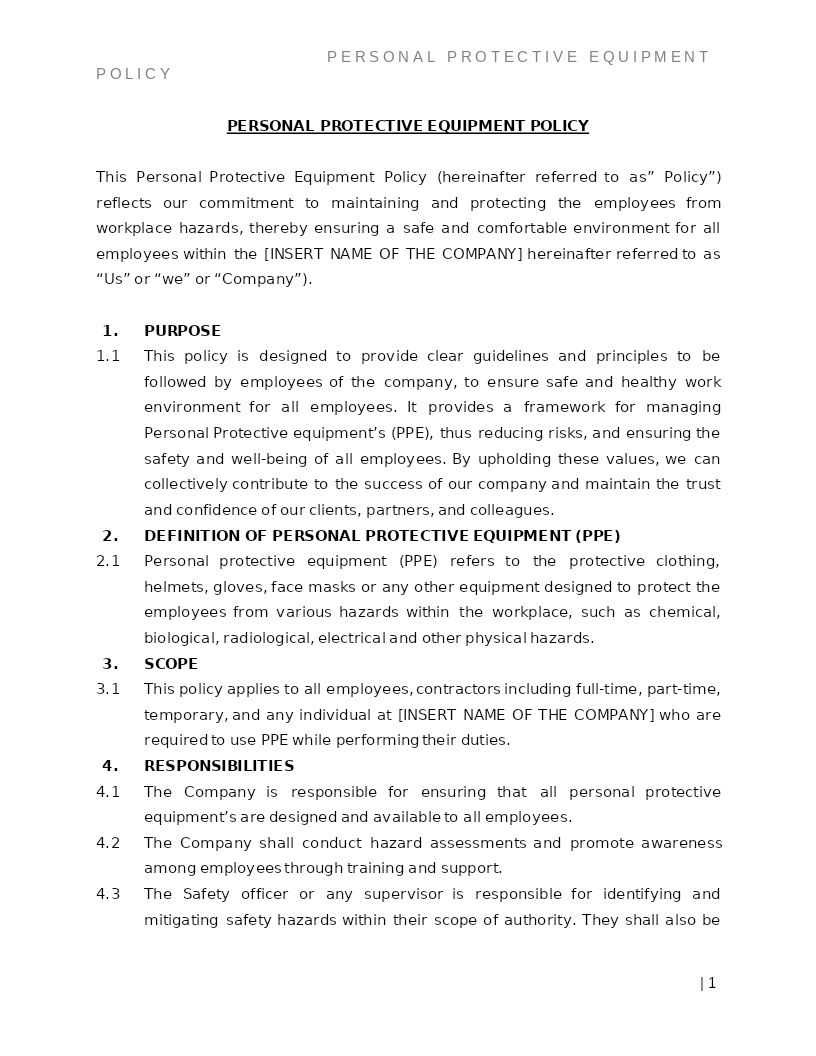
PERSONAL PROTECTIVE EQUIPMENT(PPE) POLICY
How does it work?
1. Choose this template
Start by clicking on "Fill out the template"
2. Complete the document
Answer a few questions and your document is created automatically.
3. Save - Print
Your document is ready! You will receive it in Word and PDF formats. You will be able to modify it.
Understanding the Personal Protective Equipment (PPE) Policy
When employees are exposed to workplace hazards, whether chemical, physical, biological, or mechanical, it is essential to establish clear guidelines that ensure proper use of protective gear. A Personal Protective Equipment (PPE) Policy provides that structure. It outlines employer and employee responsibilities, types of PPE required, procedures for use and maintenance, and compliance standards under U.S. occupational safety laws.
Putting a PPE Policy in place creates a safe work environment, reduces accidents, and ensures organizations meet OSHA and industry-specific safety requirements.
Where PPE Policies Are Commonly Used
PPE Policies are widely implemented across U.S. industries that involve operational hazards or regulatory oversight, including:
- Manufacturing, construction, and industrial facilities
- Healthcare organizations, laboratories, and emergency services
- Warehousing, logistics, and transportation
- Chemical plants, food processing units, and hazardous-material environments
- Schools, public institutions, and government workplaces
- Corporate offices with ergonomic, electrical, or environmental risks
Any time workers face potential exposure to harmful conditions, a PPE Policy ensures proper safeguards and standardized protective practices.
Different Types of PPE Policies You May Encounter
- General Workplace PPE Policy: Covers basic protective gear such as gloves, goggles, helmets, and footwear.
- Healthcare PPE Policy: Defines infection control measures, N95 requirements, gowns, gloves, and isolation protocols.
- Chemical Handling PPE Policy: Specifies respirators, chemical-resistant gloves, protective suits, and eyewear.
- Construction and Industrial PPE Policy: Addresses fall protection, hearing protection, high-visibility clothing, and safety boots.
- Emergency Response PPE Policy: Includes specialized equipment for fire, rescue, and hazardous-material response teams.
When Legal Guidance Becomes Helpful
Consulting a legal expert becomes important when:
- OSHA regulations need precise interpretation or state laws impose stricter safety standards
- The workplace handles chemicals, heavy machinery, or high-risk operations
- PPE failures could create liability, workers’ compensation claims, or regulatory penalties
- Multiple locations across different states require consistent compliance
- The policy must integrate with union rules, employment laws, or training requirements
- Employers need protection from claims of inadequate PPE or unsafe conditions
Legal review ensures the policy is enforceable, compliant, and tailored to the organization’s risk profile.
How to Work with This Template
- Identify workplace hazards and the PPE required for each job role
- Outline employer responsibilities for providing, training, and maintaining PPE
- Clarify employee obligations to use, inspect, and report PPE issues
- Include procedures for cleaning, storage, and replacement
- Choose applicable U.S. state and federal safety laws (OSHA as baseline)
- Review collaboratively, legal guidance is optional but recommended
- Sign electronically or physically if incorporated into employment contracts or safety manuals
This policy template aligns with widely accepted U.S. workplace safety and regulatory standards.
Frequently Asked Questions
Q1. Why is a PPE Policy essential for U.S. workplaces?
A PPE Policy ensures that employees use proper protective gear to minimize exposure to workplace hazards. It creates a structured safety environment that reduces injuries, improves compliance, and supports OSHA-mandated safety practices. With clear guidelines, businesses can avoid fines and maintain consistent safety standards across all operations.
Q2. Who is responsible for providing PPE under this policy?
Under OSHA guidelines, employers must supply appropriate PPE at no cost when hazards cannot be eliminated through engineering or administrative controls. The policy clarifies which PPE is provided, how it must be maintained, and employees’ obligations to use it correctly. This protects both the workforce and the organization from safety-related liabilities.
Q3. Can PPE Policies be customized for different job roles or departments?
Yes. PPE needs vary based on job duties, industry risks, and operational environments. A well-drafted policy tailors requirements for each department—such as welding, lab work, patient care, or construction. Customization ensures that all employees receive appropriate protection without overburdening the workplace with unnecessary requirements.
Q4. What happens if an employee refuses to follow the PPE Policy?
Most policies include disciplinary measures for non-compliance, ranging from retraining to corrective action. This protects the organization from liability and maintains workplace safety standards. Clear enforcement procedures also demonstrate that PPE compliance is mandatory, not optional, for all employees.
Q5. Does the PPE Policy cover training and equipment maintenance?
Yes. A strong PPE Policy includes training requirements, inspection routines, and maintenance procedures to ensure equipment is effective and safe. This helps prevent equipment failure, reduces accidents, and ensures employees understand how to properly use their protective gear.
Q6. Is a PPE Policy legally required for all workplaces?
While OSHA does not require a written PPE Policy for every industry, PPE-use compliance is mandatory whenever hazards exist. Having a written policy ensures consistent safety practices, reduces liability, and supports compliance during OSHA audits or inspections. Many industries require formal documentation due to high risk.
Q7. Can this policy apply to remote or hybrid workplaces?
Yes, depending on the hazards involved. Remote employees may need ergonomic guidance, electrical safety instructions, or specialized PPE for field visits. Hybrid workplaces can tailor the policy to address both office settings and hazardous work environments.
Q8. How often should a PPE Policy be reviewed or updated?
Annual reviews are recommended, but updates may be needed sooner if new equipment, hazards, or OSHA regulations emerge. Regular updates ensure continuous compliance and keep employees informed about evolving safety requirements and new protective technologies.