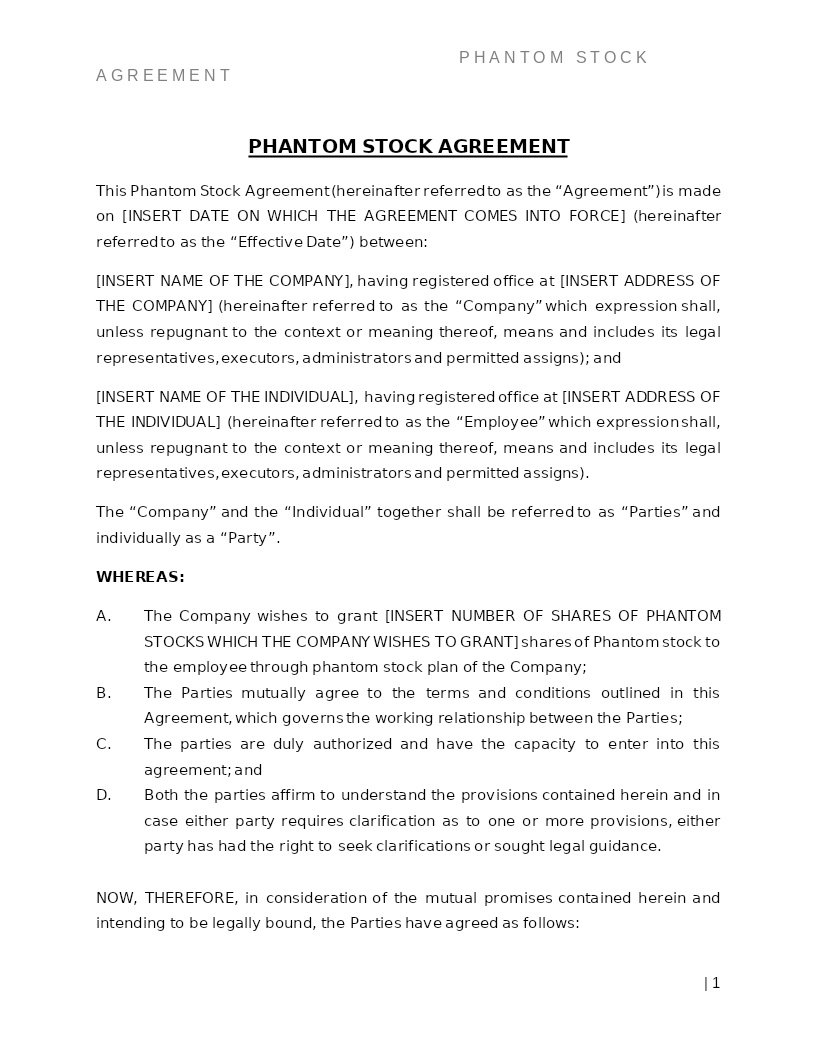
PHANTOM STOCK AGREEMENT
How does it work?
1. Choose this template
Start by clicking on "Fill out the template"
2. Complete the document
Answer a few questions and your document is created automatically.
3. Save - Print
Your document is ready! You will receive it in Word and PDF formats. You will be able to modify it.
Rewarding Employees Without Equity Dilution Through Phantom Stock Agreements
When a company wants to reward employees based on its financial growth, but without giving away actual equity, a Phantom Stock Agreement provides the perfect framework. It grants employees compensation tied to the company’s stock value or valuation, creating an incentive structure that mirrors real ownership without issuing shares.
Phantom stock plans are commonly used by U.S. startups, private companies, and growing corporations to retain high-performing employees, align long-term interests, and avoid dilution of ownership. Because no real shares are transferred, the arrangement remains contractual and is governed by U.S. employment and contract laws.
Putting a Phantom Stock Agreement in place ensures clarity around valuation, vesting, payouts, and conditions, preventing misunderstandings and potential disputes about compensation.
Where Phantom Stock Agreements Are Commonly Used
Phantom stock plans are widely adopted across U.S. industries where companies want to reward performance without altering the cap table. Common use cases include:
- Startups that want to incentivize employees without issuing equity
- Fast-growth companies planning for valuation increases
- Private, family-owned businesses that avoid bringing employees into ownership
- Professional services firms rewarding partners with performance bonuses
- Tech and SaaS companies aligning compensation with long-term company value
- Corporations offering retention-driven executive incentive programs
- Founder-led companies that prefer non-dilutive compensation structures
Any time a business wants to mimic equity benefits while preserving ownership control, a phantom stock plan becomes a strategic solution.
Different Types of Phantom Stock Plans You May Encounter
- Appreciation Only Phantom Stock Plan: Employees receive cash equivalent to the increase in value of phantom units over time. This plan rewards growth without paying out the entire value of the underlying stock.
- Full-Value Phantom Stock Plan: Employees receive the full value of phantom shares upon vesting. This more generous model mirrors real stock ownership but remains cash-settled.
- Performance-Based Phantom Units: Units vest only when specific business, revenue, or operational goals are met.
- Time-Based Vesting Phantom Plans: Units vest gradually over a defined period to support long-term retention.
When Legal Guidance Becomes Helpful
While phantom stock plans appear straightforward, legal advice becomes essential when:
- The plan includes complex valuation methods
- Executive-level or high-value payouts are involved
- The company anticipates mergers, acquisitions, or fundraising
- Multi-state employment laws affect compensation structuring
- Tax implications vary depending on plan design (IRC Section 409A)
- Payout terms need precise triggers to avoid disputes
- Confidential data or sensitive financial information is involved
Legal review ensures your plan complies with U.S. tax laws, avoids deferred compensation pitfalls, and protects employer and employee expectations.
How to Work With This Template
- Identify the parties (employer and participating employee)
- Define the phantom units and valuation methodology
- Set vesting conditions (time-based or performance-linked)
- Specify payout triggers and settlement methods
- Add termination, resignation, or misconduct consequences
- Include confidentiality, non-solicitation, or non-compete add-ons (if applicable)
- Choose the governing U.S. state law
- Sign electronically or in physical form, both enforceable under U.S. law
This template follows compensation standards recognized across the United States and is compatible with common e-signature platforms.
Frequently Asked Questions
Q1. Are Phantom Stock Agreements legal and enforceable in the United States?
Yes. Phantom stock plans are fully legal in the U.S. as long as they are clearly written and follow federal employment and tax laws, including IRS rules on deferred compensation (such as IRC Section 409A). A written agreement ensures enforceability and reduces conflicts.
Q2. Do phantom stocks give employees real shares or ownership rights?
No. Phantom stock does not grant actual equity, voting power, or ownership. Employees receive cash or equivalent compensation tied to stock value, allowing companies to reward performance without changing their cap table.
Q3. How are phantom stock payouts taxed in the U.S.?
Payouts are generally treated as ordinary income (similar to bonuses) and taxed at the employee’s applicable income tax rate. Employers may also be eligible for a corresponding deduction. Tax planning is important for compliance with IRS regulations.
Q4. Are phantom stock plans good for startups?
Absolutely. Phantom stock plans are ideal for startups that want to retain key talent without issuing equity. They help motivate employees based on company growth while keeping shareholding structures simple.
Q5. How long should a phantom stock plan vesting period be?
Most U.S. companies use a vesting period of 3–5 years, often aligned with performance milestones or long-term retention goals. Longer vesting periods help maintain stability in early-stage companies.
Q6. Can phantom stock agreements be signed electronically?
Yes. Electronic signatures are fully enforceable under the ESIGN Act and Uniform Electronic Transactions Act (UETA). Companies commonly use e-sign platforms to execute compensation agreements securely.
Q7. What common mistakes should companies avoid in phantom stock agreements?
Some key errors include:
• Failing to define valuation methodology clearly
• Not aligning the plan with IRS deferred compensation rules
• Overlooking vesting conditions or payout triggers
• Not specifying what happens upon resignation, termination, or death
• Missing governing law or dispute resolution clauses
Clear documentation prevents disputes and ensures compliance.