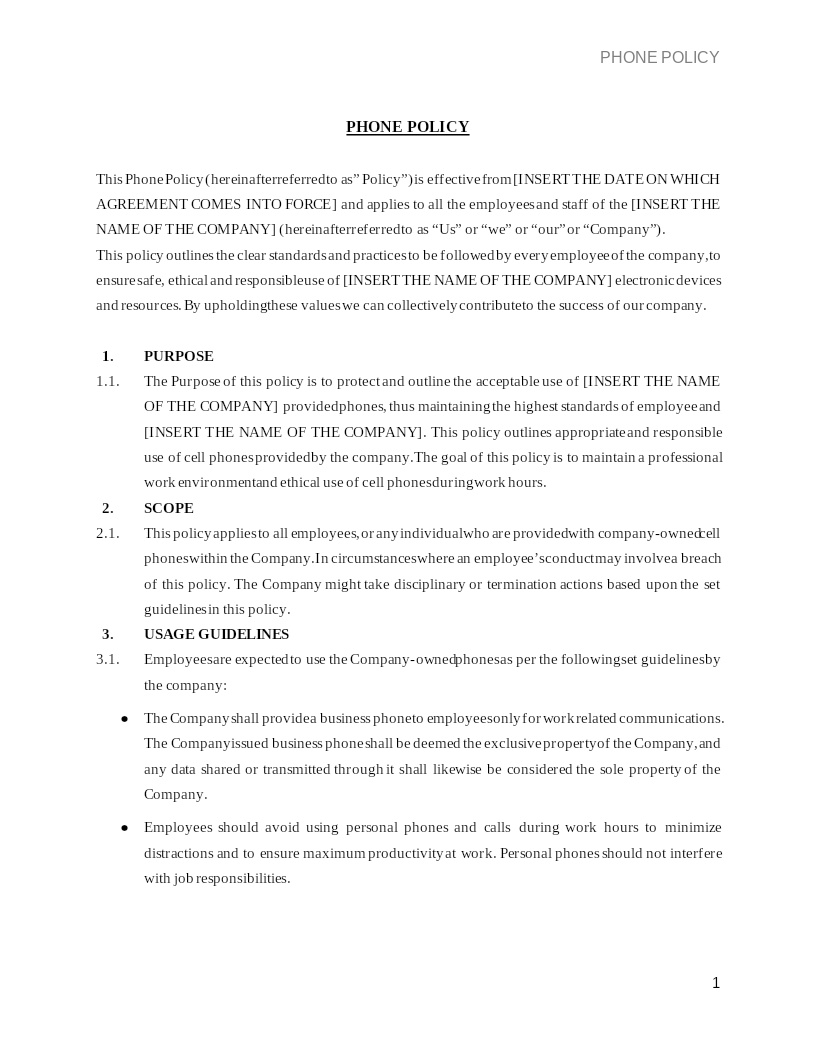
PHONE POLICY
How does it work?
1. Choose this template
Start by clicking on "Fill out the template"
2. Complete the document
Answer a few questions and your document is created automatically.
3. Save - Print
Your document is ready! You will receive it in Word and PDF formats. You will be able to modify it.
Ensuring Workplace Productivity and Data Security Through a Phone Policy
A Phone Policy is a formal organizational directive that establishes the standards, restrictions, and obligations governing the use of phones whether employer-issued or personally owned within the workplace and during work-related activities. Developed in accordance with U.S. employment law, workplace-safety rules enforced by OSHA, electronic-communication and privacy protections under the Electronic Communications Privacy Act (ECPA), and applicable state privacy and monitoring requirements, this policy defines how phone use must be managed to support productivity, protect confidential company information, reduce workplace distractions, and mitigate legal risk. The policy outlines expectations for phone usage during work hours, including restrictions on personal calls, texting, social media, recording, photography, and unauthorized use of devices in sensitive or restricted-access environments.
A comprehensive Phone Policy also establishes guidelines for the responsible use of company-issued mobile devices, including security protocols, password requirements, appropriate use of messaging applications, and compliance with data-protection and confidentiality obligations. It addresses circumstances in which personal devices may be used for work (including potential overlap with BYOD practices), outlines procedures for reporting lost or stolen devices, and describes rules applicable during meetings, client interactions, and regulated workplace settings. Additionally, the policy governs the use of phones while operating vehicles or machinery, ensuring compliance with distracted-driving laws and employer-safety mandates. By implementing this policy, organizations protect sensitive data, maintain a professional workplace atmosphere, reduce liability related to misuse, and promote consistent standards across the workforce.
Where Phone Policies Are Commonly Used
Phone Policies are widely implemented in workplaces across industries, including:
- Corporate offices managing productivity and secure communications
- Retail and hospitality environments with heavy customer interaction
- Healthcare institutions subject to HIPAA privacy requirements and restricted-use zones
- Manufacturing and industrial settings requiring strict safety compliance
- Transportation, logistics, and delivery companies governed by distracted-driving laws
- Educational institutions supervising students, staff, and operational facilities
- Government contractors operating in secure or confidential environments
- Technology companies protecting proprietary data and intellectual property
Any organization that must balance the need for communication with safety, confidentiality, and professionalism benefits from a structured Phone Policy.
Different Types of Phone Policies You May Encounter
1. General Workplace Phone Policies: Address personal and work-related phone use during working hours.
2. Company-Issued Phone Policies: Provide guidelines for employer-owned devices and related security requirements.
3. Restricted-Area or Safety-Sensitive Phone Policies: Apply in environments where phone use impacts safety, productivity, or confidentiality.
4. Customer-Service Phone Protocol Policies: Define phone etiquette, call-handling procedures, and professional communication expectations.
5. Hybrid or Remote-Work Phone Policies: Address required availability, video-call etiquette, and phone security for remote workers.
When Legal Guidance Becomes Helpful
Legal oversight is recommended when:
- The policy includes employee monitoring, call recording, or device tracking
- The workplace involves protected confidentiality standards such as HIPAA or FERPA
- Phone use intersects with safety-sensitive roles or OSHA regulations
- The organization operates vehicles or machinery and must comply with distracted-driving laws
- Confidential, proprietary, or trade-secret information is accessed via phone
- The company intends to enforce disciplinary consequences for personal phone misuse
- State-specific privacy laws restrict recording, photography, or workplace surveillance
Legal review helps ensure the Phone Policy aligns with U.S. privacy, employment, and safety laws, reducing liability and supporting enforceability.
How to Work with This Template
- Define acceptable and prohibited phone activities during work hours
- Clarify rules for personal calls, texting, and mobile data usage while on duty
- Establish guidelines for company-issued phones, including security protocols and user responsibilities
- Identify confidential areas where phone use, photography, or recording is restricted
- Include safety procedures prohibiting phone use when driving or operating machinery
- Outline expectations for professional communication during business calls or client interactions
- Address social-media use, messaging apps, and unauthorized sharing of company information
- Provide instructions for reporting lost, stolen, or compromised devices
- Specify disciplinary measures for violations consistent with U.S. employment law
- Update the policy regularly to reflect technological changes and evolving legal standards
This template reflects best practices for managing phone use within modern workplaces while maintaining compliance with U.S. laws.
Frequently Asked Questions
Q1. What is a Phone Policy, and why is it important?
A Phone Policy defines how employees may use personal or company phones during work. It is important because it helps maintain productivity, protects confidential information, and ensures compliance with safety and privacy laws.
Q2. Does the policy apply to personal phones?
Yes. The policy typically applies to both personal devices and company-issued phones when used during work hours or for work-related activities.
Q3. Are employees allowed to use phones during work hours?
Employees may use phones in accordance with employer guidelines, which may limit personal calls, texting, or social media use to designated break periods.
Q4. Does the policy restrict photography or recording?
Yes. Most policies prohibit unauthorized photography, audio recording, or video recording to protect privacy and confidential information.
Q5. Are there special rules for phone use in safety-sensitive positions?
Absolutely. Employees operating vehicles, machinery, or equipment must comply with strict no-phone rules that align with OSHA and state distracted-driving laws.
Q6. How does the policy address company-issued phones?
Company-issued phones must be used responsibly, secured with passwords, and protected against unauthorized access. They may also be subject to monitoring consistent with legal requirements.
Q7. What happens if an employee violates the Phone Policy?
Violations may result in disciplinary action, up to and including termination, depending on the severity of the misconduct.
Q8. Does the policy apply to remote workers?
Yes. Remote workers must adhere to phone-use rules governing professionalism, data protection, and communication during work activities.
Q9. Can employees be monitored while using company phones?
Monitoring may occur but must comply with federal and state privacy laws. Employers typically disclose such monitoring in advance.
Q10. Should legal counsel review a Phone Policy?
Yes. Legal review ensures the policy aligns with privacy laws, labor regulations, and workplace-safety standards, reducing the risk of disputes.