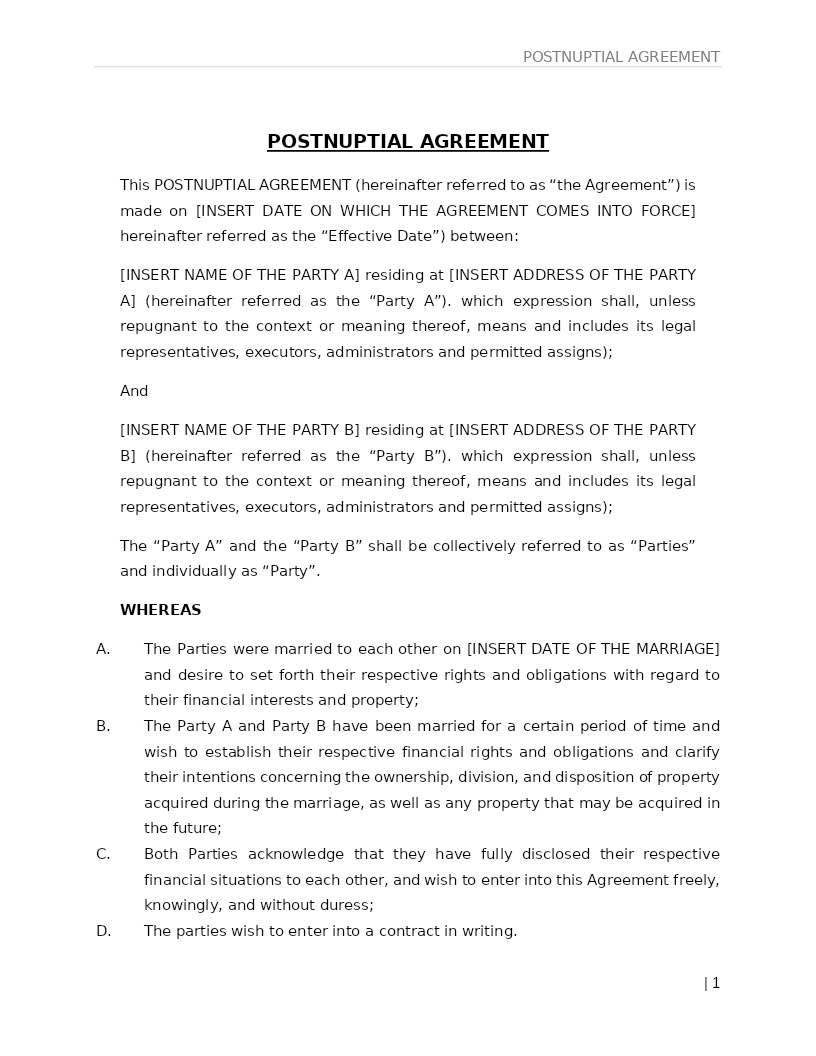
POSTNUPTIAL AGREEMENT
How does it work?
1. Choose this template
Start by clicking on "Fill out the template"
2. Complete the document
Answer a few questions and your document is created automatically.
3. Save - Print
Your document is ready! You will receive it in Word and PDF formats. You will be able to modify it.
Understanding Postnuptial Agreements in the United States
A Postnuptial Agreement is a legally binding contract created after marriage that outlines each spouse’s financial rights, responsibilities, and the division of assets and debts. In the United States, these agreements help clarify financial arrangements, protect individual property, and provide a clear plan for handling assets in the event of divorce, separation, or death.
Postnuptial Agreements promote transparency, reduce future conflicts, and strengthen trust by ensuring both partners fully understand and agree on how finances will be managed. They are particularly useful when financial circumstances change during the marriage, such as starting a business, receiving an inheritance, acquiring significant debt, or blending families.
A well-drafted Postnuptial Agreement ensures compliance with state laws, requires voluntary consent from both spouses, and must be fair, properly disclosed, and executed in accordance with U.S. marital property laws.
Where Postnuptial Agreements Are Commonly Used
Postnuptial Agreements are widely used in situations such as:
- Protecting premarital property or inherited assets
- Defining financial arrangements in blended families
- Planning asset division for high-net-worth couples
- Clarifying ownership in family businesses or startups
- Addressing newly acquired marital debt or financial risks
- Managing changes in earning capacity or career paths
- Securing financial arrangements when marital issues arise
- Replacing or updating an outdated or invalid prenuptial agreement
Any time spouses want clarity, financial protection, or a well-structured plan, a Postnuptial Agreement provides legal certainty and peace of mind.
Different Types of Postnuptial Agreements You May Encounter
- Property & Asset Division Agreements: Detail how separate and marital property will be classified and divided, both during the marriage and in the event of divorce.
- Debt Allocation Agreements: Specify how existing or future debts will be handled to protect one spouse from the other’s financial liabilities.
- Business Ownership Protection Agreements: Outline each spouse’s rights regarding business interests, income, and shares, ensuring continuity and protection for the company.
- Inheritance & Estate Planning Agreements: Used when spouses want to protect children from previous marriages or ensure specific inheritance rights.
- Support & Maintenance Agreements: Define spousal support (alimony) terms or waive them where legally allowed.
- Financial Responsibilities Agreements: Outline household financial obligations, investments, joint accounts, bill payments, and long-term financial planning.
When Legal Guidance Becomes Helpful
While some terms may seem straightforward, legal guidance is extremely important because Postnuptial Agreements must meet state-specific legal requirements to be enforceable. Legal support is especially valuable when:
- Significant assets, debts, or business interests are involved
- One spouse is contributing to the other’s business or career
- There are children from previous relationships
- The agreement affects inheritance or estate planning
- One spouse earns significantly more than the other
- The marriage has experienced financial or personal conflicts
- Future spousal support (alimony) terms are being negotiated
- The couple lives in a community-property state
- Full financial disclosure is required to ensure validity
Attorney involvement ensures the agreement is fair, voluntary, compliant, and not vulnerable to challenges in court.
How to Work With This Template
- Enter full legal names of both spouses
- Provide a complete list of assets, debts, income sources, and property
- Clarify separate vs. marital property classifications
- Define financial responsibilities during the marriage
- Specify terms for division of assets and debts
- Include any spousal support (alimony) arrangements
- Add estate planning or inheritance provisions, if necessary
- Select the governing U.S. state law
- Disclose all financial information transparently
- Review together (legal consultation strongly recommended)
- Sign voluntarily, with witnesses or notarization if required by state law
This template follows widely recognized U.S. standards and can be executed electronically or on paper, depending on state requirements.
Frequently Asked Questions
1. Is a Postnuptial Agreement legally enforceable in the U.S.?
Yes, if it meets state requirements. To be enforceable, the agreement must be voluntary, fair, properly disclosed, and signed with full financial transparency. Some states also require notarization.
2. How is a Postnuptial Agreement different from a Prenuptial Agreement?
A Prenuptial Agreement is signed before marriage, while a Postnuptial Agreement is created after marriage. Both serve a similar purpose: clarifying financial rights, protecting assets, and reducing future conflict.
3. Do we need a Postnuptial Agreement if we already have a Prenup?
Not always, but a Postnuptial Agreement is helpful if financial circumstances have changed, such as starting a business, receiving inheritance, acquiring new debts, or updating outdated prenuptial terms.
4. Can a Postnuptial Agreement help protect my business?
Yes. It can define each spouse’s rights to business income, ownership, and shares, helping protect the company and prevent disputes during financial changes or divorce.
5. Are Postnuptial Agreements allowed in all U.S. states?
Yes, but requirements vary. Some states, especially community-property states, have stricter rules regarding fairness, disclosure, and notarization.
6. Do both spouses need separate attorneys?
It is highly recommended. Having independent legal counsel for each spouse strengthens enforceability and ensures the agreement is not challenged later.
7. Can a Postnuptial Agreement waive alimony?
In many states, yes, but the waiver must be fair and reasonable at the time of signing and upon enforcement. Courts may reject unfair or overly one-sided provisions.
8. Will a Postnuptial Agreement override state marital property laws?
Yes, in most cases. Couples can decide how assets and debts should be divided instead of following default state laws, as long as the agreement is fair and legally valid.
9. Can we modify or update the agreement later?
Absolutely. Postnuptial Agreements can be revised or amended at any time if both spouses agree and sign the updated terms.
10. Is financial disclosure required?
Yes. Full and honest financial disclosure is a key component of enforceability. Concealing assets may invalidate the agreement.