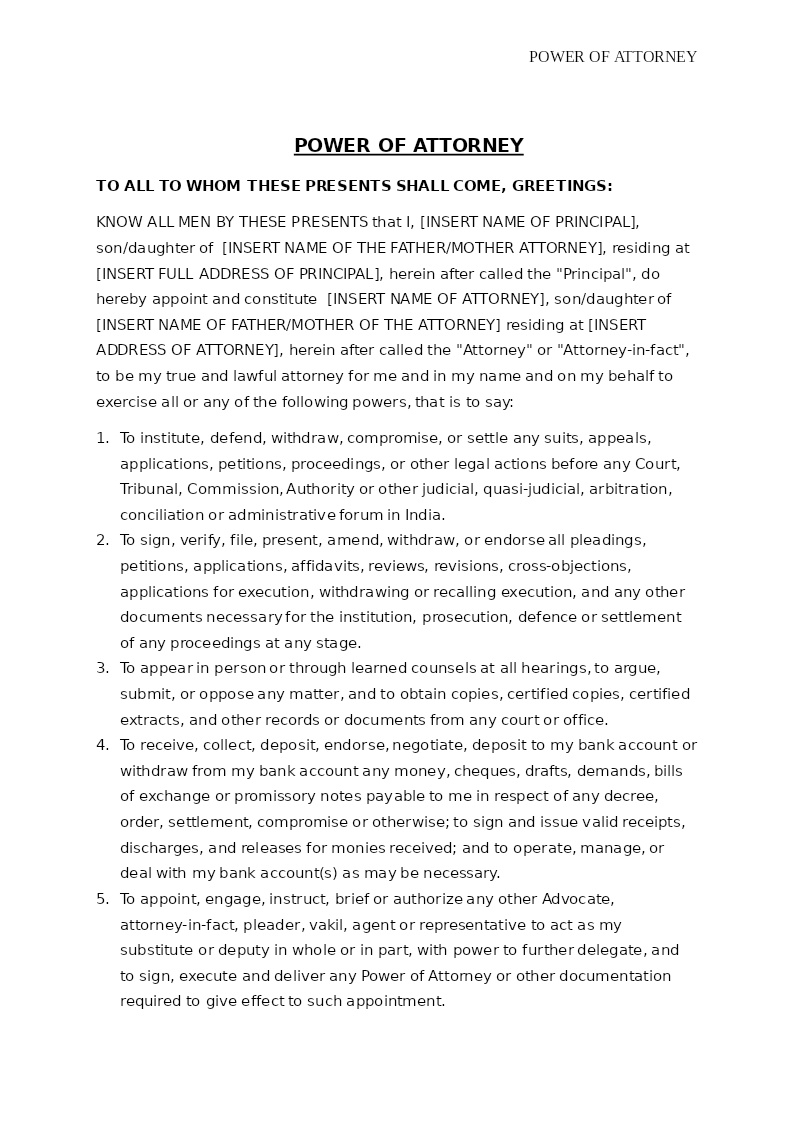
POWER OF ATTORNEY
How does it work?
1. Choose this template
Start by clicking on "Fill out the template"
2. Complete the document
Answer a few questions and your document is created automatically.
3. Save - Print
Your document is ready! You will receive it in Word and PDF formats. You will be able to modify it.
Understanding Power of Attorney
A Power of Attorney (POA) is a legally binding document that authorizes one person (the “Agent” or “Attorney-in-Fact”) to act on behalf of another person (the “Principal”). It outlines the scope of authority, the actions the agent may take, and the conditions under which those powers may be exercised.
In the United States, Powers of Attorney are governed by state laws, including the Uniform Power of Attorney Act (UPOAA) adopted by many states. POAs are commonly used for financial management, legal decisions, property transactions, healthcare directives, and business operations. This document ensures that trusted individuals can act on a principal’s behalf when they are unavailable, incapacitated, or prefer not to handle certain matters personally.
Where Powers of Attorney Are Commonly Used
POAs are widely used across personal, business, and financial scenarios, such as:
- Financial and banking transactions
- Real estate purchases, sales, or management
- Business operations, decision-making, and contract execution
- Healthcare decisions and medical consent (Medical POA)
- Estate planning, asset management, and retirement accounts
- Tax filings and representation before the IRS
- Elderly care or situations involving temporary or permanent incapacity
Whenever someone needs a trusted representative to act legally or financially on their behalf, a Power of Attorney provides clear legal authority.
Different Types of Powers of Attorney You May Encounter
- General Power of Attorney: Grants broad authority over financial and legal matters.
- Durable Power of Attorney: Remains valid even if the principal becomes incapacitated, commonly used in estate planning.
- Limited or Special Power of Attorney: Grants authority for a specific task, such as signing a document, completing a real estate closing, or handling a single transaction.
- Medical or Healthcare Power of Attorney: Authorizes an agent to make medical and healthcare decisions if the principal is unable to do so.
- Springing Power of Attorney: Takes effect only upon a specified event, such as incapacity, as defined under state law.
When Legal Guidance Becomes Helpful
Legal assistance is valuable when:
- The POA will grant broad financial or decision-making authority
- The principal requires medical or long-term care planning
- The document must comply with specific state statutes or notarization rules
- The POA involves real estate transactions requiring recordation
- Multiple agents or successor agents are being appointed
- The principal wants to limit or expand authority in customized ways
- The document affects estate planning, trusts, or tax matters
Because POA laws vary by state, legal review ensures the agreement is valid, properly executed, and enforceable.
How to Work with This Template
- Identify the principal and the appointed agent(s)
- Specify the type of POA: general, durable, limited, medical, or springing
- Define the agent’s powers and any restrictions
- Include instructions for financial, legal, or healthcare decisions
- Choose the governing state law where the POA will be used
- Add notarization or witness requirements based on state rules
- Outline when the POA becomes effective and when it terminates
- Sign electronically (if permitted) or in hard copy with proper witnesses
This template follows common U.S. standards and is compatible with major electronic signature platforms where state law allows e-signatures.
Frequently Asked Questions
Q1. What is a Power of Attorney and why is it needed?
A Power of Attorney is a legal document allowing someone you trust to act on your behalf. It is needed when you want help managing finances, handling legal matters, making healthcare decisions, or ensuring continuity if you become unavailable or incapacitated.
Q2. Are Powers of Attorney valid in all U.S. states?
Yes, but requirements differ by state. Many states follow the Uniform Power of Attorney Act, but others have unique rules regarding notarization, witnessing, and accepted forms. It’s important to complete the POA according to the state where it will be used.
Q3. Does a Power of Attorney remain valid if the principal becomes incapacitated?
Only if it is a Durable Power of Attorney. General POAs usually terminate upon incapacity unless they include “durable” language required by state law. A Durable POA ensures continuity of decision-making during illness or emergencies.
Q4. Can I limit the powers granted to my agent?
Yes. A POA can be highly customized. You may give your agent broad authority or restrict them to specific tasks, such as signing documents, accessing bank accounts, filing taxes, or managing real estate. Clear limitations help avoid misuse.
Q5. Is a Power of Attorney legally required to be notarized?
Ans. Many states require notarization for a POA to be valid, especially for real estate, financial accounts, or healthcare directives. Some states also require one or more witnesses. Following proper execution rules ensures the POA is legally enforceable.
Q6. Can a Power of Attorney be revoked or changed?
Yes. A principal can revoke or modify a POA at any time as long as they are mentally competent. Revocation should be made in writing and provided to the agent and any institutions relying on the document, such as banks or healthcare providers.
Q7. What is the difference between a Power of Attorney and a Medical Power of Attorney?
A standard POA usually covers financial and legal matters, while a Medical POA (Healthcare POA) specifically authorizes an agent to make medical decisions if the principal cannot communicate or lacks capacity. Both may be used together for complete planning.
Q8. Can multiple agents be appointed under one Power of Attorney?
Yes. You may appoint more than one agent and specify whether they must act jointly or independently. Many people also appoint backup or “successor” agents to step in if the primary agent is unavailable.
Q9. Are electronic signatures accepted for Powers of Attorney?
In many states, certain POAs, especially financial POAs, can be electronically signed under the ESIGN Act. However, healthcare and real estate POAs may require wet signatures or notarization. It depends on state law and the type of POA.
Q10. Is a Power of Attorney suitable for business decisions?
Yes. Many business owners use a POA to authorize partners or trusted individuals to sign contracts, manage accounts, or operate the business during absence or incapacity. A Business POA ensures continuity and prevents operational disruptions.