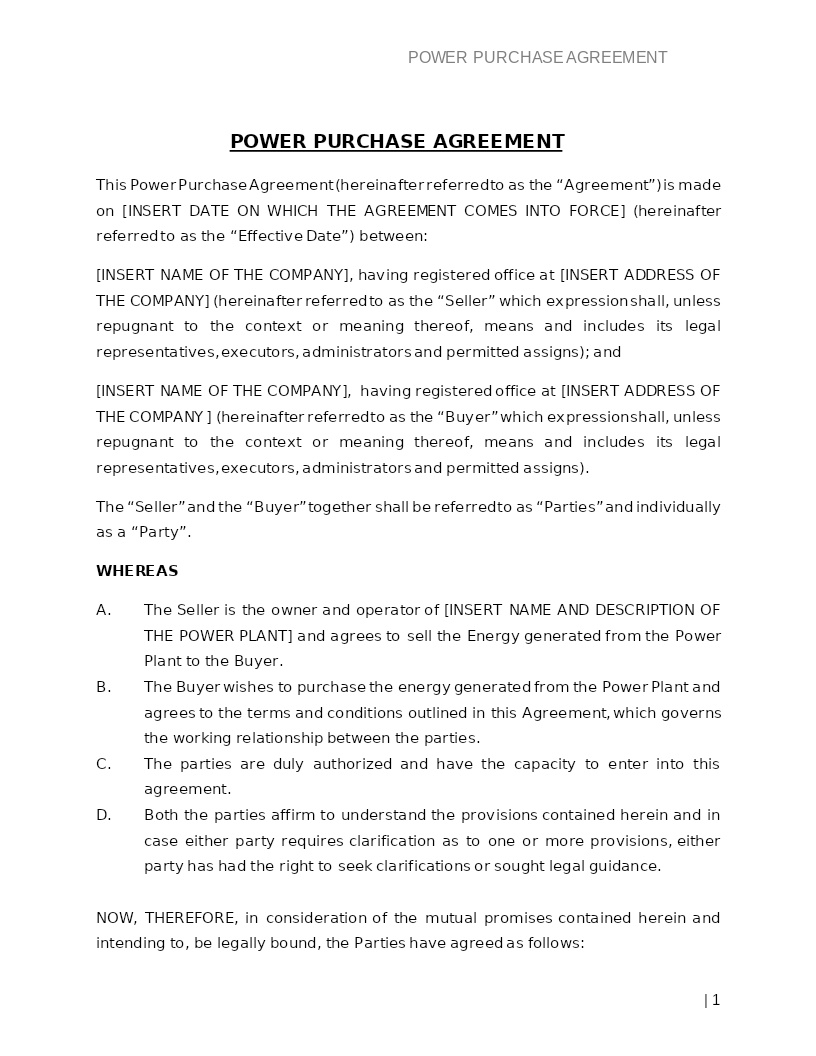
POWER PURCHASE AGREEMENT
How does it work?
1. Choose this template
Start by clicking on "Fill out the template"
2. Complete the document
Answer a few questions and your document is created automatically.
3. Save - Print
Your document is ready! You will receive it in Word and PDF formats. You will be able to modify it.
Understanding Power Purchase Agreements
A Power Purchase Agreement (PPA) is a legally binding contract between an electricity generator, such as a solar, wind, hydro, or utility scale energy developer and a buyer, typically a commercial entity, utility company, industrial facility, or governmental institution. A PPA outlines how much power will be supplied, the price per kilowatt-hour, how the electricity will be delivered, and the responsibilities of both parties.
In the United States, PPAs operate under state contract law, federal energy regulations, the Federal Energy Regulatory Commission (FERC), state utility commission rules, renewable energy standards, interconnection requirements, and environmental compliance obligations. A PPA provides cost predictability for buyers and long-term revenue stability for energy developers, making it the most widely used structure for financing renewable energy projects.
PPAs enable businesses to access clean energy without purchasing equipment or managing operations, while supporting sustainability goals and reducing long-term electricity expenses.
Where Power Purchase Agreements Are Commonly Used
PPAs are used across a wide range of commercial, industrial, and public-sector energy applications. Common situations include:
- Corporations seeking long-term clean energy for ESG or sustainability goals
- Utility companies purchasing renewable energy to meet regulatory requirements
- Universities, hospitals, and government buildings obtaining stable energy pricing
- Large-scale data centers requiring consistent, low-cost renewable power
- Commercial businesses installing on-site rooftop solar systems
- Manufacturers with high energy loads needing predictable electricity supply
- Community solar and distributed generation projects
Any time electricity is purchased over a long term, especially when renewable energy is involved, a PPA helps define clear pricing, delivery standards, and operational expectations.
Different Types of Power Purchase Agreements You May Encounter
- On-Site (Behind-the-Meter) PPA: The power-generating system is installed directly on the customer's property. Electricity is consumed on-site, often at lower-than-utility rates.
- Off-Site or Utility-Scale PPA: The customer purchases power from a remote solar or wind farm. Electricity is delivered through the grid under state and utility regulations.
- Virtual or Financial PPA (VPPA): A contract-for-differences where the buyer receives Renewable Energy Certificates (RECs) and locks in a fixed power price, without receiving physical electricity.
- Utility PPA: An agreement where a regulated utility purchases power from an independent producer to serve its customers or meet renewable portfolio standards.
When Legal Guidance Becomes Helpful
PPAs involve long-term commitments and technical, regulatory, and financial considerations. Legal guidance becomes valuable when:
- Multiple parties, investors, or lenders are involved in project financing
- The agreement includes performance guarantees, minimum energy output, or curtailment rights
- The project requires FERC approval, state utility commission filings, or interconnection permits
- Price structures involve escalators, market index adjustments, or REC transfers
- There are environmental regulations affecting the project site or generation method
- The buyer needs clear rights regarding outages, delivery failures, or maintenance obligations
Because PPAs combine elements of energy law, contract law, and renewable compliance, legal review helps ensure the agreement aligns with federal and state regulations while protecting both parties.
How to Work with This Template
- Identify the seller (energy generator) and buyer (energy customer)
- Describe the project location, technology type, and electricity generation capacity
- Define pricing terms, payment methods, billing cycles, and any price escalators
- Outline delivery conditions, metering systems, and interconnection requirements
- Include operational responsibilities, maintenance procedures, and performance guarantees
- Select the governing state law and applicable federal energy regulations
- Establish the term length, renewal options, and termination conditions
- Define insurance coverage, liability standards, and force majeure clauses
- Sign electronically or in hard copy following U.S. ESIGN Act standards
This template is fully compatible with major U.S. e-signature platforms and follows widely accepted commercial energy contracting practices.
Frequently Asked Questions
Q1. What is a Power Purchase Agreement (PPA) and how does it work?
A Power Purchase Agreement is a long-term contract where a buyer agrees to purchase electricity from a power producer at a predetermined rate. It outlines pricing, delivery, metering, and performance obligations. PPAs are widely used in the U.S. to secure stable energy costs and to support renewable energy development such as solar or wind projects.
Q2. Are PPAs common for solar and wind energy projects?
Yes. PPAs are the primary financing tool for renewable energy development in the United States. Solar and wind developers rely on PPAs to secure long-term revenue, while buyers use them to lock in clean energy pricing, meet sustainability goals, and reduce exposure to utility rate increases.
Q3. Can businesses save money through a PPA?
Often, yes. PPAs offer fixed or stable electricity pricing that can be significantly lower than standard utility rates. Businesses also avoid upfront installation or maintenance costs, making PPAs a cost-effective way to access renewable energy and reduce long-term operating expenses.
Q4. How long does a typical PPA last in the U.S.?
Most PPAs run for 10 to 25 years, depending on the project size, financing requirements, and technology used. Longer terms help stabilize pricing for the buyer and ensure reliable revenue for the energy producer.
Q5. Are electronic signatures valid and enforceable on PPAs?
Yes. Under the U.S. ESIGN Act and the Uniform Electronic Transactions Act (UETA), both electronic signatures and digital records are legally enforceable, making PPAs easy to execute through platforms like Docu Sign or Adobe Sign.
Q6. Do PPAs include Renewable Energy Certificates (RECs)?
Many PPAs include RECs, which allow businesses to claim the environmental benefits of renewable energy. The agreement specifies whether RECs transfer to the buyer and how they are tracked, helping companies achieve carbon-neutral or sustainability certifications.
Q7. What happens if the power plant produces less electricity than expected?
The PPA typically includes performance guarantees and outlines remedies if the system underperforms. These remedies may include liquidated damages, adjustments to billing, or contractual rights allowing the buyer to address energy shortfalls.
Q8. Can a PPA be terminated early?
Yes, but early termination usually requires meeting specific conditions such as paying a buyout fee, addressing regulatory changes, or proving performance failures. Most PPAs include detailed termination, default, and step-in rights to protect both parties.
Q9. Are PPAs regulated in the United States?
Yes. PPAs may fall under state public utility commission rules, FERC regulations, environmental compliance laws, and local permitting requirements. The regulatory framework ensures safe, lawful power generation and grid interconnection.
Q10. Are PPAs suitable for small and mid-sized businesses?
Absolutely. Many small and medium-sized businesses use on-site rooftop solar PPAs to lower their electricity bills without investing in equipment. PPAs help businesses access affordable renewable energy with zero upfront capital.