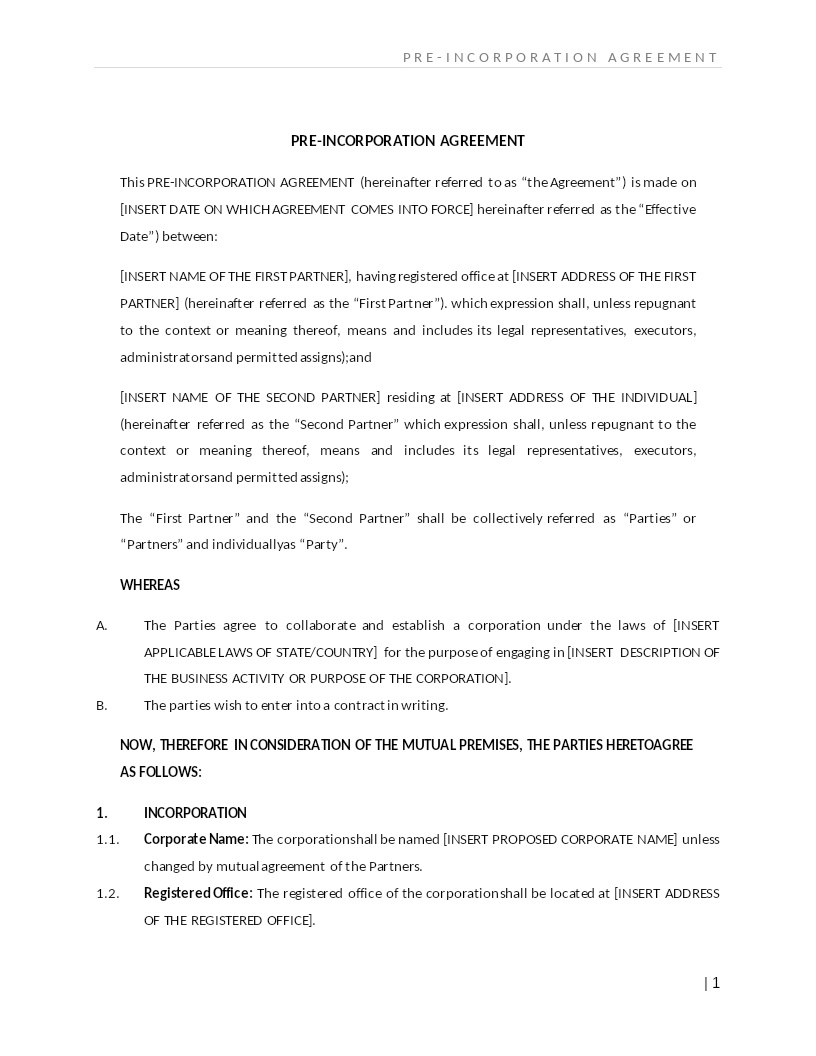
PRE-INCORPORATION AGREEMENT
How does it work?
1. Choose this template
Start by clicking on "Fill out the template"
2. Complete the document
Answer a few questions and your document is created automatically.
3. Save - Print
Your document is ready! You will receive it in Word and PDF formats. You will be able to modify it.
Understanding Pre-Incorporation Agreements
When entrepreneurs, founders, or early collaborators start planning a new company, many important commitments such as contributions, ownership splits, decision making, and responsibilities occur before the business is formally incorporated. A Pre-Incorporation Agreement creates a structured, legally recognized framework for these early arrangements.
It outlines each founder’s duties, financial contributions, equity expectations, intellectual property ownership, confidentiality terms, and steps to be taken once the company is officially formed. Establishing this agreement helps prevent misunderstandings, supports smoother incorporation, and ensures that early promises become binding obligations recognized under U.S. contract law.
Where Pre-Incorporation Agreements Are Commonly Used
Pre-Incorporation Agreements are widely used whenever individuals collaborate to launch a business, including:
• Startup planning and early-stage founder collaboration
• Technology ventures and software development projects
• Real estate investment or development groups
• Professional practices preparing to form an LLC, corporation, or partnership
• Joint ventures in the conceptual or negotiation phase
• Businesses seeking seed investment before incorporation
• Projects requiring shared resources, early expenses, or IP creation
Any time partners intend to form a company but need clarity and legal certainty beforehand, a Pre-Incorporation Agreement provides the necessary structure.
Different Types of Pre-Incorporation Agreements You May Encounter
- Founder Collaboration Agreements: Outline the roles, expectations, and contributions of individuals preparing to form a business.
- Share or Equity Contribution Agreements: Define how ownership interests will be allocated once the company is formed.
- Promoter Agreements: Used when promoters take actions on behalf of a company prior to its legal formation.
- Pre-Organization Subscription Agreements: Specify the initial shares or ownership units to be issued after incorporation.
When Legal Guidance Becomes Helpful
Although many early-stage founders use simple pre-incorporation contracts, legal advice can be helpful when:
• Intellectual property, product designs, or proprietary data are being created early
• Significant financial contributions or investments are involved
• The agreement anticipates issuing equity or ownership units
• Founders are located in different U.S. states with varying contract laws
• The business model carries regulatory considerations (e.g., fintech, healthcare)
• Early commitments involve compensation, vesting schedules, or founder exits
• Third-party promoters or contractors are acting on behalf of the future entity
How to Work with This Template
• Identify all individuals or entities participating in forming the company
• Clearly outline roles, responsibilities, and financial contributions
• Define ownership, equity expectations, or vesting terms
• Address intellectual property ownership and assignments
• Select the U.S. state law that will govern the agreement
• Document what steps must be taken once incorporation begins
• Sign electronically or in hard copy—both are valid under U.S. contract laws
Frequently Asked Questions
Q1. What is a Pre-Incorporation Agreement and why is it important?
A Pre-Incorporation Agreement outlines the commitments, roles, and expectations of founders before the company legally exists. It is important because it prevents disputes, clarifies contributions, and ensures early promises become enforceable once the business is formed.
Q2. Is a Pre-Incorporation Agreement legally enforceable in the U.S.?
Yes. U.S. courts generally enforce pre-incorporation contracts as long as they meet standard contract elements offer, acceptance, consideration and clearly describe responsibilities. Once incorporated, the company may adopt or ratify the agreement.
Q3. What topics should a Pre-Incorporation Agreement cover?
These agreements often cover founder roles, ownership splits, initial capital contributions, intellectual property ownership, confidentiality, vesting schedules, and how the business will be structured upon incorporation.
Q4. Does a Pre-Incorporation Agreement transfer intellectual property to the future company?
It can. Many agreements require founders to assign all IP created during the pre-formation stage to the company once incorporated. This protects the business’s ownership of its technology, brand, or creative assets.
Q5. Can founders change the terms later after the company forms?
Yes, founders may amend or replace the Pre-Incorporation Agreement once the company is formed, but only with mutual consent. Many startups adopt new Founder Agreements or Bylaws after incorporation.
Q6. Is this agreement required to start a new business?
Not legally, but it is strongly recommended. Without a pre-incorporation contract, misunderstandings may arise regarding who owns what, who is responsible for early expenses, or who contributed what to the business.
Q7. What happens to pre-incorporation obligations once the company is formed?
The corporation or LLC can formally adopt, ratify, or renegotiate the agreement. Once adopted, the obligations become binding on the entity and its members or shareholders.
Q8. Do investors ask to see Pre-Incorporation Agreements?
Yes. Early-stage investors often request these agreements to verify ownership structure, IP rights, and founder commitments before providing funding.
Q9. Are electronic signatures valid for Pre-Incorporation Agreements?
Absolutely. Under the U.S. ESIGN Act and state e-signature laws, electronic signatures carry the same legal effect as handwritten signatures.
Q10. Can this agreement help resolve disputes among founders later?
Yes. A clear written agreement serves as evidence of original intentions, making it easier to resolve disputes about equity, responsibilities, or contributions during future business operations.