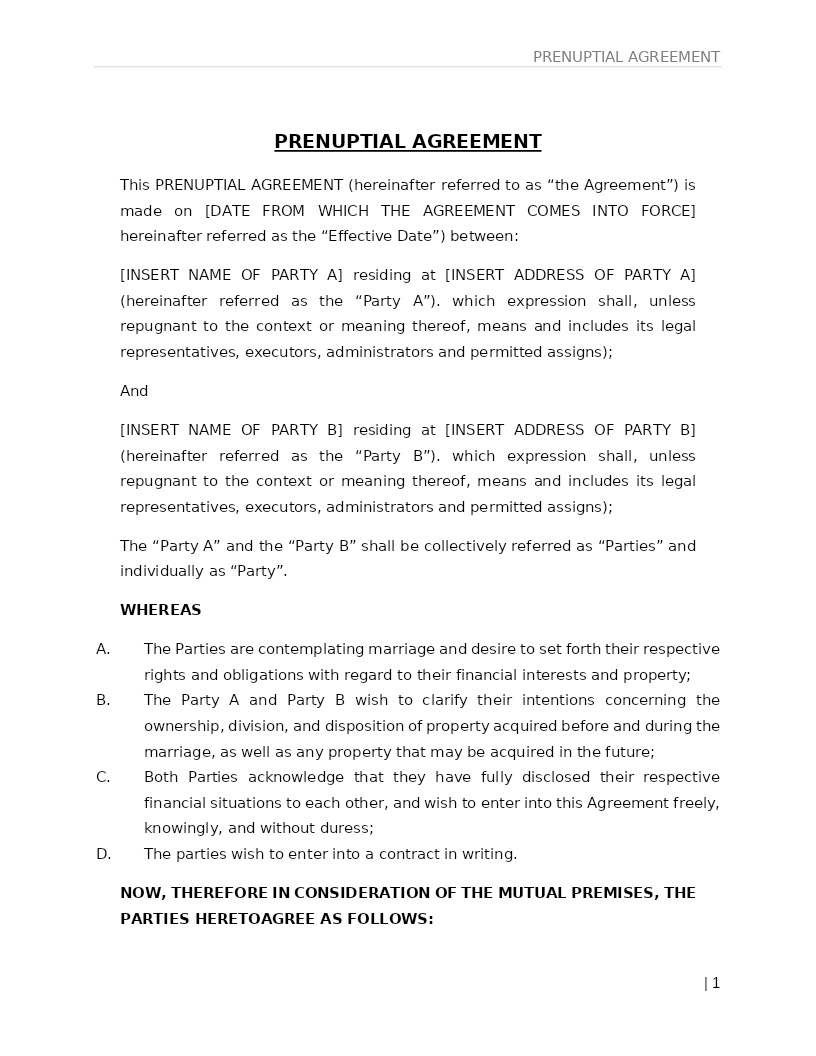
PRENUPTIAL AGREEMENT
How does it work?
1. Choose this template
Start by clicking on "Fill out the template"
2. Complete the document
Answer a few questions and your document is created automatically.
3. Save - Print
Your document is ready! You will receive it in Word and PDF formats. You will be able to modify it.
Protecting Financial Clarity Before Marriage
A Prenuptial Agreement (“prenup”) is a private contract signed by two individuals before marriage, establishing how their assets, debts, financial rights, and obligations will be managed during the marriage and in the event of divorce, separation, or death. A prenup creates a framework for financial transparency, predictable outcomes, and long-term protection.
A well-drafted prenup encourages open and honest communication, helping couples avoid future misunderstandings and ensuring both partners enter the marriage with confidence and clarity.
Where Prenuptial Agreements Are Commonly Used
Prenups are increasingly standard in a wide range of personal and financial situations, including:
- Marriages where one or both partners own significant individual assets, such as property, investments, or businesses
- Situations involving family-owned companies, professional practices, or partnerships
- Cases where one partner has substantial debts, such as student loans, business liabilities, or credit obligations
- Marriages involving children from previous relationships who require defined inheritance or protection
- Couples with high future-earning potential, including entrepreneurs, physicians, entertainers, and executives
- Scenarios involving expected inheritances, trust funds, or generational wealth
- Cross-border marriages where different legal systems might apply
Any time personal or family financial interests are intertwined, a prenuptial agreement sets clear expectations and boundaries just as an NDA does for business disclosures.
Different Types of Prenuptial Agreements You May Encounter
- Traditional Prenuptial Agreement: A comprehensive contract covering asset division, spousal support, debt allocation, and estate rights.
- Business-Focused Prenup: Used when one or both partners own a business. Protects ownership shares, income streams, and valuation in case of divorce.
- Debt-Protection Prenup: Tailored for couples where one party brings substantial personal or business debt.
- Blended Family Prenup: Designed to protect children from previous marriages and preserve intended inheritance rights.
- High-Net-Worth Prenup: Addresses complex financial portfolios, multi-state assets, trusts, investments, or corporate holdings.
- Cross-Jurisdiction Prenup: Customized for partners from different states or countries to resolve conflict-of-law issues and specify governing jurisdiction.
When Legal Guidance Becomes Helpful
While some prenups are straightforward, legal advice becomes essential when:
- One or both partners own a business, professional practice, or intellectual property
- Assets exist in multiple states or countries
- There are children from prior relationships
- One partner has significant debts
- There are trusts, inheritances, or estate-planning concerns
- Either party expects future income increases, stock options, or equity grants
- The agreement needs tax clarity or must coordinate with existing estate plans
- There is a notable difference in earning capacity or financial background
- One party wants strong protection for business valuation or future growth
Legal review isn’t legally required in every U.S. state, but having independent counsel helps ensure the prenup is enforceable, fair, and compliant with state-specific laws, which vary widely.
How to Work with This Template
- Identify the personal and financial details of each party
- Define what assets and debts are considered separate vs. marital
- Clarify expectations for spousal support, if any
- Outline how assets will be divided in scenarios such as divorce or death
- Choose the governing state law
- Decide whether future income, appreciation, or inheritances will be separate or shared
- Review the terms together (legal review recommended for enforceability)
- Sign the agreement before the marriage ceremony, with proper disclosures
The template follows widely recognized U.S. contract standards and is compatible with both electronic and hard-copy signatures.
Frequently Asked Questions
Q1. What makes a prenuptial agreement legally enforceable in the U.S.?
A prenup becomes legally enforceable when it is entered into voluntarily, contains full financial disclosure from both partners, and is fair at the time of signing. Courts also look at whether each partner had the opportunity to consult a lawyer and whether the agreement was signed without pressure. If a prenup follows state laws and reflects genuine informed consent, it is generally upheld. Signing the document well before the wedding further strengthens its enforceability.
Q2. Why is full financial disclosure required in a prenup?
Full disclosure ensures that both partners understand the true financial landscape before they waive any rights or enter into binding terms. If a partner hides major assets or debts, the court may view the agreement as unfair or deceptive and refuse to enforce it. Transparency eliminates mistrust and helps ensure that both parties make informed, confident decisions. It also shows the court that the agreement was negotiated honestly and responsibly.
Q3. Can a prenup cover future earnings or property acquired after marriage?
Yes, couples can decide in advance how future income, investments, businesses, bonuses, or real estate will be classified and divided. This is especially helpful for individuals whose careers or businesses are expected to grow significantly after marriage. By defining these terms beforehand, couples avoid disputes later if one partner becomes substantially wealthier. It also ensures both partners understand how future financial changes will affect the marriage.
Q4. Can a prenuptial agreement protect my business?
A prenup can safeguard a business by keeping ownership, profits, and decision-making rights separate from marital assets. This prevents a spouse from gaining control or an ownership interest in the business if the marriage ends. It also helps avoid disruptive legal battles that could affect business operations or partnerships. Many entrepreneurs use prenups to protect not only themselves but also their employees, investors, and co-founders.
Q5. Does a prenup override state marital property laws?
A valid prenup can override most default state laws governing property division and spousal rights. Instead of relying on state rules, couples can decide their own terms for how assets and financial responsibilities will be handled. Courts generally uphold these customized arrangements as long as they are fair and not unconscionable. This gives couples greater control over their financial futures rather than leaving those decisions to statutory formulas.
Q6. Can we include spousal support or alimony terms in a prenup?
Yes, couples can outline how spousal support will be handled, including whether it will be waived, limited, or guaranteed. However, courts may reject alimony clauses that create extreme hardship for one partner or appear grossly unfair at the time of enforcement. The goal is to balance predictability with fairness. When drafted carefully and in compliance with state rules, spousal-support provisions are typically enforceable.
Q7. Is a prenup useful even if we don’t have many assets right now?
A prenup is beneficial even for couples just starting because it addresses how future income, savings, and property will be managed and shared. It helps prevent arguments later by clarifying expectations about debt, financial roles, and long-term responsibilities. Many couples use prenups to prepare for future growth or career changes. It is simply a planning tool, not a reflection of wealth.
Q8. Can a prenup be updated after marriage?
Yes. If circumstances change, couples can sign a postnuptial agreement that revises or replaces their existing prenup. This allows them to adjust for new assets, children, career changes, or financial shifts. Postnups must meet the same legal standards of fairness, disclosure, and voluntariness as prenups. Updating the agreement keeps it aligned with the couple’s evolving needs.