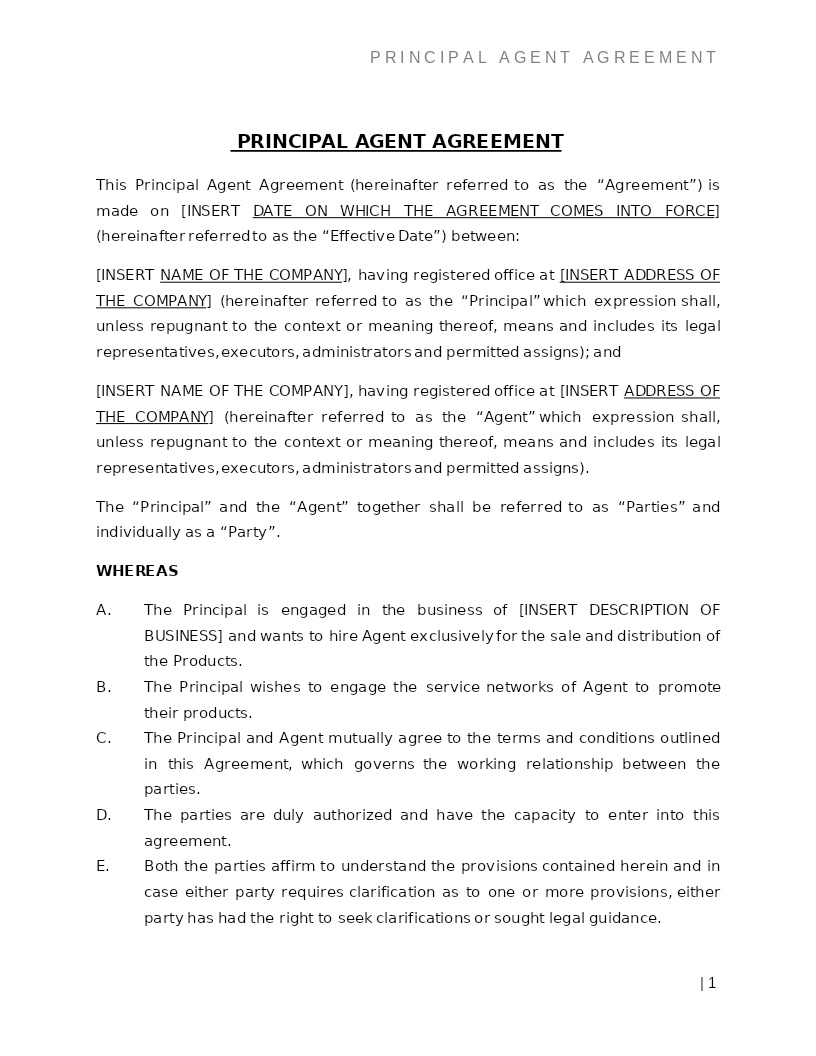
PRINCIPAL AGENT AGREEMENT
How does it work?
1. Choose this template
Start by clicking on "Fill out the template"
2. Complete the document
Answer a few questions and your document is created automatically.
3. Save - Print
Your document is ready! You will receive it in Word and PDF formats. You will be able to modify it.
Creates a foundation of trust between Principal and agent
A principal-agent agreement is a legally binding contract that establishes the relationship in which one party (the agent) is authorized to act on behalf of, represent, or perform designated tasks for another party (the principal). This agreement defines the scope of authority granted to the Agent, delineates the rights and obligations of both parties, and sets forth the conditions under which the Agent may make decisions, enter into transactions, or otherwise conduct activities for the benefit of the Principal.
This contractual framework ensures clarity regarding the extent and limitations of the agent’s authority, the fiduciary duties owed to the principal, the obligations relating to reporting and accountability, and the restrictions on the agent’s conduct. It serves as the structural safeguard that allows the principal to delegate authority while maintaining oversight, trust, and legal protection.
Principal-agent agreements are widely used across commercial, financial, real estate, employment, procurement, and representation-related transactions. By establishing clear expectations and defining permissible actions, the agreement enables both parties to collaborate effectively without concerns about unauthorized acts, conflicts of interest, or misuse of delegated authority.
Where Principal–Agent Agreements Are Commonly Used
Such agreements are standard in a range of commercial and organizational scenarios, including:
- Appointment of sales or marketing agents
- Real estate brokerage and property representation
- Procurement, sourcing, or vendor negotiation activities
- Contract negotiation and execution on behalf of a business
- Representation before government bodies or regulatory authorities
- Logistics and supply-chain coordination
- Collection of payments, fund management, or client billing
- Franchise representation and territorial agency appointments
- International representation or cross-border commercial dealings
Any time authority is delegated outside the principal’s direct operational environment, a principal-agent agreement sets transparent limits on what the agent may and may not do.
Different Types of Principal–Agent Agreements
1. General Agency Agreement: Grants broad authority to perform a wide range of actions on behalf of the principal.
2. Special or Limited Agency Agreement: Authorizes the agent to perform only a specific act or limited set of transactions.
3. Exclusive Agency Agreement: Provides one designated agent with exclusive authority within a defined territory or scope.
4. Non-Exclusive Agency Agreement: Allows multiple agents to represent the principal concurrently under predefined conditions.
5. Commission-Based Agency Agreement: Used where compensation is tied to sales, contracts secured, or transactions completed.
When Legal Guidance Becomes Helpful
While straightforward agency relationships can be formed without extensive legal oversight, professional legal advice can be critical when:
- The Agent is empowered to enter into binding contracts
- Substantial financial authority or fund handling is involved
- Multiple jurisdictions or international laws apply
- Regulatory approvals or licensing requirements are implicated
- The relationship involves trade secrets, confidential information, or commercially sensitive materials
- Complex commission structures, indemnities, or liability allocations are necessary
- The Principal must minimize risk from unauthorized acts or omissions
Legal review strengthens enforceability and ensures that the delegation of authority is properly aligned with transactional, regulatory, and risk management needs.
How to Work With This Template
- Identify the parties and clearly state the agency relationship
- Define the scope and limit of authority granted to the agent.
- Outline fiduciary duties, reporting obligations, and standards of conduct
- Specify compensation, commissions, reimbursements, and expense treatment
- Select the governing state law and dispute resolution mechanisms
- Establish termination rights, notice periods, and post-termination obligations
- Review the terms jointly (legal review recommended)
- Sign electronically or in hard copy
This framework follows standard commercial practices and is compatible with widely recognized contract norms.
Frequently Asked Questions
Q1. Is a principal–agent agreement necessary even for informal representation?
Yes. Authority is often exercised earlier than anticipated, and a written agreement reduces the risk of unauthorized commitments or misunderstandings.
Q2. Can the same agreement be reused for new agents?
Yes, provided it is revised to reflect the new agent’s identity, scope of authority, and compensation arrangements.
Q3. What if the agent exceeds the authority granted?
Such acts are unauthorized. The principal may refuse to be bound and may pursue remedies for breach, misrepresentation, or negligence.
Q4. Are electronic signatures enforceable?
Yes. Federal and state laws recognize electronically executed agency agreements as valid and binding.
Q5. Does this agreement create fiduciary obligations?
Yes. Agents must act in the principal’s best interests, maintain loyalty, disclose relevant information, and avoid conflicts of interest.
Q6. Can this agreement authorize financial decision-making?
Yes, but such authority must be explicitly defined and may require compliance with jurisdiction-specific regulations.
Q7. Is this agreement suitable for individuals and companies?
Yes. Either party may be an individual, corporation, partnership, or other legal entity.
Q8. What happens if the agent breaches the agreement?
The principal may terminate the relationship, demand an accounting, seek damages, or pursue remedies under the dispute clause.
Q9. Does it apply to verbal instructions given by the principal?
Only if the agreement permits oral directions. Written instructions remain best practice.
Q10. Can the agent appoint sub-agents?
They are not allowed unless expressly permitted. Agency authority is generally personal and non-transferable.
Q11. Do revisions require mutual consent?
Yes. No amendment is effective unless approved by both parties.
Q12. Is this agreement valid across states or internationally?
Yes. A governing law clause resolves jurisdictional issues and standardizes interpretation.
Q13. What if the principal adds new responsibilities later?
These may be included through an addendum or supplemental agreement.