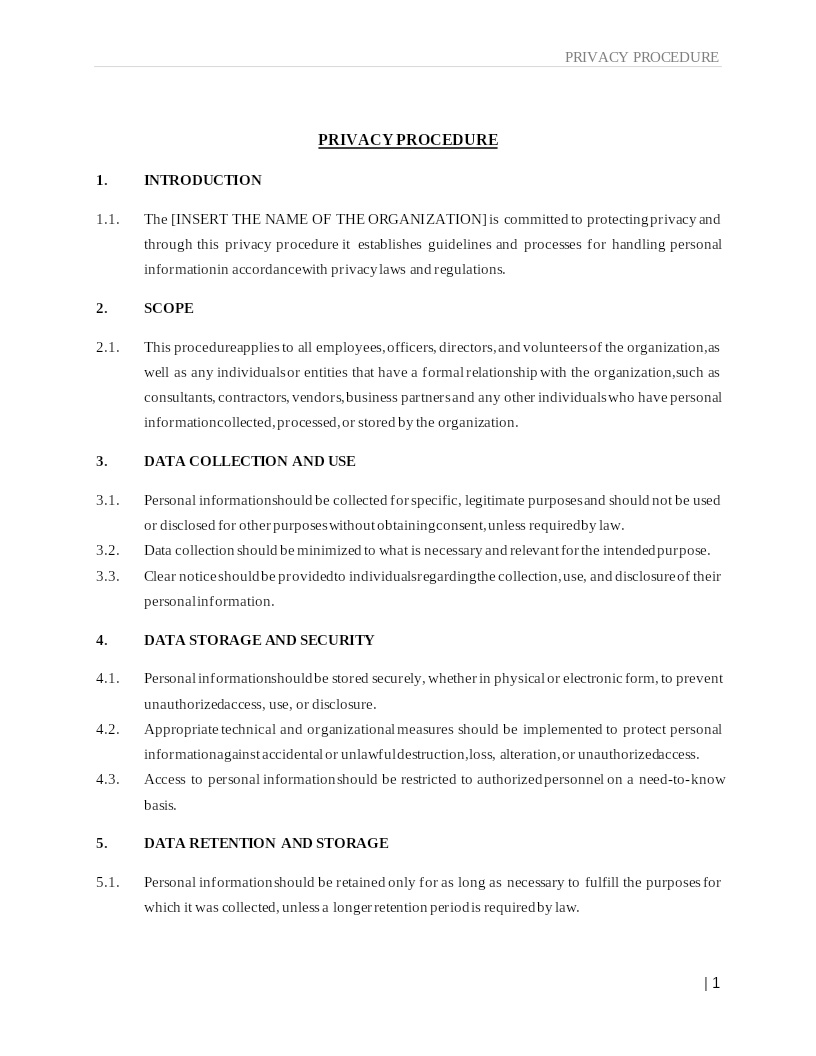
PRIVACY POLICY
How does it work?
1. Choose this template
Start by clicking on "Fill out the template"
2. Complete the document
Answer a few questions and your document is created automatically.
3. Save - Print
Your document is ready! You will receive it in Word and PDF formats. You will be able to modify it.
Protecting Personal Information and Ensuring Transparency Through a Privacy Policy
A Privacy Policy is a legally required statement that outlines how an organization collects, uses, shares, stores, and protects personal information obtained from consumers, website users, employees, or third-party stakeholders. Developed in accordance with U.S. federal and state privacy regulations, including the California Consumer Privacy Act (CCPA/CPRA), Virginia’s VCDPA, Colorado’s Privacy Act, Children’s Online Privacy Protection Act (COPPA) for minors, applicable financial-privacy rules under GLBA, and overarching principles enforced by the Federal Trade Commission (FTC), this policy provides a transparent explanation of data-handling practices. It establishes the organization’s commitment to safeguarding personal information, maintaining user trust, and complying with evolving privacy obligations. The policy also explains data-subject rights, legal bases for processing data, and the circumstances under which information may be disclosed to service providers, affiliates, regulatory authorities, or other third parties.
A comprehensive Privacy Policy identifies the categories of personal information collected such as identifiers, contact information, biometric data, financial information, usage data, location data, and technical device information and describes how and why such data is collected, whether directly from users or indirectly through cookies, tracking technologies, customer-support interactions, or automated systems. It outlines the purposes for which personal information is processed, including service delivery, security monitoring, fraud prevention, analytics, marketing, legal compliance, contractual obligations, and customer account management. The policy further provides disclosures regarding consumer rights under applicable state privacy laws, such as the right to access, correct, delete, opt out of targeted advertising or data sales, and restrict the use of sensitive personal information. It explains the organization’s commitment to implementing reasonable administrative, technical, and physical safeguards to protect data from unauthorized access, breaches, or misuse. By establishing this policy, organizations reduce legal risk, strengthen compliance with privacy regulations, promote transparency, and enhance consumer confidence.
Where Privacy Policies Are Commonly Used
Privacy Policies are required or recommended in a wide range of industries, including:
- Technology companies, SaaS platforms, mobile apps, and digital service providers
- Healthcare organizations handling protected health information (PHI)
- Financial institutions subject to GLBA and related confidentiality mandates
- Retail and e-commerce companies collecting customer data and payment information
- Hospitality and travel businesses utilizing reservation systems
- Educational institutions managing student records subject to FERPA
- Government contractors entrusted with regulated data or sensitive information
- Nonprofits collecting donor information, volunteer data, or community-service records
Any organization that collects or processes personal information benefits from a clearly documented Privacy Policy.
Different Types of Privacy Policies
1. Website and Online Privacy Policies: Explain how data is collected through websites, apps, and digital platforms.
2. Employee Privacy Notices: Describe data practices applicable to employees, contractors, or job applicants.
3. Financial Privacy Policies (GLBA): Apply to financial service providers and banks handling consumer financial records.
4. Healthcare Privacy Policies (HIPAA): Cover protected health information and patient confidentiality requirements.
5. Children’s Privacy Policies (COPPA): Apply to websites or apps directed at children under 13.
When Legal Guidance Becomes Helpful
Legal review is strongly recommended when:
- The company processes consumer data regulated by CCPA/CPRA or similar state laws
- The organization collects sensitive personal information (biometric data, health data, financial data)
- The policy includes disclosures for cross-border data transfers or cloud-service providers
- The company implements cookies, behavioral tracking, or targeted advertising
- Minors’ data is collected, which triggers special obligations under COPPA
- The organization faces cybersecurity or data-breach risks requiring compliance with state breach-notification statutes
- Vendor agreements involve data-processing, confidentiality, or security obligations
- FTC enforcement guidance impacts marketing, email practices, or data-security representations
Legal oversight ensures the policy is accurate, complete, compliant, and enforceable.
How to Work with This Template
- Identify the categories of personal information collected and processed
- Clarify how information is collected directly, automatically, or through third parties
- Explain the purposes of data processing and the legal bases for doing so
- Provide disclosures required by applicable state privacy laws
- Detail consumer rights and mechanisms for submitting privacy requests
- Describe how personal information is stored, protected, and retained
- Outline disclosure practices involving service providers or external partners
- Include a cookie or tracking-technology notice if relevant
- Address children’s privacy requirements if minors use the site or service
- Provide instructions for responding to data-breach incidents under state law
- Require periodic review and updates of the Privacy Policy to maintain legal compliance
This template reflects best practices for U.S. privacy compliance and provides transparency to individuals interacting with your business.
Frequently Asked Questions
Q1. What is a Privacy Policy, and why is it necessary?
A Privacy Policy explains how an organization collects, uses, and protects personal information. It is necessary because U.S. state laws such as CCPA/CPRA, VCDPA, and CPA require clear disclosures and user rights, and transparency builds consumer trust.
Q2. Does U.S. law require a Privacy Policy on every website?
Most websites that collect personal information must provide a Privacy Policy. Some industries, such as finance, healthcare, and children’s services, are specifically legally required to do so.
Q3. What types of personal data does a Privacy Policy cover?
Identifiers, contact information, browsing data, location data, financial information, device data, and sensitive personal information (depending on operations).
Q4. Does the Privacy Policy cover cookies and tracking technologies?
Yes. Modern policies include disclosures about cookies, analytics, targeted advertising, and similar tracking tools.
Q5. Does U.S. law give consumers rights regarding their personal information?
Yes. State privacy laws may grant rights to access, delete, correct, restrict processing, and opt out of data sales or targeted advertising.
Q6. Are businesses required to protect user data?
Absolutely. Organizations must implement reasonable security measures and comply with state data-breach notification laws.
Q7. Does the policy apply to third-party service providers?
Yes. The policy explains how data may be shared with vendors and requires those vendors to maintain confidentiality and security standards.
Q8. What happens if a company violates its Privacy Policy?
The company may face regulatory penalties, FTC enforcement actions, litigation, or reputational damage.
Q9. How often should a Privacy Policy be updated?
At least annually, or whenever new laws, technologies, or business practices impact data-collection activities.
Q10. Should legal counsel review a Privacy Policy?
Yes. Due to the complexity of U.S. privacy law and state-level variations, legal review ensures completeness, accuracy, and compliance.