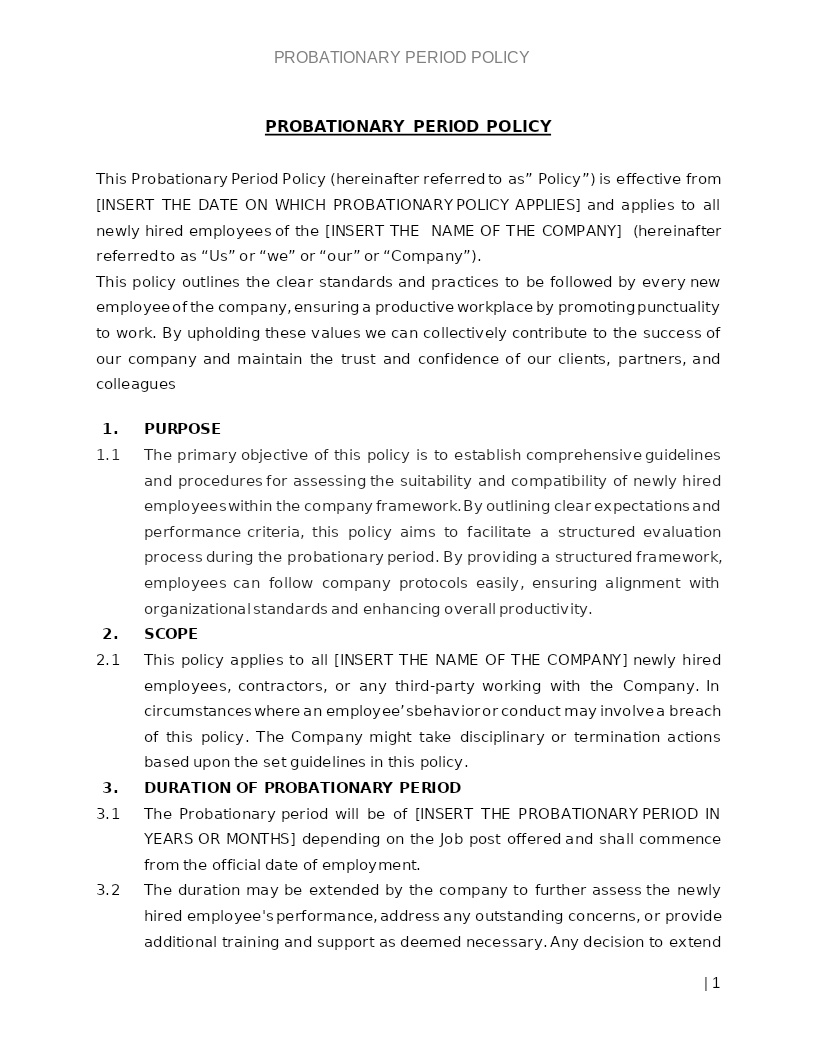
PROBATIONARY PERIOD POLICY
How does it work?
1. Choose this template
Start by clicking on "Fill out the template"
2. Complete the document
Answer a few questions and your document is created automatically.
3. Save - Print
Your document is ready! You will receive it in Word and PDF formats. You will be able to modify it.
Understanding Probationary Period Policy In U.S.
A Probationary Period Policy is an internal employment policy that establishes a defined introductory period, typically 30, 60, or 90 days, and in some industries up to 6 months, during which a new employee’s performance, behavior, and job suitability are evaluated. This policy gives both the employer and employee an opportunity to determine whether the employment relationship is the right long-term fit. In the United States, probationary periods must comply with federal labor laws, state employment requirements, and the principles of at-will employment. This policy ensures transparency, structured evaluation, and clearly communicated expectations during the employee’s initial phase with the organization.
Where a Probationary Period Policy Is Generally Used
A Probationary Period Policy is typically used in:
- Corporations onboarding new full-time or part-time employees
- Small businesses assessing new hires for role suitability
- Professional industries requiring skill verification periods
- Remote and hybrid work settings where performance must be evaluated
- Roles where safety, compliance, or client interactions demand careful review
- Organizations implementing performance-based confirmation systems
Different Types of Probationary Periods You May Encounter
- Standard Probationary Period (60–90 Days): Used by most U.S. employers to evaluate job performance, attendance, and cultural fit.
- Extended Probationary Period: Applied when additional time is needed for performance evaluation or skill improvement.
- Project-Based Probation: Used for employees hired specifically for temporary or project-driven work.
- Performance-Improvement Probation: Issued when an employee underperforms, giving them time to meet required standards.
- Conditional Employment Probation: Applied to roles requiring background checks, licensing, or certifications before confirmation.
When Legal Guidance Becomes Helpful
Compliance assistance becomes important when:
- The organization operates across multiple U.S. states
- Employees are covered by union, collective bargaining, or contract terms
- Roles require licensing or federal regulatory compliance (e.g., healthcare, finance)
- Termination decisions during probation may raise legal risk
- A probationary policy interacts with FMLA, ADA, overtime laws, or wage/hour policies
- The company wants protection from wrongful termination claims
Lawyers help ensure your policy aligns with U.S. labor regulations, reduces liability, and protects the employer while respecting employee rights.
How to Work With This Probationary Period Policy
- Clearly communicate probation terms during onboarding
- Provide employees with written expectations and job duties
- Conduct periodic evaluations and document performance
- Offer feedback, coaching, or training as needed
- Maintain compliance with at-will employment and state labor laws
- Formally confirm employment or extend/terminate probation with proper documentation
- Retain evaluation records for compliance and internal policy tracking
Frequently Asked Questions
Q1. Is a probationary period legally required in the U.S.?
No, probationary periods are not mandatory under U.S. labor laws, but they are widely used. Employers may adopt them to assess job suitability and performance before confirming long-term employment. They must still follow federal and state employment laws during the probation.
Q2. Can an employee be terminated during probation?
Yes, in most states, employment is at-will, meaning an employer may terminate a probationary employee for lawful, non-discriminatory reasons. Termination must still comply with federal laws such as Title VII, ADA, and wage/hour regulations.
Q3. Does a probationary period affect employee benefits?
Some employers offer limited or conditional benefits during probation, while others provide full benefits from day one. U.S. laws such as the Affordable Care Act may require benefits eligibility after a certain number of hours worked, regardless of probation status.
Q4. Can a probationary period be extended?
Yes, employers may extend probation when additional time is needed to evaluate performance or behavior. Extensions must be documented clearly, communicated to the employee, and applied consistently to avoid claims of unfair treatment.
Q5. Does probation override at-will employment?
No. Probationary status does not eliminate at-will employment protections. Employees may still resign at any time, and employers may terminate employment for lawful reasons. The policy simply structures the evaluation period.
Q6. What happens at the end of the probationary period?
The employer may confirm the employee as a regular hire, extend the probation, or terminate employment. Many organizations conduct a formal review to document performance and ensure compliance with internal HR standards.
Q7. Are employees entitled to unemployment benefits if terminated during probation?
Eligibility depends on state laws and the reason for termination. Some states allow probationary employees to receive unemployment benefits if they were terminated without misconduct or if they worked long enough to qualify.
Q8. Should employers document evaluations during probation?
Yes. Proper documentation protects the employer in case of disputes and ensures transparency in the evaluation process. Written reviews, feedback records, and attendance logs help demonstrate fair and consistent treatment.