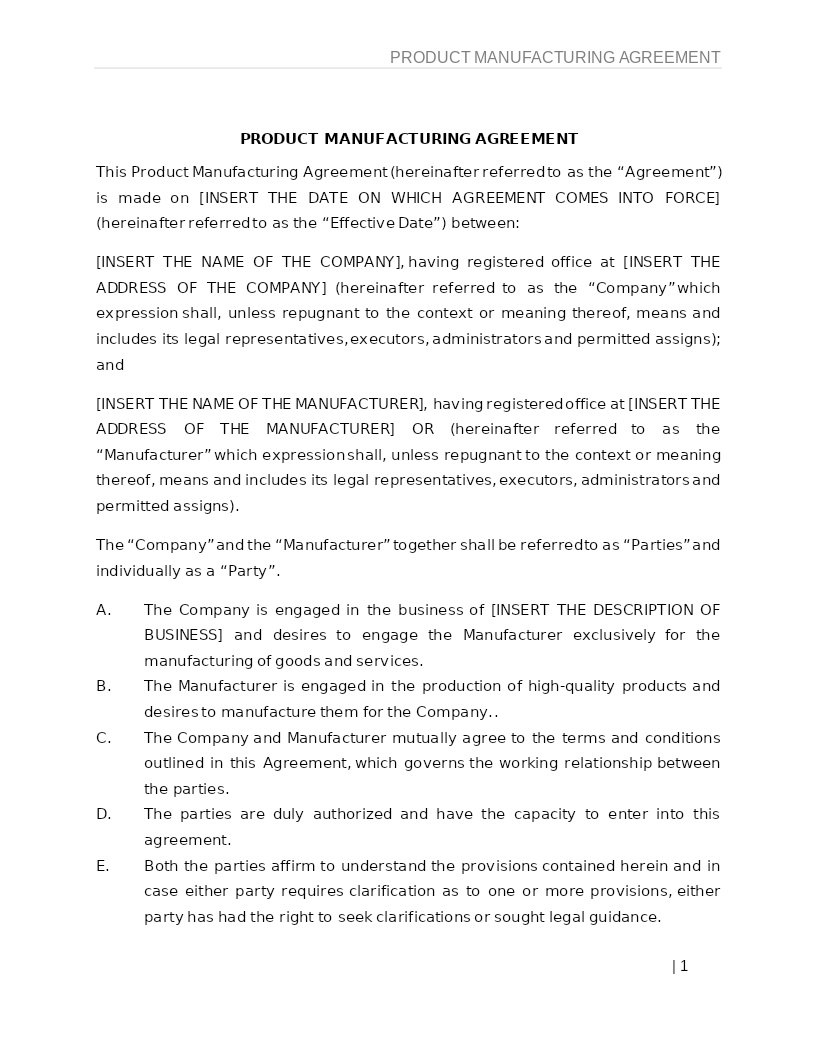
PRODUCT MANUFACTURING AGREEMENT
How does it work?
1. Choose this template
Start by clicking on "Fill out the template"
2. Complete the document
Answer a few questions and your document is created automatically.
3. Save - Print
Your document is ready! You will receive it in Word and PDF formats. You will be able to modify it.
Ensuring High-Quality, Compliant, and Reliable Production Through Product Manufacturing Agreements
When a business needs a third-party manufacturer to produce its products, a Product Manufacturing Agreement provides the legal framework that governs the entire production process. It outlines responsibilities, product specifications, quality standards, pricing, timelines, and intellectual property protections.
For U.S. businesses, especially consumer brands, private-label companies, tech hardware firms, and e-commerce sellers, this agreement ensures clarity, protects confidential information, and reduces operational risks. By establishing expectations upfront, companies can avoid supply chain disputes, quality failures, and financial losses while maintaining consistent production standards.
Where Product Manufacturing Agreements Are Commonly Used
Product Manufacturing Agreements are widely used across the United States, particularly in industries involving outsourced production. Common use cases include:
- Consumer goods and retail brands using third-party factories
- Private-label manufacturers producing items for online sellers
- Food, beverage, and cosmetic companies requiring FDA-compliant production
- Electronics, hardware, and IoT device companies outsourcing assembly
- Apparel companies partnering with domestic or overseas factories
- Health and wellness brands manufacturing supplements or beauty products
- Startups scaling production without owning manufacturing facilities
Any business relying on contract manufacturers benefits from having clear, enforceable production terms.
Different Types of Product Manufacturing Agreements You May Encounter
- Full-Service Manufacturing Agreement: The manufacturer handles sourcing, production, packaging, and delivery.
- Component Manufacturing Agreement: Used when a manufacturer produces only a part or component of a larger product.
- Private Label Manufacturing Agreement: The manufacturer produces goods that will be branded and sold under the purchaser’s label.
- OEM (Original Equipment Manufacturer) Agreement: The manufacturer produces products that the purchaser markets under its own brand.
- Contract Packaging and Assembly Agreement: Covers packaging, labeling, kitting, or assembly rather than full production.
Each type outlines responsibilities, quality standards, and rights based on the business model.
When Legal Guidance Becomes Helpful
Manufacturing arrangements involve operational, financial, and regulatory risks. Legal review is especially valuable when:
- The product involves technical specifications or safety standards
- The manufacturer is overseas or multiple jurisdictions are involved
- FDA, FTC, CPSC, or industry-specific compliance is required
- Intellectual property (designs, molds, formulas) needs strong protection
- High-value production runs or long-term supply commitments are involved
- Specialized warranties, indemnities, or product liability risks exist
- Quality assurance and inspection rights must be detailed precisely
Legal review ensures your agreement is enforceable, compliant, and aligned with your operational needs.
How to Work With This Template
- Identify both parties (brand owner/purchaser and manufacturer)
- Clearly describe the products and technical specifications
- Set quality standards, inspection rights, and defect thresholds
- Outline pricing, production timelines, and delivery terms
- Define intellectual property ownership and confidentiality obligations
- Establish warranty terms, liability limits, and indemnification
- Choose the governing U.S. state law and dispute resolution method
- Sign electronically or in hard copy, both enforceable under U.S. law
This template follows standard U.S. commercial contracting practices and supports domestic or international manufacturing partnerships.
Frequently Asked Questions
Q1. Is a Product Manufacturing Agreement necessary for working with a factory or supplier?
Yes. A written agreement protects both parties by clearly defining product requirements, quality standards, pricing, timelines, and responsibilities. It prevents misunderstandings and provides a legal foundation if issues arise during production.
Q2. What key elements should a U.S. Product Manufacturing Agreement include?
Important elements include specifications, quality control procedures, pricing, IP ownership, warranties, inspection rights, confidentiality obligations, and dispute resolution. These terms ensure consistent quality and predictable production.
Q3. Does this agreement protect my intellectual property (designs, formulas, molds)?
Yes. U.S. manufacturing agreements typically include strong IP protection clauses, preventing the manufacturer from copying, sharing, or using your proprietary designs or trade secrets for other clients.
Q4. Can this agreement be used for overseas manufacturers?
Yes. Many U.S. companies use the same structure for international production, but additional clauses, such as export compliance, international arbitration, customs requirements, and foreign jurisdiction challenges, may be required.
Q5. How does a Product Manufacturing Agreement ensure quality control?
The agreement outlines inspection rights, testing procedures, defect allowances, and remedies for non-compliant products. This ensures manufacturers maintain agreed quality standards and reduces costly production issues.
Q6. Are electronic signatures valid for manufacturing agreements in the U.S.?
Yes. Under the ESIGN Act and UETA, electronic signatures are legally enforceable and commonly used in commercial manufacturing contracts.
Q7. What happens if the manufacturer delays production or fails quality checks?
The agreement provides remedies such as penalties, rework requirements, replacement of defective goods, or termination rights. Clear dispute processes help maintain production continuity and reduce financial risk.