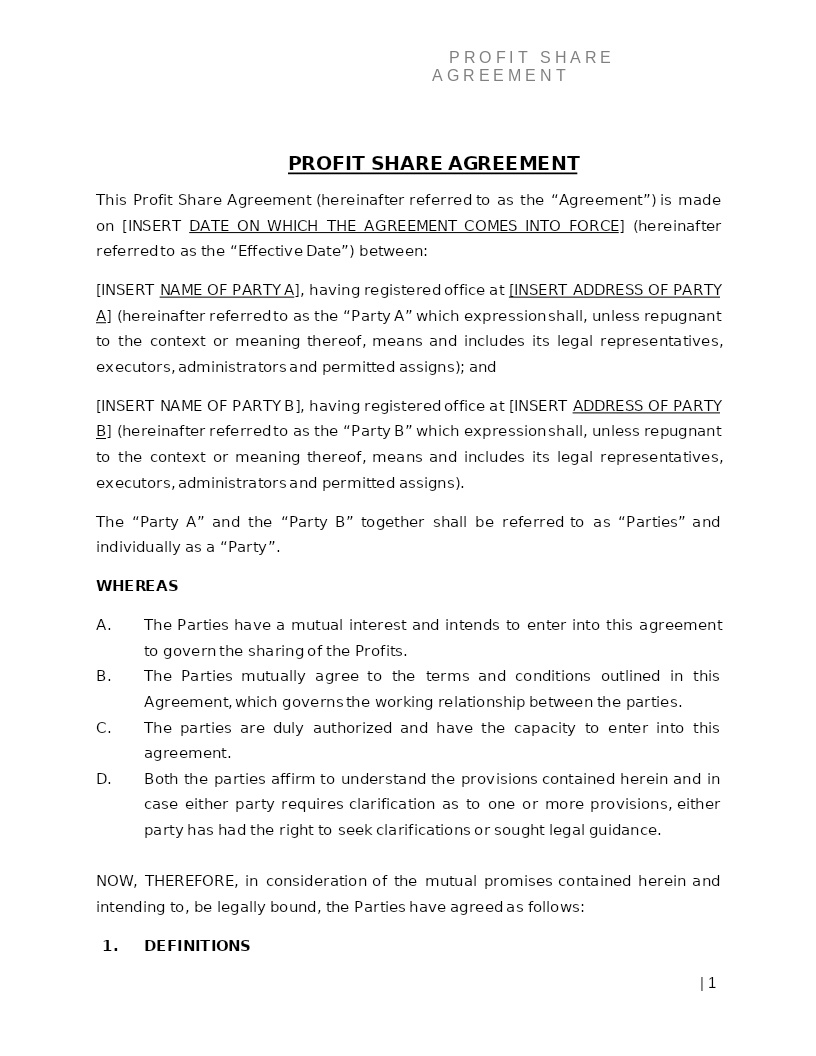
PROFIT SHARING AGREEMENT
How does it work?
1. Choose this template
Start by clicking on "Fill out the template"
2. Complete the document
Answer a few questions and your document is created automatically.
3. Save - Print
Your document is ready! You will receive it in Word and PDF formats. You will be able to modify it.
Understanding Profit-Sharing in U.S. Business Relationships
Whether you’re forming a partnership, entering into a joint venture, or compensating contributors for their role in a project, a Profit Sharing Agreement provides the clarity and structure needed to allocate profits fairly. It outlines who receives what, how profits are calculated, and when payments are made, making it an essential tool for maintaining transparency and avoiding financial disputes.
This agreement creates a foundation of trust, accountability, and aligned incentives by clearly defining the profit-distribution framework before operations begin.
Where Profit Sharing Agreements are commonly used
Profit-sharing structures are widely used across multiple U.S. commercial settings, including:
- Partnership formations and LLC operating arrangements
- Joint ventures and co-development collaborations
- Investor participation arrangements
- Employee incentive and bonus programs
- Service-based contributions tied to project success
- Revenue-generating ventures such as content monetization, franchising, or licensing arrangements
- Commission-based or performance-based collaborations
Any time multiple parties contribute resources or effort toward a business activity, a Profit Sharing Agreement ensures everyone knows how profits will flow.
Why Businesses in the USA need a Profit Sharing Agreement
- Ensures Fair and Transparent Distribution of Profits: The agreement clearly defines how profits will be shared among partners, investors or employees, preventing misunderstanding and disputes. It promotes trust by making profit allocation predictable and consistent with the parties’ contributions and expectations.
- Encourages Motivation and Collaboration: Profit sharing is an effective tool to incentivize partners, investors, and employees. By tying rewards to performance, it encourages long-term involvement and fosters a sense of ownership in the business.
- Reduces Legal and Financial Disputes: A written profit-sharing structure minimizes the risk of litigation by setting clear rules for profit distribution, expense deductions, accounting methods, and rights of each party. Protects all parties by setting clear terms for revenue sharing. It also offers legal protection in case any disagreement arises.
- Supports Business Growth and Investor Confidence: Investors and strategic partners often prefer businesses that have well-defined financial arrangements. A structured profit-sharing plan showcases professionalism, stability, and long-term vision.
When Legal Guidance Becomes Helpful
Profit sharing arrangements are highly situation-specific. U.S. businesses require customized agreements to address unique operational, legal, and financial variables. Consulting with professional lawyers ensures:
Tailoring Rights, Liabilities and Scope of Work:
- Legal experts help define each party’s duties, contributions, limitations, and obligations. They ensure protection against scope creep, breaches of obligations, and potential financial exposure.
Alignment with Business Model and Industry Practices:
- U.S. businesses across industries—tech, finance, manufacturing, healthcare, consulting—have distinct needs. Lawyers customize clauses to reflect your operational realities, compliance needs, and industry-specific risks.
Full Compliance with U.S State and Federal Laws: Profit sharing can trigger requirements under:
- Business and Partnership laws
- Employment Laws (if tied to employees)
- Securities Regulations (if investors share profits)
- Federal and state tax rules
Lawyers ensure that the agreement complies with the relevant jurisdiction and does not unintentionally violate employment or securities regulations.
Identification of Complex Risks and Unnoticed Liabilities
Legal professionals address issues such as:
- ambiguous profit calculation
- improper revenue recognition
- misused of shared resources
- tax risk
- cross-border complications
- potential disputes
They draft provisions that protect you in scenarios that typically overlook.
Customizing Intellectual Property (IP) Rights
- In modern U.S. businesses, IP often drives income. Lawyers ensure IP ownership, licensing rights, and usage restrictions are clear—especially in joint ventures, software development, content creation, and consulting engagements.
Effective Negotiation and Real-Time Adjustments
- Business negotiations evolve quickly. Lawyers adapt terms instantly, clarify contentious points, and advocate for your interests during discussions with other parties.
Tailored Payment and Distribution Mechanisms
Legal Experts can structure profit distribution based on:
- milestones
- net profit thresholds
- revenue-to-expenses ratio
- timelines
- industry-standards models
This ensures fairness and prevents cash-flow issues or late payment disputes.
Multi-Jurisdictional and Cross-Border Considerations:
- For U.S. businesses dealing with foreign partners or operating in multiple states, legal counsel ensures compliance with conflicting laws on taxation, data sharing, governing law, and dispute resolution.
Enhanced Dispute Resolution and Enforcement
- Lawyers design clear dispute resolution mechanisms—mediation, arbitration, or litigation—and draft enforceable clauses tailored to the selected U.S. jurisdiction.
Practical, Experience-Based Protections:
Experienced attorneys incorporate real-world insights into risk management, drafting clauses to cover:
- delays
- non-performance
- profit manipulation
- insolvency
- force majeure events
These provisions ensure your agreement is not just legally sound but practically effective.
How to work with this Template:
- Identify all parties who will share profits and list their details.
- Define the purpose of profit-sharing arrangement or project
- Choose the profit calculation method
- Set each party's profit percentage and how distributions will be made
- Decide the payment schedule- monthly, quarterly or annually.
- Outline each party's contributions and responsibilities to avoid disputes
- Select the governing state law that will apply to the agreement
- Review, Customize and sign the agreement electronically or on paper.
Frequently Asked Questions
Q1. What is a Profit Sharing Agreement and why is it important for U.S. businesses?
A Profit Sharing Agreement is a legally binding contract that outlines how profits will be distributed among partners, investors, employees, or collaborators. For U.S. businesses, it ensures transparency, fair allocation of earnings, and clear expectations from the beginning. This prevents disputes, strengthens financial planning, and helps maintain long-term trust between all parties involved.
Q2. How are profits typically calculated in a Profit Sharing Agreement?
Profit calculations are usually based on net profit, meaning total revenue minus approved expenses, taxes, and operational costs. However, the method can be customized depending on the business model. Clearly defining the profit formula is crucial to avoid misunderstandings and ensure consistent, accurate financial distribution.
Q3. Who should use a Profit Sharing Agreement in the United States?
This agreement is useful for LLCs, partnerships, joint ventures, startup investors, contractors, and even employees participating in incentive programs. Any situation where two or more parties contribute to generating revenue can benefit from a structured profit-sharing arrangement to maintain fairness and legal protection.
Q4. Do Profit Sharing Agreements need to be reviewed by a lawyer?
While not legally mandatory, legal review is highly recommended in the U.S. A lawyer ensures the agreement complies with state laws, clearly outlines the rights and liabilities of each party, and covers risks related to taxes, financial disputes, and contributions. Legal advice helps prevent future conflicts and supports enforceability.
Q5. Are profit-sharing payments taxable in the United States?
Yes. Profit-sharing distributions are generally considered taxable income. Depending on the business structure, parties may receive tax forms such as Schedule K-1 (for LLCs and partnerships) or 1099 forms (for contractors). Understanding tax obligations is essential to avoid penalties and ensure proper reporting to the IRS.
Q6. Can Profit Sharing Agreements be modified after signing?
Yes. Profit-sharing arrangements can be updated through a written amendment that all parties agree to and sign. This flexibility is helpful when business conditions change, new partners join, or the original structure needs adjustment to reflect updated roles, contributions, or financial realities.
Q7. What happens if the business earns no profit or faces a loss?
In most U.S. agreements, no profit means no distribution. However, the contract can specify alternative arrangements, such as minimum guaranteed payments or carry-forward profit sharing in future cycles. Clear terms help avoid disputes and ensure all parties understand what to expect during low-revenue periods.
Q8. Is a Profit Sharing Agreement valid if parties live in different U.S. states?
Yes. Profit Sharing Agreements remain valid across state lines as long as the contract includes a governing law clause specifying which state’s laws will apply. Electronic signatures are also legally enforceable, making it easy for parties in different locations to enter into the agreement smoothly.