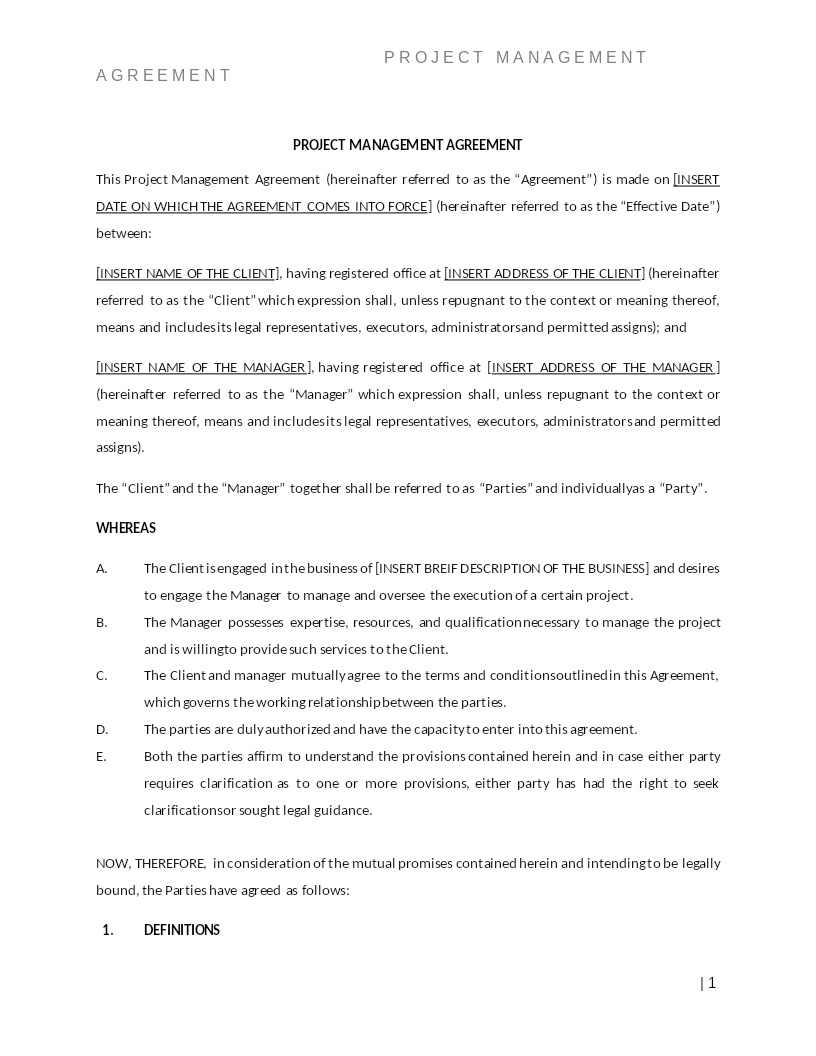
PROJECT MANAGEMENT AGREEMENT
How does it work?
1. Choose this template
Start by clicking on "Fill out the template"
2. Complete the document
Answer a few questions and your document is created automatically.
3. Save - Print
Your document is ready! You will receive it in Word and PDF formats. You will be able to modify it.
Defining Professional Oversight Duties in Project Management Engagements
Organizations frequently rely on outside professionals to oversee planning, coordination, execution, and evaluation of business initiatives. To protect the interests of all parties involved, it is essential to establish a formal agreement that governs these responsibilities. A Project Management Agreement fulfills this purpose. It delineates the terms under which the Project Manager provides planning, supervisory, and administrative services to the Client, in accordance with U.S. contract law, professional services standards, and applicable industry regulations.
By entering into a Project Management Agreement, the parties create a binding legal framework that clarifies the scope of services, deliverables, timelines, compensation, confidentiality requirements, intellectual property ownership, performance expectations, and remedies for breach. Such an agreement ensures that complex projects are executed in a structured, compliant, and efficient manner.
Where Project Management Agreements Are Commonly Used
Project Management Agreements are utilized across a wide range of professional, commercial, and technical environments, including:
- Construction and development projects
- Software implementation, SaaS deployment, and IT infrastructure rollouts
- Marketing, creative, and content production projects
- Business process improvement and organizational change management
- Product development, engineering, and manufacturing projects
- Compliance-driven or regulatory initiatives
- Corporate expansion, relocation, or restructuring efforts
- Multi-stakeholder or cross-departmental project coordination
Any time a business engages a professional to manage the planning and execution of a project, this agreement establishes the terms governing that relationship.
Different Types of Project Management Agreements You May Encounter
1. Full-Service Project Management Agreements: Cover planning, execution, monitoring, and project closure duties.
2. Consulting-Based Project Management Agreements: Focus on advisory, oversight, and coordination rather than hands-on execution.
3. Construction Project Management Agreements: Address scheduling, subcontractor coordination, budgeting, and site oversight.
4. IT Project Management Agreements: Cover software integration, technical implementation, migration, and rollout activities.
5. Project-Based Scope Agreements: Apply to defined projects with fixed deliverables and clear timelines.
When Legal Guidance Becomes Helpful
Legal consultation may be advisable when:
- The project involves multiple contractors, vendors, or stakeholders
- Confidential or proprietary information will be shared
- Intellectual property is created as part of the project deliverables
- The Client requires strict timelines, performance metrics, or penalties
- The agreement involves substantial financial investment or risk
- The work is subject to regulatory compliance or industry-specific rules
- Insurance, indemnification, or liability limitations must be clarified
Professional review ensures the agreement complies with U.S. service contract laws, supports proper risk management, and prevents disputes.
How to Work With This Template
- Identify the Project Manager and Client
- Define the scope of services and core responsibilities
- Specify project deliverables, milestones, and expected timelines
- Establish compensation terms, payment schedules, and expense reimbursement
- Outline confidentiality, data security, and intellectual property provisions
- Set forth performance obligations, reporting duties, and communication expectations
- Select governing law and jurisdiction
- Review the agreement for compliance with relevant U.S. standards
- Execute the agreement electronically or in hard copy
This template aligns with widely accepted U.S. professional services practices and is compatible with major e-signature platforms.
Frequently Asked Questions
1. What is a Project Management Agreement, and why is it important?
A Project Management Agreement is a legally binding contract that defines the terms under which a Project Manager provides planning, coordination, and oversight services for a Client. It is important because it clarifies responsibilities, timelines, deliverables, and legal protections, ensuring smooth project execution and reduced risk of disputes.
2. What duties does a Project Manager typically perform under this agreement?
Duties may include project planning, scheduling, resource allocation, team coordination, reporting, risk management, vendor oversight, and project closure activities. The exact scope should be clearly detailed in the agreement.
3. Is the Project Manager liable for project delays or failures?
Liability depends on the agreement’s terms. Many contracts limit the Project Manager’s liability unless delays result from negligence or breach of duty. Clear definitions of responsibilities reduce uncertainty.
4. How is compensation structured in a Project Management Agreement?
Compensation may be hourly, flat-fee, milestone-based, or tied to project phases. The agreement should detail payment schedules, reimbursable expenses, and invoice procedures.
5. Who owns the intellectual property created during the project?
IP ownership depends on the contract. Some agreements grant ownership to the Client, while others retain it with the Project Manager unless assigned. IP terms should be explicitly stated.
6. Does this agreement include confidentiality requirements?
Yes. Project Managers often access sensitive business information, so the agreement should include strict confidentiality and data security provisions.
7. Can the Project Manager subcontract tasks?
Only if expressly permitted. Many agreements require prior written approval before subcontracting any duties.
8. Are electronic signatures valid for Project Management Agreements?
Yes. Under the ESIGN Act, electronic signatures are legally enforceable, and most service agreements can be executed digitally.
9. What happens if the Client changes the project scope?
Scope changes typically trigger a “change order” process involving revised timelines, deliverables, and fees. This prevents misunderstandings and ensures both parties agree to modifications.
10. Can the agreement be terminated early?
Yes. Termination provisions usually allow termination for breach, non-performance, or convenience with notice. The agreement should specify final payment obligations and transition support.