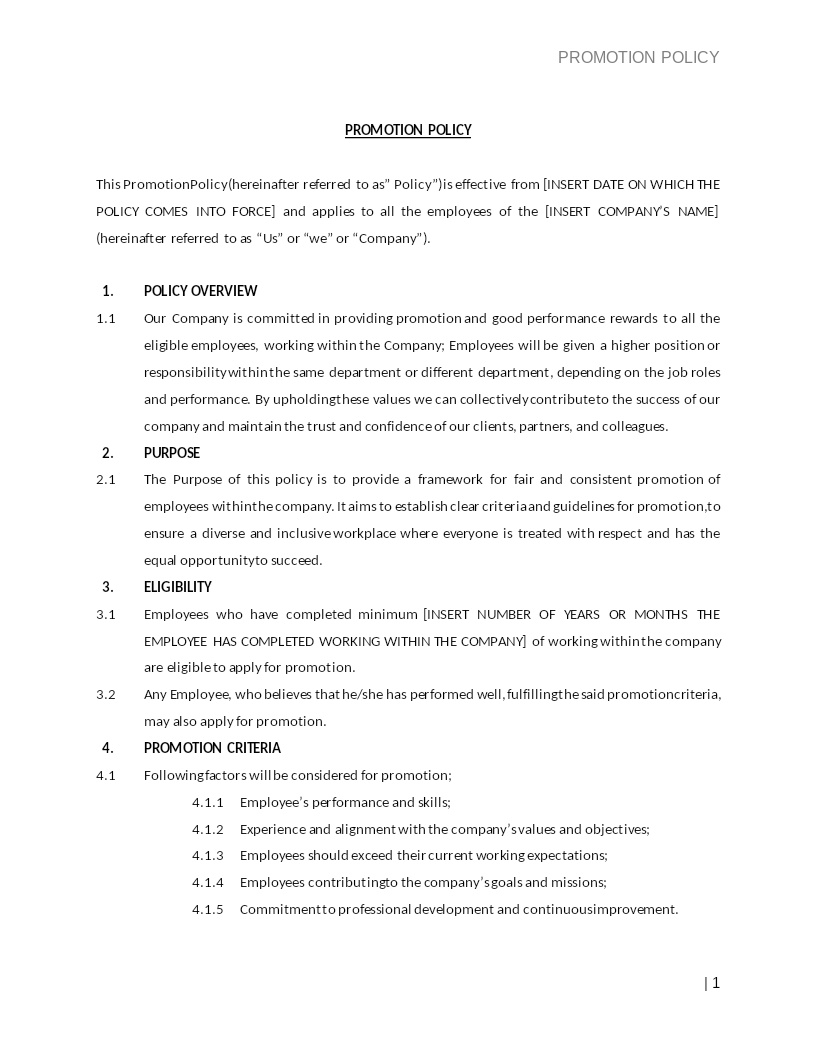
PROMOTION POLICY
How does it work?
1. Choose this template
Start by clicking on "Fill out the template"
2. Complete the document
Answer a few questions and your document is created automatically.
3. Save - Print
Your document is ready! You will receive it in Word and PDF formats. You will be able to modify it.
Understanding Promotion Policy in U.S.
A Promotion Policy is a formal framework that defines the standards, procedures, and criteria used by U.S. organizations to evaluate and advance employees into higher roles. It establishes transparent guidelines for assessing performance, competencies, qualifications, and behavioral attributes. The policy ensures that promotional decisions are fair, consistent, and compliant with U.S. employment laws, including equal opportunity and anti-discrimination regulations. A well-designed Promotion Policy supports employee development, enhances organizational productivity, and helps businesses retain top talent by providing clear pathways for career growth.
Where a Promotion Policy Is Commonly Used
• Corporations and private companies
• Government agencies and public sector entities
• Healthcare systems and hospitals
• Educational institutions and research bodies
• Retail, hospitality, and service-based industries
• Start-ups and tech companies
• Manufacturing and industrial organizations
• Non-profit organizations
Different Types of Promotion Policies
- Merit-Based Promotion Policy: Advances employees based on performance, achievements, and skill development.
- Seniority-Based Promotion Policy: Focuses on length of service, tenure, and institutional experience.
- Competency-Based Promotion Policy: Evaluates promotions based on demonstrated competencies, leadership skills, and capability assessments.
- Hybrid Promotion Policy: Combines merit, experience, and performance evaluations for balanced decision-making.
- Career Path Promotion Policy: Offers predefined career tracks for upward mobility within specific departments or roles.
- Equity & Inclusion Promotion Policy: Ensures compliance with anti-discrimination laws and promotes diverse workplace growth.
When Legal Guidance Becomes Helpful
Consulting real-time lawyers and in-house counsel ensures that your Promotion Policy is legally compliant, enforceable, and tailored to your organization’s needs. Legal professionals help:
• Ensure compliance with U.S. laws such as Title VII, ADA, ADEA, and EEOC regulations
• Create transparent criteria to prevent discrimination claims or biased decisions
• Develop documentation standards that protect the company during employee disputes
• Establish fair evaluation, grievance, and appeal procedures
• Address industry-specific considerations such as union regulations or federal workforce laws
• Create enforceable internal rules aligned with corporate governance
• Reduce legal risks associated with wrongful termination or unfair promotion claims
Their expertise helps maintain a professional, equitable, and defensible promotional process.
How to Use This Promotion Policy
• Apply standardized evaluation criteria across departments
• Train managers on unbiased and lawful decision-making practices
• Maintain detailed performance records and documentation
• Communicate promotion pathways clearly to employees
• Use structured interview and assessment tools for transparency
• Ensure periodic review of the policy to meet changing business and legal needs
Frequently Asked Questions
Q1. Why is a Promotion Policy important for U.S. companies?
A Promotion Policy ensures that advancement decisions are made fairly, consistently, and in compliance with federal and state employment laws. It helps organizations avoid bias, discrimination risks, and legal challenges. It also boosts employee morale by providing clarity on how career growth is achieved within the organization.
Q2. Does a Promotion Policy help prevent workplace disputes?
Yes. By clearly outlining the criteria and procedures for promotions, the policy reduces confusion and misunderstandings. Employees understand how decisions are made and what is required for advancement. This transparency significantly lowers the chances of grievances or claims of unfair treatment.
Q3. Is a Promotion Policy legally required in the U.S.?
While not legally mandatory, having a Promotion Policy helps ensure compliance with laws such as Title VII of the Civil Rights Act and EEOC anti-discrimination guidelines. It serves as a protective tool for employers by demonstrating fair and consistent decision-making practices.
Q4. What factors are typically considered when promoting employees?
Common factors include performance reviews, job knowledge, leadership capabilities, work ethic, seniority, skills, and alignment with company values. Some U.S. organizations also consider certifications, training, and behavioral assessments. The policy ensures these criteria are applied uniformly.
Q5. Can a Promotion Policy support diversity and inclusion initiatives?
Absolutely. A well-drafted policy helps eliminate unconscious bias, supports equal opportunity, and encourages diverse leadership development. It aligns with EEOC standards and ensures promotion decisions are based on merit rather than personal preferences or discriminatory factors.
Q6. How often should a Promotion Policy be updated?
Organizations should review it annually or when laws, job structures, or internal processes change. Regular review ensures continued compliance, fairness, and alignment with strategic business goals. Updates also address evolving workforce expectations and organizational growth.
Q7. Does a Promotion Policy apply to both internal and external candidates?
Primarily, it governs internal promotions, but some organizations integrate it with external hiring processes. This ensures fair comparison between existing employees and outside applicants. Clear guidelines support transparent decision-making and help retain internal talent.
Q8. How does a Promotion Policy increase employee motivation?
Employees are more inspired to perform when they understand the path to advancement. The policy highlights required skills and expectations, encouraging productivity, development, and engagement. It promotes a culture of growth, leading to better retention and organizational performance.