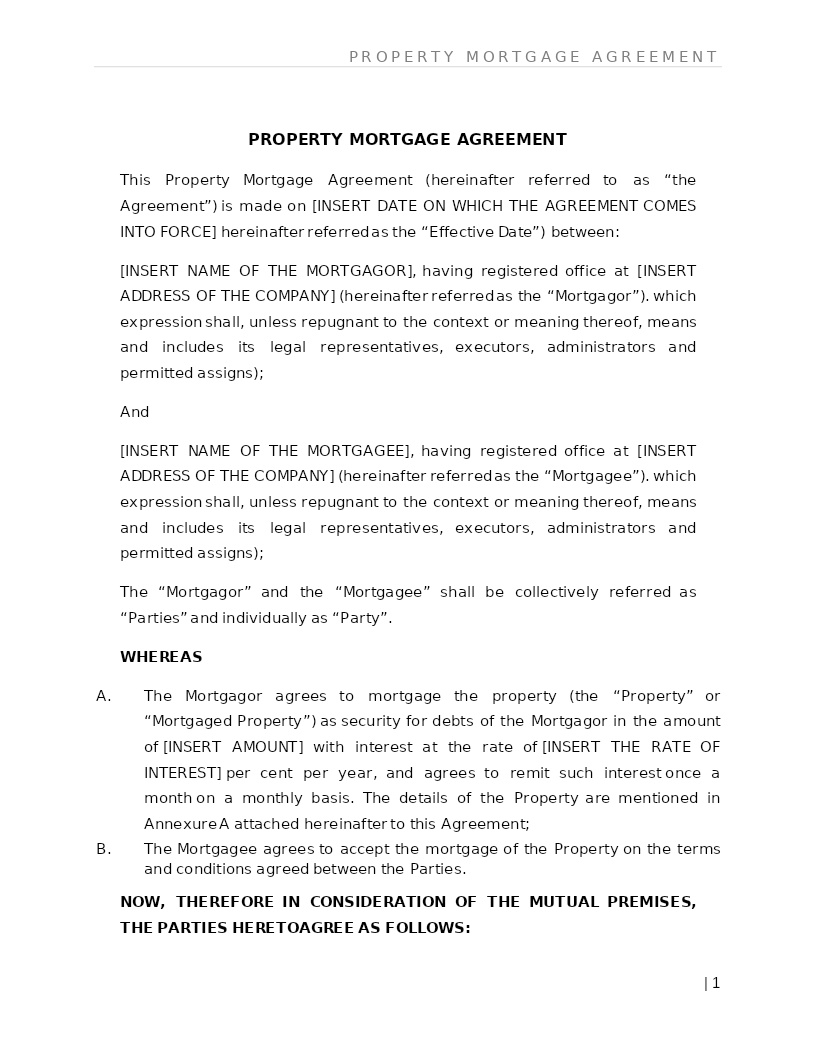
PROPERTY MORTGAGE AGREEMENT
How does it work?
1. Choose this template
Start by clicking on "Fill out the template"
2. Complete the document
Answer a few questions and your document is created automatically.
3. Save - Print
Your document is ready! You will receive it in Word and PDF formats. You will be able to modify it.
Understanding the Purpose and Use of a Property Mortgage Agreement
When a borrower seeks financing for purchasing, refinancing, or leveraging real estate, it is essential to establish a clear legal framework governing the loan and the rights tied to the secured property. A Property Mortgage Agreement provides that structure. It defines the loan terms, the lender’s security interest, the borrower’s obligations, and the consequences of default.
Having this agreement in place creates transparency between the lender and borrower, protects both sides from financial and legal uncertainty, and ensures compliance with U.S. state-specific real estate and lending laws.
Where Property Mortgage Agreements Are Commonly Used
Property-secured lending arrangements appear across numerous real-estate and commercial financing situations, including:
- Residential home purchases and refinancing
- Commercial real-estate loans for offices, warehouses, or rental properties
- Construction financing for new builds or property improvement projects
- Business loans secured by real estate
- Private lending arrangements involving collateralized property
- Investment property acquisitions or equity-release financing
Any time real estate is pledged as security, a written mortgage agreement outlines how the loan will operate and the protections afforded to both parties.
Different Types of Property Mortgage Agreements You May Encounter
- Fixed-Rate Mortgage: A loan where the interest rate remains constant throughout the term, offering predictable monthly payments.
- Adjustable-Rate Mortgage (ARM): A loan with an interest rate that changes periodically based on a financial index, often starting with a lower initial rate.
- Balloon Mortgage: A structure involving lower monthly payments with a large final payment due at the end of the term.
- Commercial Mortgage: Used for income-producing properties or business-related real estate, often involving more complex underwriting and security conditions.
- Private or Hard Money Mortgage: A loan from private lenders, typically for short-term financing, with real estate as the primary collateral.
When Legal Guidance Becomes Helpful
While many mortgage transactions follow standard procedures, professional legal involvement becomes valuable when:
- The agreement includes non-standard repayment structures, rate adjustments, or balloon clauses.
- The lender is private, or multiple lenders share interest in the same property.
- The mortgage secures a commercial property, development project, or multi-unit investment.
- The loan or property spans multiple states with differing recording laws.
- Additional protections such as prepayment penalties, escrow requirements, or cross-collateralization are included.
- The property carries title complexities, easements, or liens requiring legal review.
Legal assistance ensures the contract is enforceable, compliant with lending regulations, and fully aligned with the financial and operational realities of the transaction.
How to Work with This Template
- Identify the borrower and lender, including all ownership parties for the property.
- Clearly define the loan purpose, principal amount, interest structure, and repayment schedule.
- Describe the property being pledged as collateral, including its legal description.
- Choose the state law that governs the agreement and ensure recording requirements are met.
- Specify events of default, lender remedies, and borrower protections.
- Review the terms together (legal review is optional but recommended for high-value property).
- Sign electronically or physically and ensure the agreement is properly notarized for recording.
This agreement is drafted in a format widely recognized across U.S. real estate markets and is compatible with common e-signature and county-recording standards.
Frequently Asked Questions
Q1. Is a Property Mortgage Agreement necessary for real estate financing in the U.S.?
Yes. A written mortgage agreement is essential because it outlines the borrower’s obligations, the lender’s security interest, and the terms of repayment. Without it, the lender cannot legally enforce rights against the property in the event of default. It also ensures compliance with state recording and lending laws.
Q2. How does this agreement protect the lender’s interests?
The agreement grants the lender a legal lien on the property, allowing foreclosure if the borrower fails to meet payment or contractual obligations. It creates a clear framework for remedies, interest calculations, and default procedures, ensuring the lender’s financial risk is minimized. This protection is recognized and enforceable under U.S. state property laws.
Q3. Does the borrower benefit from having a detailed mortgage agreement?
Absolutely. A structured agreement clarifies repayment schedules, interest rates, escrow requirements, and borrower rights. It also prevents unexpected charges or ambiguous obligations. Borrowers gain transparency and protection, especially in long-term mortgages spanning 15–30 years.
Q4. Is this agreement valid for both residential and commercial properties?
Yes. While the structure remains similar, commercial mortgages may include additional terms such as assignment of rents, maintenance obligations, or personal guarantees. The agreement can be customized to align with the property type, financing structure, and applicable state regulations.
Q5. Do both parties need legal review before signing?
Legal review is not mandatory but is strongly recommended for complex, high-value, or multi-state transactions. Lawyers ensure all clauses are enforceable, the property title is clear, default terms are fair, and no regulatory requirements are overlooked. This reduces future disputes and financial risk.
Q6. Can this agreement be signed electronically?
Yes. Under the ESIGN Act and state laws, electronic signatures are fully enforceable for mortgage agreements, provided both parties consent to electronic execution. However, notarization may still be required electronically or in person before recording the mortgage with the county office.
Q7. What happens if the borrower defaults on the mortgage?
Default allows the lender to initiate remedies outlined in the agreement, including late fees, acceleration of the loan, or foreclosure. Each state has specific foreclosure procedures, judicial or non-judicial, that determine how the property may be sold. The agreement ensures these consequences are clearly defined upfront.
Q8. Can this mortgage agreement be used for refinancing or second mortgages?
Yes. The template can be adapted for refinancing, equity loans, or subordinate liens. It clearly identifies whether the lender’s position is primary or secondary and outlines the borrower’s updated obligations. Proper recording ensures lien priority is preserved under state law.