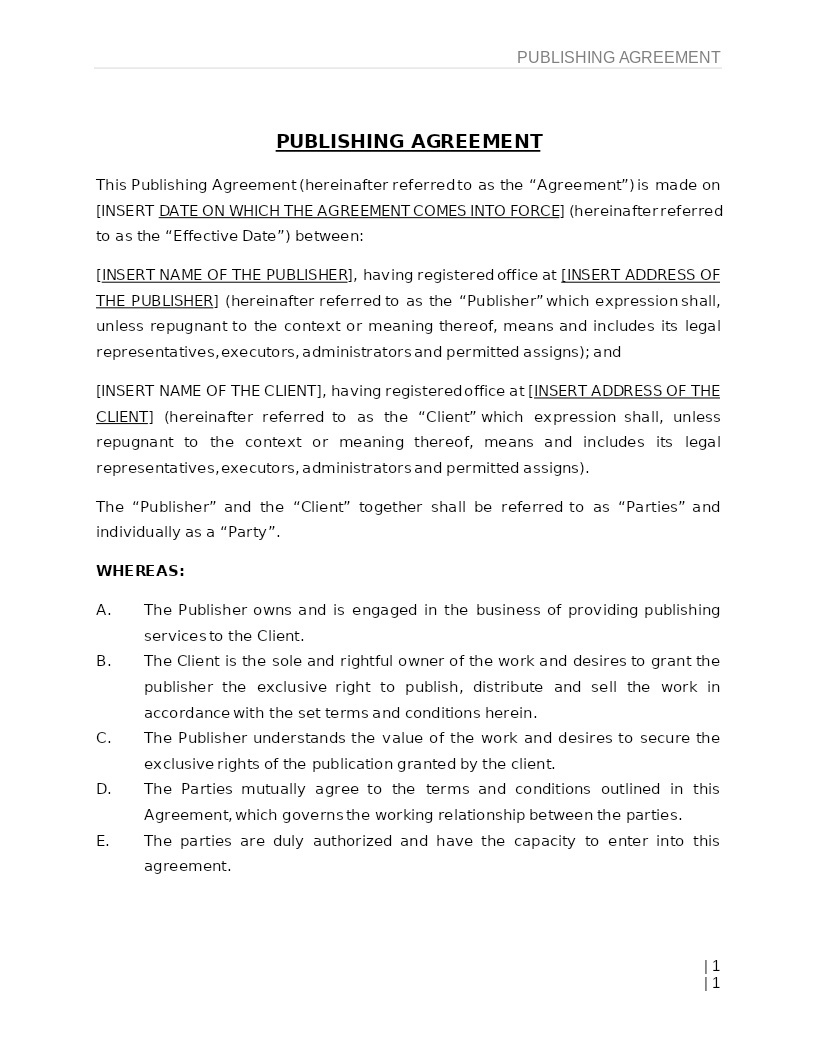
PUBLISHING AGREEMENT
How does it work?
1. Choose this template
Start by clicking on "Fill out the template"
2. Complete the document
Answer a few questions and your document is created automatically.
3. Save - Print
Your document is ready! You will receive it in Word and PDF formats. You will be able to modify it.
Ensuring Clear, Fair, and Legally Protected Publishing Relationships Through Publishing Agreements
A Publishing Agreement is a legally binding contract between an author (or content creator) and a publisher that defines the terms for producing, distributing, and promoting the author’s work. In the United States, this agreement is essential for protecting intellectual property rights, establishing financial arrangements, and confirming both parties’ responsibilities throughout the publishing lifecycle. It provides legal clarity on ownership, royalties, publication formats, editorial control, marketing efforts, and distribution channels.
The agreement ensures transparency and avoids conflicts by clearly documenting how the work will be used, who controls the rights, and how revenue will be shared. It also outlines what happens if the relationship ends, how rights revert, and how disagreements are resolved,making it a foundational tool for authors and publishers seeking a professional, long-term partnership.
Where Publishing Agreements Are Commonly Used
Publishing agreements in the U.S. are widely used for:
- Books (fiction, nonfiction, academic, self-help)
- E-books and digital publications
- Audiobooks and narrated versions
- Magazines, journals, and periodicals
- Online blogs, websites, and subscription-based content
- Educational materials and academic research
- Music, photography, and visual media rights
- Hybrid publishing and self-publishing partnerships
Any situation involving commercial distribution of creative content benefits from a formal publishing agreement.
Different Types of Publishing Agreements You May Encounter
- Traditional Publishing Agreement: The publisher handles editing, printing, distribution, and marketing, while the author earns royalties based on sales.
- Self-Publishing or Assisted Publishing Agreement: The author funds production or receives partial services, retaining more rights and control.
- Digital Publishing Agreement: Focuses on e-books, online platforms, and digital formats, including rights for streaming, audio, or subscription services.
- Exclusive Publishing Agreement: Grants the publisher exclusive rights to publish and distribute the work in certain formats, territories, or languages.
- Non-Exclusive Publishing Agreement: Allows the author to license the work to multiple publishers simultaneously, offering flexibility.
- Subsidiary Rights Agreement: Covers film, TV, translation, merchandising, and foreign rights, often essential for authors with global potential.
Each type provides different levels of control, compensation, and distribution flexibility.
When Legal Guidance Becomes Helpful
Legal consultation is especially important when:
- Negotiating royalties, advances, or complex revenue-sharing
- Assigning or licensing intellectual property rights
- Offering exclusive or global publishing rights
- Working with multiple publishers or co-authors
- Granting adaptation rights such as film, audio, or foreign translations
- Ensuring compliance with U.S. copyright law
- Understanding moral rights, attribution, and derivative works
A lawyer ensures the agreement is enforceable, fair, and aligned with the author’s long-term interests.
How to Work With This Template
- Identify the author and publisher clearly
- Specify the formats, territories, and rights being granted
- Outline editorial processes, marketing efforts, and timelines
- Establish royalty rates, payment schedules, and audit rights
- Protect IP ownership and define what rights remain with the author
- Include confidentiality and non-disclosure terms
- Add dispute resolution, governing law, and termination conditions
- Ensure all signatures, digital or written, are valid under U.S. law
This template supports standard U.S. publishing industry practices and ensures legal clarity for both parties.
Frequently Asked Questions
Q1. Why is a Publishing Agreement essential for authors and publishers in the U.S.?
A Publishing Agreement protects both parties by clearly defining rights, financial terms, and publication responsibilities. It ensures the author’s IP remains protected while outlining the publisher’s role in editing, marketing, and distributing the work. This legal clarity helps avoid disputes and creates a structured, professional publishing relationship.
Q2. Do authors lose ownership of their work when signing a Publishing Agreement?
Not always. Most U.S. publishing agreements grant the publisher limited rights while the author retains overall ownership. The agreement specifies what rights are transferred,such as print, digital, audio, or translation rights, and for how long. Authors should negotiate terms to ensure they maintain long-term control of their intellectual property.
Q3. How are royalties typically calculated under a Publishing Agreement?
Royalty rates depend on the format (print, e-book, audiobook), distribution model, and the publisher’s policies. Payments are usually based on net receipts or list price, and the agreement includes schedules for royalty statements, audits, and payment timelines. Clear royalty terms help authors track earnings and ensure fair compensation.
Q4. What happens if the publisher fails to publish the work on time?
Most agreements include a publication deadline or timeframe. If the publisher fails to meet it, rights may automatically revert to the author or allow the author to terminate the agreement. This ensures that authors are not stuck in inactive or non-performing publishing arrangements.
Q5. Can the publisher make edits without the author’s approval?
Editorial control varies by contract. Many U.S. publishing agreements require author approval for major edits but allow publishers to make minor corrections for clarity or formatting. The agreement should clearly outline the editing process to ensure both parties agree on the final presentation of the work.
Q6. What rights can publishers obtain beyond printing the book?
Publishers may acquire subsidiary rights such as audio, translation, film adaptation, merchandising, or foreign distribution. These rights can significantly increase revenue. The agreement must specify which rights are granted, how they will be monetized, and how profits are shared between author and publisher.
Q7. What if the author wants to republish or license the work elsewhere?
This depends on whether the agreement grants exclusive or non-exclusive rights. Exclusive agreements restrict the author from publishing the work elsewhere until the contract ends or rights revert. Non-exclusive agreements allow widespread distribution. Rights reversion clauses protect authors who want long-term flexibility.
Q8. Are electronic signatures valid for Publishing Agreements in the U.S.?
Yes. Under the ESIGN Act and UETA, electronic signatures are legally binding for publishing contracts, making remote agreements fast and enforceable. This is especially useful for digital publishers, agents, and authors working across different states or countries.