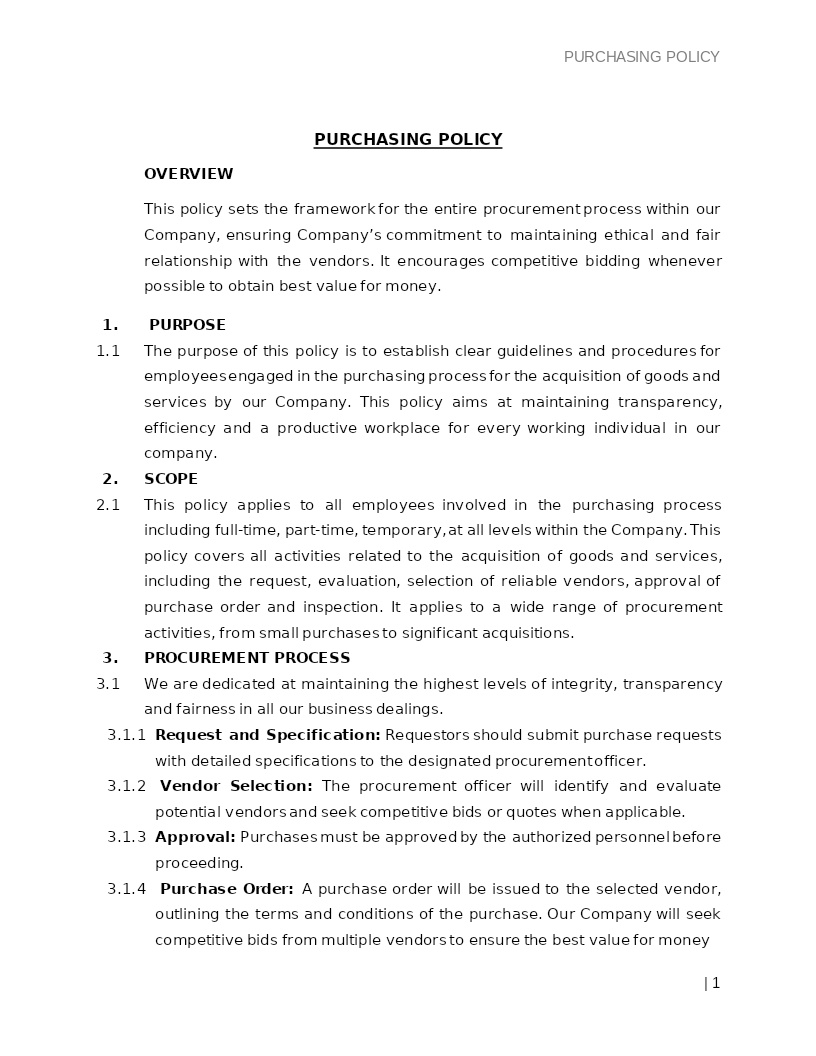
PURCHASING POLICY
How does it work?
1. Choose this template
Start by clicking on "Fill out the template"
2. Complete the document
Answer a few questions and your document is created automatically.
3. Save - Print
Your document is ready! You will receive it in Word and PDF formats. You will be able to modify it.
Understanding Purchasing Policy in U.S.
A Purchasing Policy outlines the rules, standards, and procedures an organization follows when acquiring goods and services. It establishes guidelines for vendor selection, competitive bidding, purchase approvals, budget compliance, and contract management. This policy ensures purchases are made ethically, transparently, and cost-effectively while supporting organizational goals.
A strong Purchasing Policy helps prevent fraud, reduces financial risks, promotes fair competition, and aligns spending with U.S. legal and regulatory requirements. By setting clear expectations for employees and vendors, the policy enhances accountability and supports efficient, responsible procurement operations.
Where Purchasing Policies Are Commonly Used
Purchasing Policies are widely implemented across industries where procurement activities are essential to daily operations. They are commonly used in:
• Corporate offices, manufacturing companies, and distribution networks
• Government agencies, non-profit organizations, and public institutions
• Healthcare, education, and regulated sectors with strict compliance needs
• Retail, hospitality, logistics, and service-based industries
• Technology firms and organizations managing software, licensing, and subscriptions
• Any business with centralized, decentralized, or hybrid procurement systems
Any organization that purchases goods or services benefits from a structured and transparent procurement process.
Different Types of Purchasing Practices You May Encounter
- Competitive Bidding and Vendor Evaluation: Ensures transparency and fairness by requiring multiple quotes, vendor assessments, and documented comparisons before making purchasing decisions.
- Approval Hierarchies and Budget Controls: Define who can authorize purchases at different spending levels, helping maintain financial discipline and prevent unauthorized expenditures.
- Contract and Purchase Order Management: Standardizes agreements, terms, and purchase documentation to ensure clarity, traceability, and legal compliance.
- Preferred Vendor or Approved Supplier Programs: Promote quality, cost efficiency, and consistency by directing procurement toward vetted, reliable vendors.
- Compliance and Audit Requirements: Ensure purchases meet federal, state, and industry-specific regulations while maintaining accurate documentation for audits and internal reviews.
When Legal Guidance Becomes Helpful
Legal counsel is especially valuable when customizing a Purchasing Policy because:
• U.S. laws governing procurement, contracts, bidding, and financial transactions vary by industry and state.
• Regulated sectors, such as healthcare, finance, and education, must adhere to strict purchasing and documentation requirements.
• Lawyers ensure purchasing agreements include proper indemnities, warranties, intellectual property terms, and compliance language.
• Counsel helps address vendor risks, fraud prevention, anti-corruption compliance (e.g., FCPA), and conflict-of-interest rules.
• Multi-state operations require alignment with different tax laws, consumer protection rules, and supplier regulations.
• Legal review strengthens enforceability, minimizes disputes, and ensures adherence to internal governance standards.
In-house and external counsel ensure that the entire purchasing framework supports ethical, compliant, and efficient operations.
How to Work With This Policy Template
• Define procurement categories, approval levels, and budget oversight rules.
• Establish vendor selection criteria, bidding requirements, and evaluation methods.
• Align purchasing procedures with U.S. legal requirements, financial controls, and audit standards.
• Clarify documentation rules, purchase order processes, and contract management responsibilities.
• Address conflict-of-interest disclosures, ethical guidelines, and fraud-prevention measures.
• Implement periodic monitoring and policy reviews to remain compliant with changing laws or industry needs.
Frequently Asked Questions
Q1. Why is a Purchasing Policy important for organizations?
A Purchasing Policy ensures that all procurement decisions follow transparent, consistent, and ethical standards. It helps employees understand how purchases should be made and prevents overspending or unauthorized purchases. This structure protects the organization from financial risks and enhances operational efficiency.
Q2. Does a Purchasing Policy support compliance with U.S. laws?
Yes. It helps organizations comply with contract law, financial regulations, tax requirements, documentation standards, and industry-specific purchasing rules. A well-drafted policy reduces the risk of legal issues, fraud, or penalties by ensuring purchasing actions meet federal and state requirements.
Q3. What key areas does a Purchasing Policy typically cover?
Common areas include vendor selection, competitive bidding, purchasing approvals, contract management, ethical guidelines, financial controls, and recordkeeping. These elements ensure that purchases are cost-effective, high-quality, and aligned with business objectives.
Q4. How does the policy reduce the risk of fraud or unethical behavior?
It establishes strict rules for vendor evaluation, approval processes, conflict-of-interest disclosures, and documentation. By outlining clear boundaries and oversight responsibilities, the policy prevents favoritism, unauthorized spending, and fraudulent procurement practices.
Q5. Can a Purchasing Policy help improve cost efficiency?
Absolutely. By standardizing vendor selection and negotiating bulk or preferred rates, the policy helps organizations secure better pricing and avoid unnecessary expenses. Budget controls further ensure spending aligns with company goals and financial plans.
Q6. How does this policy support accountability and transparency?
Purchasing decisions must follow defined processes, approvals, and documentation requirements. This ensures every purchase can be traced, reviewed, and audited. Such transparency helps identify inefficiencies, strengthen internal controls, and maintain ethical procurement practices.
Q7. What happens if a purchase does not follow the policy?
Unauthorized or non-compliant purchases may result in corrective actions, delayed approvals, financial adjustments, or disciplinary measures. The policy ensures consistent enforcement and protects the organization from financial or legal exposure due to improper procurement decisions.
Q8. Is a Purchasing Policy useful for small businesses as well?
Yes. Small businesses benefit significantly from clearer procedures, reduced costs, and improved vendor relationships. Even simple policies help ensure consistent purchasing decisions, protect against fraud, and provide a scalable foundation as the business grows.