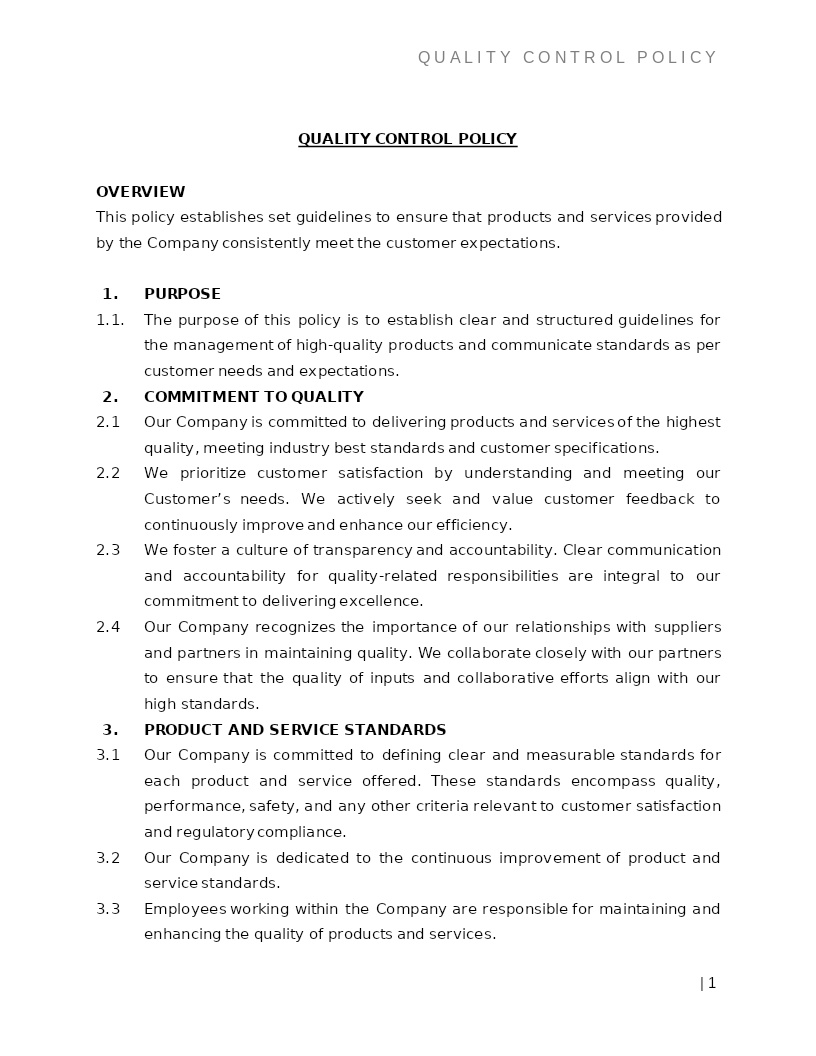
QUALITY CONTROL POLICY
How does it work?
1. Choose this template
Start by clicking on "Fill out the template"
2. Complete the document
Answer a few questions and your document is created automatically.
3. Save - Print
Your document is ready! You will receive it in Word and PDF formats. You will be able to modify it.
Understanding the Purpose and Use of a Quality Control Policy
When a business is committed to delivering consistent, reliable, and high-standard products or services, it becomes essential to establish a structured framework for monitoring and maintaining quality. A Quality Control Policy provides that structure. It outlines the procedures, inspection methods, testing guidelines, and performance criteria used to ensure that all outputs meet established standards of excellence.
Having this policy in place strengthens customer trust, ensures regulatory compliance, reduces operational risks, and promotes internal accountability. It enables organizations to detect issues early, improve efficiency, and maintain a strong reputation in competitive markets.
Where Quality Control Policies Are Commonly Used
Quality control guidelines are widely implemented across U.S. industries, including:
- Manufacturing and production facilities with high-volume output
- Food, beverage, and pharmaceutical sectors governed by strict safety standards
- Technology, electronics, and SaaS companies ensuring product reliability
- Healthcare organizations bound by patient-safety and regulatory protocols
- Professional services firms maintaining accuracy and consistency in deliverables
- Construction, engineering, and logistics companies ensuring safe and compliant operations
- Retail and e-commerce businesses focused on customer satisfaction and brand reliability
Any organization that seeks consistent results and customer confidence benefits from a written QC policy.
Different Types of Quality Control Practices You May Encounter
- Process-Based Quality Control: Monitors production or service workflows to ensure each step meets the required guidelines.
- Product Testing and Inspection Programs: Involves periodic testing, sampling, and inspection of final outputs to maintain standards.
- Compliance and Regulatory Quality Checks: Ensures operations adhere to U.S. regulations such as FDA, OSHA, ISO, or industry-specific standards.
- Supplier and Vendor Quality Monitoring: Evaluates the quality of materials, components, or services sourced from external partners.
- Corrective and Preventive Action (CAPA) Procedures: Identifies root causes of defects and implements measures to prevent recurrence.
When Legal Guidance Becomes Helpful
Most basic quality procedures can be developed internally, but legal and in-house counsel involvement becomes essential when:
- Operations fall under regulated sectors (FDA, USDA, OSHA, DOT, FTC).
- Product warranties, disclaimers, or liability clauses intersect with quality guarantees.
- Vendor or supplier contracts include quality benchmarks or penalties for defects.
- The company handles hazardous products or safety-sensitive services.
- Multi-state operations require alignment with differing state regulations.
- Claims of defect, product failure, or customer harm may result in legal action.
Legal review helps ensure the policy is compliant, enforceable, and aligned with regulatory and contractual obligations.
How to Work with This Template
- Identify quality standards and benchmarks relevant to your industry or product line.
- Establish procedures for inspections, testing, audits, and ongoing quality monitoring.
- Define employee responsibilities and internal reporting processes.
- Select governing state laws and integrate applicable U.S. regulatory requirements.
- Review internally or with legal counsel (optional).
- Communicate the policy clearly to employees and integrate it into operational workflows.
This policy follows widely recognized quality management standards used throughout the United States.
Frequently Asked Questions
Q1. Why is a Quality Control Policy important for U.S. businesses?
It ensures consistency, reduces defects, and improves customer satisfaction. A structured policy strengthens brand reputation and enhances operational efficiency. It also helps organizations comply with federal and state regulations governing product safety and service reliability.
Q2. Does this policy help reduce costs and waste?
Yes. Quality control helps identify defects early, preventing costly rework, recalls, and customer complaints. By improving accuracy and reducing errors, businesses lower operational expenses and increase overall productivity.
Q3. Can this policy support compliance with industry regulations?
Absolutely. Many industries require strict adherence to standards such as FDA, ISO, OSHA, or state-specific guidelines. A formal QC policy ensures that processes align with regulatory requirements, reducing legal and financial risks.
Q4. How does a quality policy improve customer satisfaction?
Consistent quality leads to reliable products or services that meet customer expectations. Satisfied customers are more likely to remain loyal, recommend the brand, and reinforce the company’s reputation for excellence.
Q5. Does this policy apply to both products and services?
Yes. Quality control is essential for physical products, digital offerings, and service-based industries. The policy ensures that all deliverables—regardless of type—meet defined performance and safety standards.
Q6. How does this policy help manage vendor and supplier quality?
It establishes clear expectations for materials, components, or services sourced externally. By monitoring supplier performance and enforcing quality benchmarks, organizations reduce the risk of defects and disruptions in the supply chain.
Q7. Can a Quality Control Policy support internal training efforts?
Yes. QC standards form the basis for training employees on proper procedures, inspection requirements, and compliance responsibilities. This ensures consistent performance and strengthens accountability across teams.
Q8. Does a Quality Control Policy contribute to long-term business success?
Absolutely. By promoting continuous improvement, reducing risks, and maintaining strong customer trust, the policy enhances competitiveness and long-term growth. It fosters a culture of excellence that benefits every level of the organization.