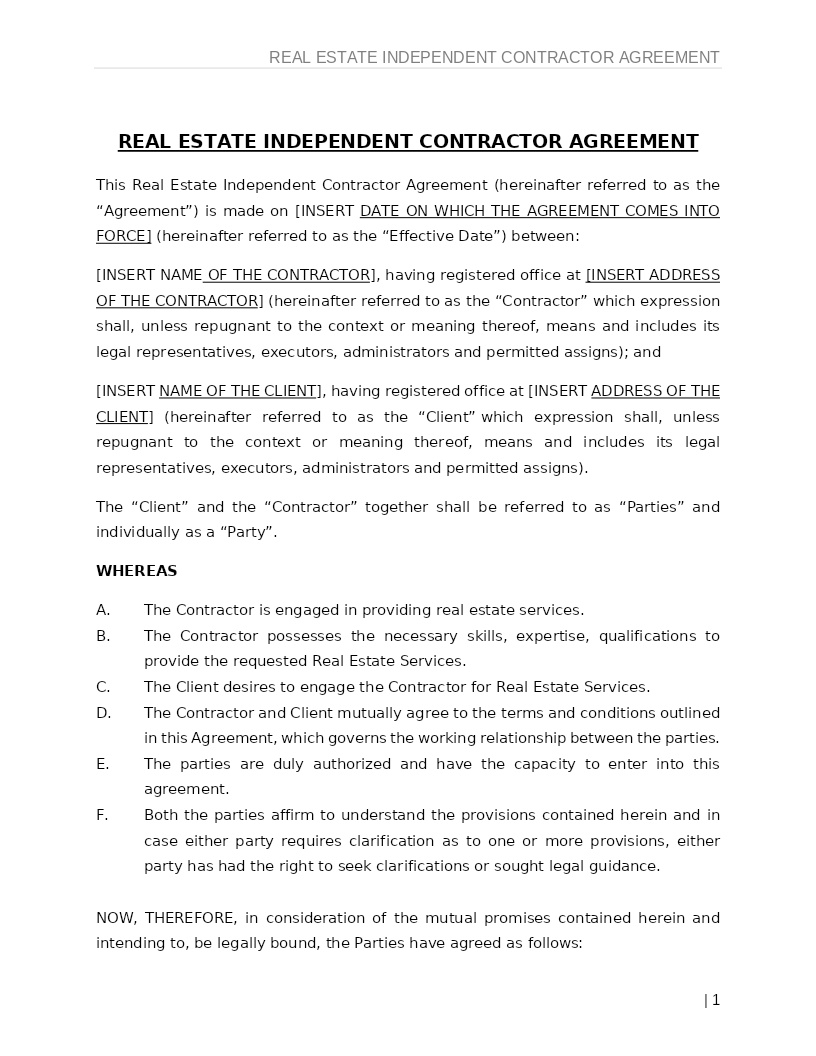
REAL ESTATE INDEPENDENT CONTRACTOR AGREEMENT
How does it work?
1. Choose this template
Start by clicking on "Fill out the template"
2. Complete the document
Answer a few questions and your document is created automatically.
3. Save - Print
Your document is ready! You will receive it in Word and PDF formats. You will be able to modify it.
Understanding Real Estate Independent Contractor Agreements
A Real Estate Independent Contractor Agreement is a legally binding contract between a real estate brokerage (the “Broker”) and an agent or salesperson (the “Independent Contractor”) that outlines the terms under which the agent provides real estate services. This agreement clarifies commission structures, responsibilities, licensing requirements, brokerage policies, marketing rules, confidentiality, and compliance with state and federal real estate laws.
In the United States, these agreements operate under state real estate licensing laws, IRS classification rules, the Fair Housing Act, local MLS requirements, and industry regulations. The agreement ensures that the agent is properly classified as an independent contractor not an employee while defining the professional obligations and expectations of both parties.
Where Real Estate Independent Contractor Agreements Are Commonly Used
These agreements are widely used in various real estate environments, including:
- Residential and commercial brokerage firms
- Independent real estate agencies
- Luxury property sales and leasing teams
- Real estate investment partnerships
- Property management services
- Leasing and rental brokerage services
- Referral networks and licensed real estate consultants
Whenever a real estate agent performs services for a brokerage without becoming an employee, this agreement provides structure and clear legal protections.
Different Types of Real Estate Contractor Arrangements
- Residential Real Estate Contractor Agreement: For agents focused on home sales, rentals, and residential markets.
- Commercial Real Estate Contractor Agreement: For agents working with commercial leases, office spaces, retail properties, or industrial facilities.
- Referral or Lead-Generation Contractor: For licensed agents who generate leads or referrals rather than performing full brokerage services.
- Property Management Contractor Agreement: For agents assisting with leasing, tenant relations, and property operations.
When Legal Guidance Becomes Helpful
Legal review is valuable when:
- Commission splits, caps, or bonus structures are complex
- Agents work across multiple states with differing licensing rules
- MLS access, branding rights, or marketing obligations need clarification
- The agreement includes non-compete or non-solicitation clauses
- The brokerage provides compliance training, tools, or support
- The parties want clarity around independent contractor classification
- The agent handles high-value transactions or commercial clients
Legal guidance helps ensure proper classification, compliance with real estate laws, and protection against audit risks.
How to Work with This Template
- Identify the Broker and Independent Contractor with licensing details
- Describe duties, responsibilities, and permitted real estate activities
- Include commission structures, payment terms, and referral fee rules
- Add marketing standards, branding requirements, and MLS policies
- Incorporate confidentiality, data protection, and client privacy clauses
- Address compliance with federal and state real estate laws
- Choose the governing U.S. state law
- Add termination rules, dispute resolution, and renewal terms
- Sign electronically or physically per applicable state regulations
This template aligns with U.S. real estate industry practices and is compatible with major e-signature platforms.
Frequently Asked Questions
1. What is a Real Estate Independent Contractor Agreement and why is it important?
This agreement outlines the relationship between a real estate broker and an agent who works as an independent contractor. It is important because it clarifies commission terms, responsibilities, and legal compliance while preventing agents from being misclassified as employees.
2. Are real estate agents' employees or independent contractors in the U.S.?
In most cases, licensed real estate agents are classified as independent contractors under IRS rules and state real estate laws. This allows agents flexibility in work hours while requiring brokers to follow compliance and supervision obligations.
3. What should be included in a Real Estate Independent Contractor Agreement?
Key elements include commission splits, licensing requirements, responsibilities, MLS rules, marketing standards, confidentiality obligations, and termination terms. These provisions help maintain professionalism and regulatory compliance.
4. Can a brokerage control the agent’s work schedule?
No. Independent contractors must maintain control over when and how they perform their work. Brokers may provide policies, training, and compliance oversight but cannot impose employee-style work schedules.
5. How are commissions handled under this agreement?
Commissions are typically paid according to negotiated splits, caps, or tiered structures. The agreement outlines how payments are calculated, distributed, and documented, including referral fees and bonuses.
6. Are agents required to follow MLS and advertising rules?
Yes. Agents must comply with MLS rules, state advertising laws, brokerage branding guidelines, and Fair Housing Act requirements. The agreement usually includes provisions to ensure ethical and legal listings and marketing.
7. Can this agreement include non-compete or non-solicitation terms?
Yes, but they must comply with state laws. Many agreements include limited non-solicitation clauses to protect brokerage clients and confidential information, especially after termination.
8. Does the agreement cover expenses or tools provided by the broker?
It can. Some brokers offer tools, training, or marketing materials. Others require agents to cover their own expenses. The agreement clarifies who pays for MLS fees, advertising, transportation, and office materials.
9. Are electronic signatures valid for Real Estate Independent Contractor Agreements?
Yes. Under the U.S. ESIGN Act, electronic signatures are legally binding, and many brokerages prefer digital execution for convenience.
10. Is this agreement suitable for new or part-time real estate agents?
Absolutely. New, part-time, and experienced agents all use this agreement to define their relationship with a brokerage, outline responsibilities, and establish commission rights.