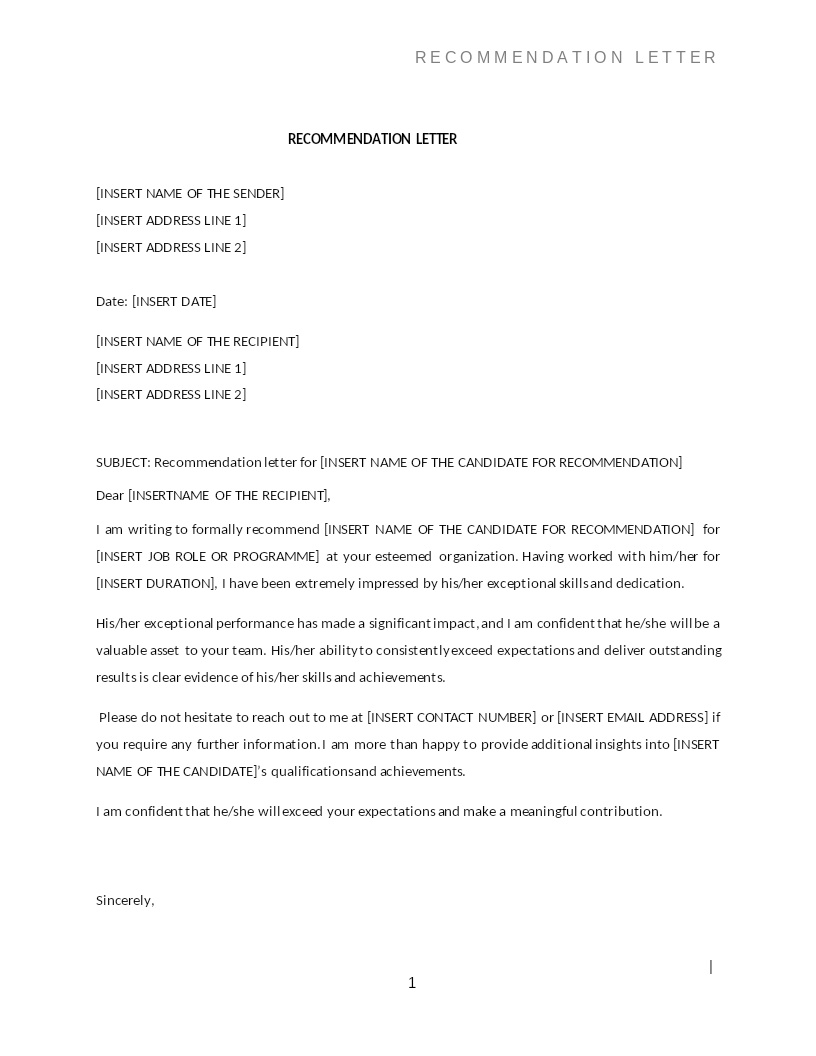
RECOMMENDATION LETTER
How does it work?
1. Choose this template
Start by clicking on "Fill out the template"
2. Complete the document
Answer a few questions and your document is created automatically.
3. Save - Print
Your document is ready! You will receive it in Word and PDF formats. You will be able to modify it.
Presenting Professional Endorsements for Career, Academic, and Personal Advancement
When someone applies for a job, seeks admission to an academic program, or pursues a new professional opportunity, a Recommendation Letter plays a pivotal role in showcasing their character, skills, and achievements. It provides structured insight from a credible individual who has observed the applicant’s work ethic and capabilities firsthand.
A strong Recommendation Letter adds depth to an applicant’s profile, builds trust with decision-makers, and supports a more informed evaluation of their potential and suitability.
Where Recommendation Letters Are Commonly Used
Recommendation Letters are widely relied upon in a variety of contexts, including:
- Job applications, promotions, and internal evaluations
- College or university admissions, scholarship applications
- Graduate school, research programs, or fellowship opportunities
- Professional licensing boards and certification programs
- Volunteer positions, community service roles, or internships
- Immigration processes requiring proof of character or skills
- Specialized programs, leadership tracks, or competitive placements
Any time an applicant needs verified insights into their performance or character, a Recommendation Letter serves as an authoritative supporting document.
Different Types of Recommendation Letters You May Encounter
- Professional Recommendation: Written by a supervisor, employer, or colleague to highlight workplace achievements and capabilities.
- Academic Recommendation: Provided by teachers, professors, or academic advisors to showcase academic performance, leadership, and potential.
- Character or Personal Recommendation: Offered by mentors, community leaders, or acquaintances to affirm integrity, behavior, and personal values.
- Program-Specific Recommendation: Tailored for scholarships, internships, licensing boards, or specialized opportunities requiring unique competencies.
When Legal Guidance Becomes Helpful
While most Recommendation Letters are straightforward, legal advice becomes valuable when:
- The letter is part of an immigration, licensing, or regulatory proceeding
- The employer requires compliance with internal HR or confidentiality rules
- The recommender must reference sensitive organizational information
- The letter may impact legal disputes, background checks, or formal investigations
- The recommender wants clarity on liability, defamation risks, or wording limitations
- The letter accompanies other legal or contractual documents
Legal review ensures accuracy, reduces risk, and keeps the letter compliant with relevant laws or organizational policies.
How to Work with This Template
- Identify the recommender and their relationship to the applicant
- Describe the applicant’s strengths, skills, and achievements
- Provide specific examples that demonstrate capability and character
- Highlight qualities relevant to the job, program, or opportunity
- Include contact information for verification
- Review and finalize the content before signing
This structure is compatible with U.S. academic institutions, employers, and professional programs.
Frequently Asked Questions
Q1. What makes a Recommendation Letter effective?
An effective Recommendation Letter provides specific, firsthand insights into the applicant’s skills, character, and accomplishments. It goes beyond generic praise by offering real examples of leadership, problem-solving, or teamwork. Decision-makers often rely on detailed and credible observations to evaluate fit. The more personalized the letter, the stronger its impact.
Q2. Who should write a Recommendation Letter?
Ideally, it should come from someone who directly supervised, taught, mentored, or worked with the applicant. The recommender should understand the individual’s strengths and be able to provide meaningful examples. Titles matter less than the quality of the relationship and credibility of the recommender. Choosing someone who knows the applicant well leads to a more authentic letter.
Q3. How long should a Recommendation Letter be?
A typical letter is one page, usually 3–5 paragraphs covering relationship context, strengths, achievements, and closing remarks. Length is less important than clarity and relevance. The goal is to offer enough detail to support the application without overwhelming the reader. Concise, focused letters are often viewed more favorably.
Q4. Can a Recommendation Letter be reused for multiple applications?
Yes, but tailored letters are more effective. Many applicants request general letters for repeated use, but customizing the skills or qualifications to the specific job or program increases impact. Some institutions also require letters to be addressed separately. Updating the letter helps maintain accuracy and relevance.
Q5. Is a Recommendation Letter legally binding?
No, it is not a contract. However, information provided must be truthful and non-misleading. Recommenders may face reputational or legal consequences if they knowingly provide false information. It is important that the content reflects genuine experience and professional judgment. Accuracy protects both the recommender and the applicant.
Q6. Can Recommendation Letters be submitted electronically?
Yes. Many U.S. employers, universities, and online portals accept digital uploads or electronically signed letters. Systems like LinkedIn, university admissions portals, and online HR platforms streamline submission. Electronic submission is typically faster and more secure. Always follow the recipient’s instructions for format and delivery.
Q7. Should a Recommendation Letter include weaknesses?
Not necessarily. While honesty is important, the purpose of the letter is to support the applicant. Recommenders typically emphasize strengths while providing balanced but positive context where appropriate. If weaknesses are addressed, they should be framed constructively. Many decision-makers focus on potential, not perfection.
Q8. Are Recommendation Letters required for all job or academic applications?
Not always, but many employers and institutions use them to strengthen applicant evaluations. They provide insights that résumés or transcripts cannot capture. Even when optional, submitting a strong letter can differentiate the applicant from others. They are especially important for competitive roles and academic programs.