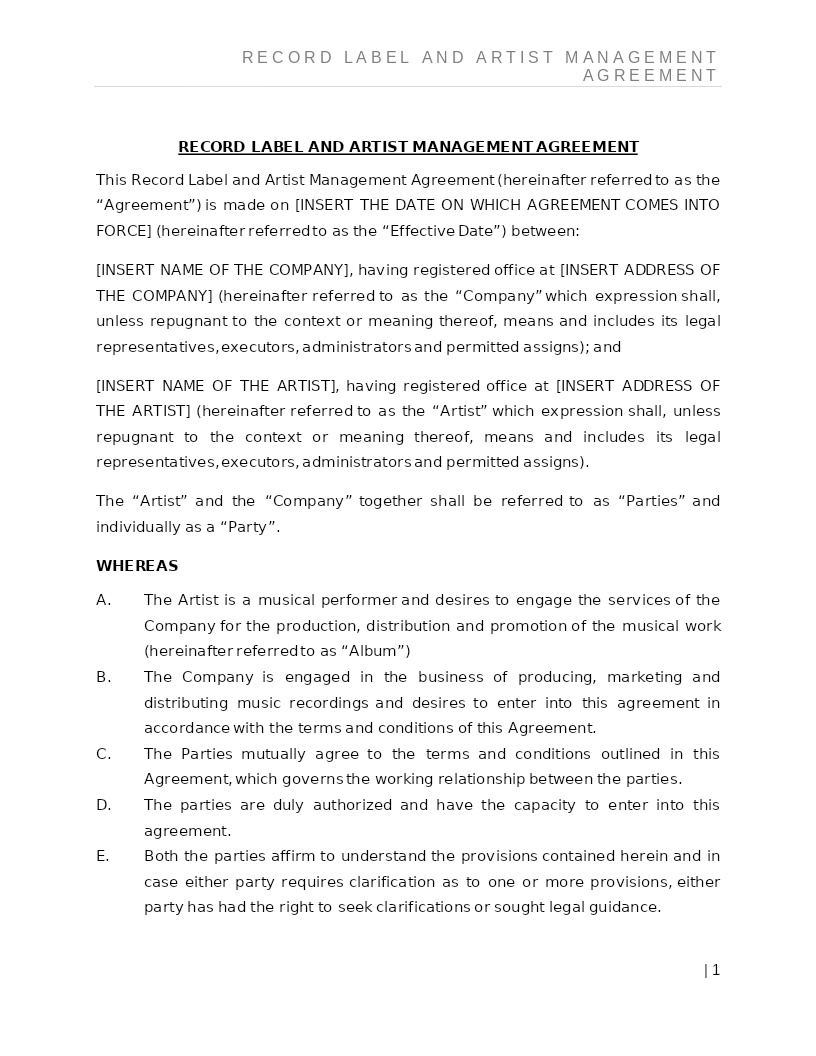
RECORD LABEL AGREEMENT
How does it work?
1. Choose this template
Start by clicking on "Fill out the template"
2. Complete the document
Answer a few questions and your document is created automatically.
3. Save - Print
Your document is ready! You will receive it in Word and PDF formats. You will be able to modify it.
Protecting Creative Rights & Revenue in Artist–Label Relationships
When artists enter into discussions with a record label, whether for producing an album, distributing music, or building a long-term career, there must be a clear framework that governs how music, revenue, and creative rights will be handled. A Record Label Agreement provides that structure. It defines how music will be produced, how it will be marketed, how revenue will be shared, and what rights each party holds over the recordings.
Putting a Record Label Agreement in place establishes the trust needed for both parties to collaborate openly, share creative material, invest financial resources, and plan releases without worrying about ownership disputes or uneven obligations.
Where Record Label Agreements Are Commonly Used
Record Label Agreements are standard across many situations in the U.S. music industry, including:
- Signing new or emerging artists for singles, EPs, or full album releases
- Artist development arrangements covering training, branding, and production
- Distribution-only partnerships for independent musicians
- 360° deals covering touring, merchandise, brand sponsorships, and content monetization
- Co-label or joint venture projects between independent and major labels
- Acquisition of sound recordings, remix rights, or re-recording permissions
Any time a label invests money, marketing resources, studio time, or distribution support, a Record Label Agreement sets clear expectations about what the artist must deliver and what the label must provide.
Different Types of Record Label Agreements You May Encounter
- Traditional Label Agreement: The label funds production, marketing, and distribution. In return, it typically owns the master recordings and recoups its expenses from sales and streaming revenue before paying royalties.
- Distribution Agreement: The artist retains ownership of their master's while a label or distributor handles digital and physical distribution across platforms like Spotify, Apple Music, and Amazon Music.
- 360° Artist Deal: The label participates in multiple income streams music, touring, publishing, merchandise, and endorsements, because it invests significantly in the artist’s overall career development.
- Development or Production Deal: Used when producers or smaller labels develop an artist’s style, sound, or early catalogue before approaching a major label.
- Joint Venture Agreement: The artist and label share ownership, decision-making authority, and profits. This structure is common for well-established independent artists.
When Legal Guidance Becomes Helpful
Most standard artist label discussions benefit from legal input, but professional guidance becomes essential when:
- Ownership of master recordings is a key negotiation point
- Multiple jurisdictions or international distribution channels are involved
- The agreement includes complex revenue models such as 360° rights or cross-collateralization
- The music includes samples or third-party rights requiring clearance
- Significant financial investment, touring advances, or long-term exclusivity is involved
- The relationship requires detailed clauses on creative control or release schedules
- The artist or label needs tailored protections for brand identity, copyrights, or digital content
- The deal affects or interacts with existing publishing contracts or management agreements
Legal review helps ensure the arrangement is enforceable, compliant with U.S. copyright laws, and customised to protect both creative and financial interests.
How to Work with This Template
- Identify the parties (label and artist)
- Clearly state the purpose of the agreement: release of singles, an EP, an album, or long-term collaboration
- Define ownership of master recordings, trademarks, and promotional content
- Outline royalty percentages, payment schedules, and recoupment terms
- Specify marketing, distribution, and touring responsibilities
- Choose governing state law
- Review the terms together (legal review recommended)
- Sign electronically or in hard copy
The template follows widely recognised U.S. contract standards and is compatible with major e-signature platforms.
Frequently Asked Questions
Q1. Is a Record Label Agreement necessary before releasing music through a label?
Yes. A Record Label Agreement ensures both the artist and the label understand their financial, creative, and promotional responsibilities. In the U.S. industry where ownership of masters and royalty structures affect long-term revenue, having a written contract prevents misunderstandings and secures legal protection for both parties.
Q2. Does signing a Record Label Agreement mean the label owns my music?
Not automatically. Ownership depends on the type of deal. In traditional label contracts, the label often owns the master recordings because it funds production and marketing. However, many independent and modern distribution deals let artists keep ownership while giving the label rights to distribute or monetize the recordings. The agreement should clearly outline who owns what.
Q3. How do royalties work in a U.S. Record Label Agreement?
Royalties are usually a percentage of revenue earned from streaming, downloads, physical sales, and licensing. Labels typically recover (“recoup”) their investments such as studio costs, advances, and promotional expenses, before paying the artist. A detailed contract helps artists understand exactly how royalties are calculated and when they can expect payments.
Q4. What is a recoupable advance and how does it affect artists?
A recoupable advance is upfront money a label pays to an artist for living, recording, or touring expenses. It is not a gift; the label recovers this amount from the artist’s future royalties. Only after the advance is fully recouped does the artist begin to earn royalty income. Understanding recoupment is crucial for forecasting earnings.
Q5. Can an independent artist use this Record Label Agreement template?
Yes. Independent artists often use tailored versions of record label agreements when partnering with boutique labels, online distributors, or production teams. While a template provides a helpful starting point, customizing it ensures the deal reflects the artist’s actual rights, goals, and creative control. Legal review is strongly recommended.
Q6. Are electronic signatures valid for Record Label Agreements in the United States?
Absolutely. Under the ESIGN Act, electronic signatures are legally binding in all U.S. states. This allows artists and labels to finalize deals quickly, even when working remotely or across different states.
Q7. What happens if there is a breach of the Record Label Agreement?
If either party violates the agreement such as delaying delivery of music, failing to pay royalties, or withholding promotional support the non-breaching party can pursue remedies such as termination, arbitration, financial compensation, or enforcement of specific performance. Most contracts also require written notice before taking action.
Q8. Does a U.S. Record Label Agreement allow for global music distribution?
Yes. Most U.S. agreements include worldwide distribution rights, allowing music to be released and streamed internationally. To simplify enforcement, the parties choose one U.S. state’s law to govern the contract, even when the music is distributed globally.
Q9. Should artists consult a music lawyer before signing?
Yes. Record Label Agreements can shape an artist’s career for years affecting ownership, income, creative control, and release freedom. A knowledgeable U.S. music attorney can negotiate better terms, clarify ambiguous clauses, and ensure the contract protects the artist’s long-term interests.