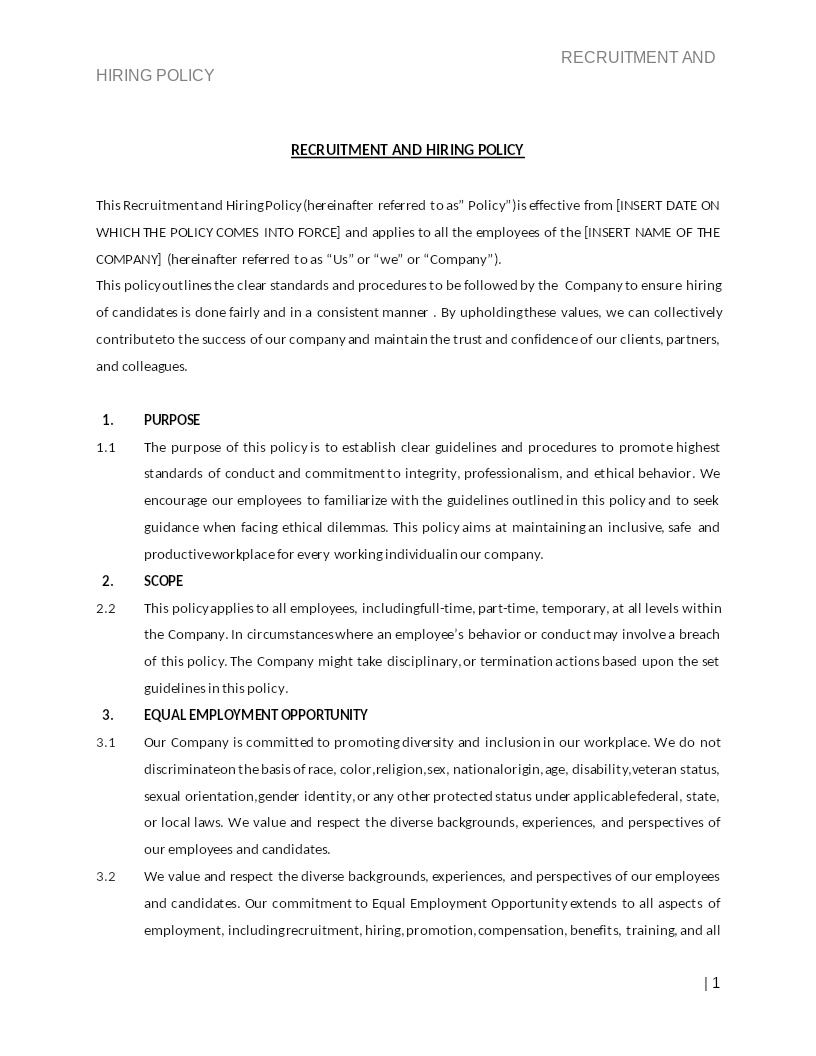
RECRUITMENT AND HIRING POLICY
How does it work?
1. Choose this template
Start by clicking on "Fill out the template"
2. Complete the document
Answer a few questions and your document is created automatically.
3. Save - Print
Your document is ready! You will receive it in Word and PDF formats. You will be able to modify it.
Understanding the Recruitment and Hiring Policy
A Recruitment and Hiring Policy establishes a clear, consistent, and legally compliant process for attracting, evaluating, and onboarding new employees. It outlines how job openings are created, how candidates are sourced, what evaluation standards apply, and how final hiring decisions are made. This policy ensures fairness, transparency, and equal opportunity throughout the hiring lifecycle while helping organizations comply with U.S. employment laws—including anti-discrimination rules, labor standards, and recordkeeping requirements.
A well-defined hiring policy supports efficient growth, reduces legal risk, and promotes a professional and ethical approach to talent acquisition.
Where Recruitment and Hiring Policies Are Commonly Used
Organizations rely on a structured hiring policy in many situations, including:
• Expanding teams or filling new positions
• Replacing employees due to turnover
• Conducting campus recruitment or internship programs
• Engaging external recruiters, staffing agencies, or talent consultants
• Implementing DEI (Diversity, Equity & Inclusion) initiatives
• Standardizing hiring practices across departments or locations
• Maintaining compliance during mass hiring or seasonal staffing
Any organization intending to hire employees benefits from a documented and standardized hiring process.
Different Components Often Included in a Hiring Policy
- Job Requisition & Approval Process: Defines how new roles are requested, reviewed, and approved internally.
- Candidate Sourcing & Advertising: Details how job listings are posted, promoted, and marketed—ensuring equal opportunity compliance.
- Screening & Interview Procedures: Outlines standardized steps for reviewing applications, scheduling interviews, and evaluating candidates.
- Background Checks & Verification: Includes rules for reference checks, employment verification, eligibility to work in the U.S. (Form I-9), and optional background screenings.
- Selection & Offer Approval: Establishes criteria and decision rules for extending employment offers and negotiating terms.
- Onboarding & Documentation: Ensures new hires complete required forms, orientation, and compliance training.
When Legal Guidance Becomes Helpful
Although an internal policy can be created without formal legal review, legal guidance is useful when:
• The organization hires across multiple U.S. states with different employment laws
• Roles involve minors, regulated industries, or safety-sensitive duties
• The company wants to conduct background checks or drug tests
• Employment advertisements must meet EEOC or ADA compliance
• International candidates require visa sponsorship
• Policies involve AI-based hiring tools that trigger new state regulations
How to Work with This Template
• Identify roles, responsibilities, and hiring authority
• Outline each stage of the recruitment process clearly
• Add screening steps, tests, or evaluation standards
• Choose a governing U.S. state law for employment matters
• Include equal-opportunity and non-discrimination statements
• Review internally and update periodically
• Share with hiring managers and HR teams
• Use digital platforms for approvals and documentation
Frequently Asked Questions (FAQ)
Q1. Why are a Recruitment and Hiring Policy important for U.S. organizations?
It ensures that hiring practices are fair, consistent, and compliant with federal and state employment laws. A structured policy reduces risks of bias, supports equal opportunity, and helps organizations make objective hiring decisions that withstand legal scrutiny.
Q2. Does this policy help with EEOC and anti-discrimination compliance?
Yes. A clear hiring policy reinforces compliance with EEOC guidelines and laws prohibiting discrimination based on race, gender, age, disability, religion, or other protected characteristics. It establishes uniform evaluation standards and prevents inconsistent decision-making.
Q3. Can the Recruitment and Hiring Policy be applied across multiple states?
Absolutely. The policy can be used nationally but should be adapted to reflect relevant state-specific laws such as pay transparency requirements, background check rules, or interview restrictions.
Q4. Should background checks be included in the hiring policy?
Yes, if they are part of the hiring process. The policy should explain when background checks are used, how they comply with FCRA (Fair Credit Reporting Act) rules, and how candidates are notified.
Q5. How does the policy support fair candidate selection?
It outlines objective evaluation criteria such as skills, experience, and qualifications ensuring that all candidates are assessed using the same standards. This improves fairness and transparency.
Q6. Can this policy guide hiring managers during interviews?
Yes. It provides structured interview guidelines, question rules, documentation practices, and prohibited topics, helping hiring managers conduct compliant and professional interviews.
Q7. Does the policy cover remote or hybrid hiring processes?
It can. Many organizations include virtual interview guidelines, remote onboarding steps, and digital documentation standards to support modern hiring needs.
Q8. How often should the hiring policy be updated?
Most organizations review it annually or whenever major employment-law changes occur. Updates ensure ongoing compliance with EEOC, FLSA, ADA, and state-level regulations.
Q9. Can the policy be used for both full-time and part-time hiring?
Yes. It applies to all employment types, including full-time, part-time, temporary, contract-to-hire, and seasonal positions, ensuring consistent procedures across the board.
Q10. Does the policy help in defending hiring decisions if challenged legally?
Yes. A documented hiring process demonstrates consistency, fairness, and adherence to legal standards, which is useful if an organization must respond to discrimination claims or regulatory questions.