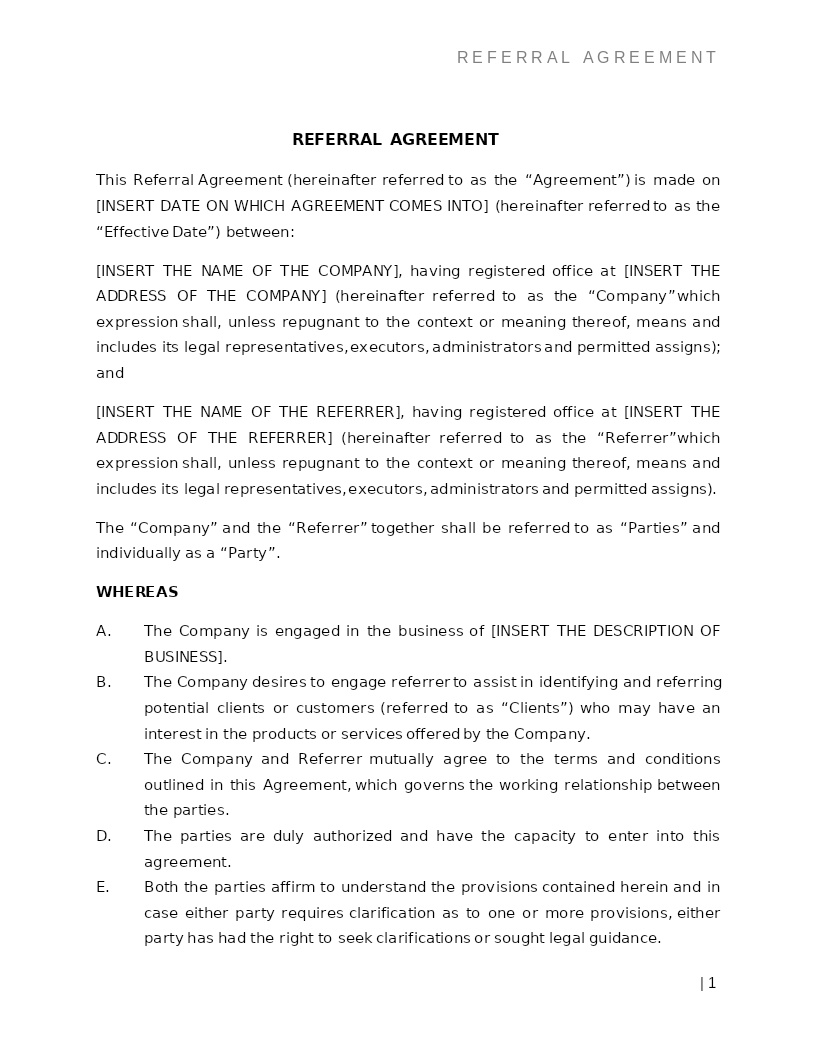
REFERRAL AGREEMENT
How does it work?
1. Choose this template
Start by clicking on "Fill out the template"
2. Complete the document
Answer a few questions and your document is created automatically.
3. Save - Print
Your document is ready! You will receive it in Word and PDF formats. You will be able to modify it.
Understanding the Referral Agreement
When a business relies on referrals to acquire new customers, it is essential to clearly define how those referrals will be made, tracked, and compensated. A Referral Agreement provides that structure. It outlines how one party (the referrer) introduces potential clients to another party (the recipient) and sets the terms for commissions, payments, confidentiality, and performance expectations.
Putting a Referral Agreement in place establishes trust, protects both parties, and ensures that referrals are handled in a consistent and legally compliant manner.
Where Referral Agreements Are Commonly Used
Referral Agreements are standard across many industries where relationship-based marketing and lead generation drive revenue, including:
- Professional services (law firms, accounting firms, consultants)
- Real estate agencies and brokerage networks
- SaaS companies, tech platforms, and affiliate programs
- Financial services, insurance agents, and investment advisors
- Healthcare practitioners operating permissible referral programs
- Construction, contracting, and trade-based industries
- Influencer or creator-based referral arrangements
Whenever referrals generate new business opportunities, a Referral Agreement ensures clarity, accountability, and fair compensation for successful leads.
Different Types of Referral Agreements You May Encounter
- Commission-Based Referral Agreement: The referrer earns a percentage of revenue or a fixed fee when the referral becomes a paying client.
- Affiliate or Link-Based Referral Agreement: Common in e-commerce or SaaS industries where referrals are tracked through affiliate links or codes.
- Flat-Fee Referral Agreement: The referrer receives a one-time payment for each successful lead.
- Partnership or Channel Referral Agreement: Businesses form long-term referral partnerships with shared revenue structures or mutual lead exchanges.
- Employee Referral Agreement: Used internally within companies to reward employees for referring clients or candidates.
- Exclusive Referral Agreement: The referrer is given exclusive rights to refer clients within certain industries, markets, or territories.
When Legal Guidance Becomes Helpful
Even simple referral arrangements benefit from legal review when:
- Commission structures are complex or revenue-based
- Referrals involve regulated industries (finance, insurance, healthcare, legal services)
- Multi-jurisdictional operations require state-specific compliance
- Confidential or proprietary customer information is shared
- Intellectual property such as marketing materials or brand assets is used
- The agreement includes exclusivity or non-compete restrictions
- The referral relationship affects consumer rights or privacy requirements
- Payment obligations depend on long-term customer contracts or renewals
Legal guidance ensures the agreement is enforceable, compliant, and aligned with both parties’ operational and regulatory requirements.
How to Work with This Template
- Identify the referrer and recipient clearly
- Define what qualifies as a “successful referral” and how it will be tracked
- Specify commission rates, payment timelines, and any recurring payment terms
- Clarify confidentiality obligations and data privacy considerations
- Select the governing U.S. state law for the agreement
- Outline responsibilities, marketing permissions, and communication protocols
- Review terms collaboratively—legal review optional but recommended
- Sign electronically or physically—U.S. law fully recognizes e-signatures
This template aligns with widely recognized standards in U.S. referral, affiliate, and partnership programs.
Frequently Asked Questions
Q1. What is a Referral Agreement and why is it important for U.S. businesses?
A Referral Agreement is a legal contract that defines how referrals will be made and compensated. It helps protect both parties by establishing eligibility criteria, commission rates, confidentiality, and dispute resolution methods. In the U.S., these agreements support transparent, scalable, and legally compliant referral programs.
Q2. When does a referral qualify for commission under this agreement?
This varies based on the terms. A referral may qualify once a lead becomes a paying customer, signs a contract, completes a purchase, or meets specific revenue thresholds. Clearly defining qualification criteria prevents misunderstandings and payment disputes.
Q3. Can a Referral Agreement include recurring commissions or long-term payouts?
Yes. Many U.S. businesses, especially SaaS companies, include recurring commissions for ongoing subscriptions or renewals. The agreement should specify duration, payment frequency, and renewal tracking to avoid ambiguity.
Q4. How is confidentiality handled in a Referral Agreement?
Referral Agreements often include confidentiality provisions to protect sensitive client information, pricing structures, internal processes, and proprietary data. This ensures that both parties handle shared information responsibly and in compliance with U.S. privacy laws.
Q5. Are Referral Agreements enforceable across different states?
Yes. Parties can choose a governing state, commonly New York, California, Texas, or Delaware, which ensures enforceability even if the referrer and recipient operate in different jurisdictions.
Q6. Can a Referral Agreement include exclusivity provisions?
Absolutely. Some businesses grant referrers exclusive rights within specific industries, regions, or market segments. Exclusivity terms should be clearly outlined, including duration, territory, and any performance requirements.
Q7. What happens if a dispute arises over unpaid commissions?
Most Referral Agreements include dispute resolution mechanisms such as mediation, arbitration, or jurisdiction-specific litigation. These clauses help resolve conflicts efficiently while avoiding costly legal battles.
Q8. Is this agreement suitable for affiliate programs and online referrals?
Yes. Referral Agreements are frequently used in digital marketing, influencer partnerships, affiliate link programs, and SaaS referral networks. The contract ensures that online referrals are tracked, verified, and compensated accurately.