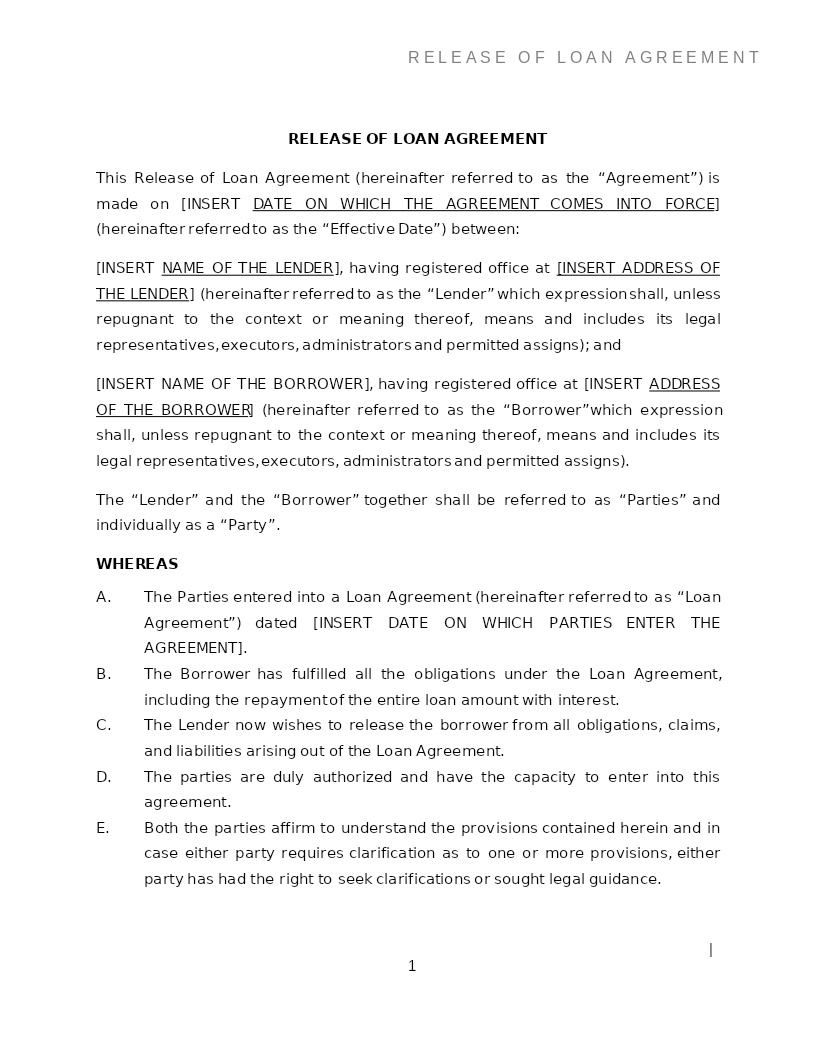
RELEASE OF LOAN AGREEMENT
How does it work?
1. Choose this template
Start by clicking on "Fill out the template"
2. Complete the document
Answer a few questions and your document is created automatically.
3. Save - Print
Your document is ready! You will receive it in Word and PDF formats. You will be able to modify it.
Formally Releasing Borrowers from Debt Obligations Through a Release of Loan Agreement
When a borrower satisfies, settles, or otherwise resolves their financial obligations under a loan, it becomes essential for the parties to formally acknowledge that the debt has been extinguished. A Release of Loan Agreement serves this purpose. It documents the lender’s confirmation that the borrower has fulfilled repayment obligations, whether through full payment, negotiated settlement, refinancing, or debt forgiveness, in accordance with U.S. contract principles, lending regulations, debt-collection laws, and applicable federal and state financial statutes.
A Release of Loan Agreement ensures that no ambiguity remains regarding the borrower’s outstanding balance, the lender’s rights, or the complete discharge of the loan. It provides written proof that the lender waives further claims related to the debt, acknowledges closure of the loan account, and releases any associated security interests or liens. This agreement protects both parties by creating a verifiable, legally enforceable record of debt resolution.
Where Release of Loan Agreements Are Commonly Used
Release of Loan Agreements are utilized in diverse financial and commercial scenarios, including:
- Full repayment of personal, commercial, or secured loans
- Settlement arrangements resolving outstanding debt obligations
- Refinancing transactions in which a new lender assumes old debt
- Release of liens on vehicles, equipment, or real property
- Private lending arrangements between individuals or businesses
- Termination of promissory notes, credit facilities, or micro-loans
- Debt forgiveness agreements between related parties or partners
- Resolution of overdue accounts in compliance with debt-collection laws
Any situation in which a lender must formally certify that a debt obligation is satisfied may require executing a Release of Loan Agreement.
Different Types of Release of Loan Agreements You May Encounter
1. Full Release of Loan Agreements: Confirm complete repayment and termination of all obligations.
2. Partial or Conditional Release Agreements: Apply when only a portion of the debt is forgiven or when conditions must be met.
3. Lien Release Agreements: Release security interests in collateral such as real estate, vehicles, or equipment.
4. Settlement-Based Loan Releases: Document agreements where the borrower resolves the loan for less than the full balance.
5. Co-Signer or Guarantor Release Agreements: Release individuals who originally guaranteed repayment obligations.
When Legal Guidance Becomes Helpful
Legal consultation may be advisable when:
- The loan involves secured collateral requiring lien release documentation
- The lender is forgiving debt, which may have tax implications
- The parties are negotiating a reduced settlement amount
- There is uncertainty about whether additional consideration is required
- Disputes exist regarding the loan balance, interest, or late fees
- The release affects rights under a promissory note, guaranty, or security agreement
- State-specific lending or debt-collection regulations must be complied with
- The lender seeks assurance that all claims, defenses, and liabilities are fully waived
An attorney can ensure the release complies with U.S. lending laws, is enforceable, and mitigates future liability or disputes.
How to Work with This Template
- Identify the original loan agreement, including date, parties, and principal amount
- Specify whether the release is full, partial, conditional, or settlement-based
- Confirm that all repayment obligations have been satisfied or waived
- Release any associated liens, security interests, or collateral claims
- Clarify whether the lender waives all future claims related to the loan
- Address tax implications, reporting duties, and any required notices
- State that the remaining provisions of the original loan are no longer binding
- Require signatures from authorized representatives and retain for records
- Ensure compliance with federal, state, and local lending regulations
This template reflects standard U.S. lending-industry practices and may be used by banks, private lenders, financial institutions, or individuals involved in loan-related transactions.
Frequently Asked Questions
Q1. What is a Release of Loan Agreement, and why is it important?
A Release of Loan Agreement is a legal document confirming that a borrower has satisfied or settled a loan. It is important because it prevents future claims or misunderstandings, provides proof of debt discharge, and releases any collateral or liability associated with the loan.
Q2. Does a Release of Loan Agreement cancel all obligations?
Yes, if written as a full release. Partial or conditional releases may cancel only specific obligations. The agreement should clearly specify the extent of the release.
Q3. Is lien release included in the agreement?
If collateral was pledged, the agreement should include or reference a lien-release document. This ensures the borrower regains full ownership of the collateral without encumbrances.
Q4. Are electronic signatures valid on Release of Loan Agreements?
Yes. Under the ESIGN Act, electronic signatures are enforceable and widely accepted for loan-related documentation.
Q5. What happens if the borrower still owes fees or interest?
The agreement must clearly state whether such amounts are forgiven or remain due. Ambiguity may create legal exposure, so detailed drafting is essential.
Q6. Can a lender forgive a loan without a release?
Technically yes, but it is strongly discouraged. A release provides formal legal proof of forgiveness and protects both parties from future disputes.
Q7. Does a loan release affect credit reporting?
It may. If the loan is fully paid, the lender may update credit bureaus. If settled for less than owed, the lender may report the settlement. The agreement should clarify reporting obligations.
Q8. Are there tax consequences for loan forgiveness?
Possibly. Under IRS rules, forgiven debt may be considered taxable income unless an exception applies. Borrowers should consult tax professionals.
Q9. Can a release be revoked after signing?
Generally, no. Once executed, a Release of Loan Agreement is legally binding unless fraud, coercion, or material error is proven.
Q10. What if the lender refuses to provide a release?
Borrowers may request documentation, escalate the matter, or seek legal assistance. Lenders may be required under certain laws or loan terms to provide confirmation of payoff.