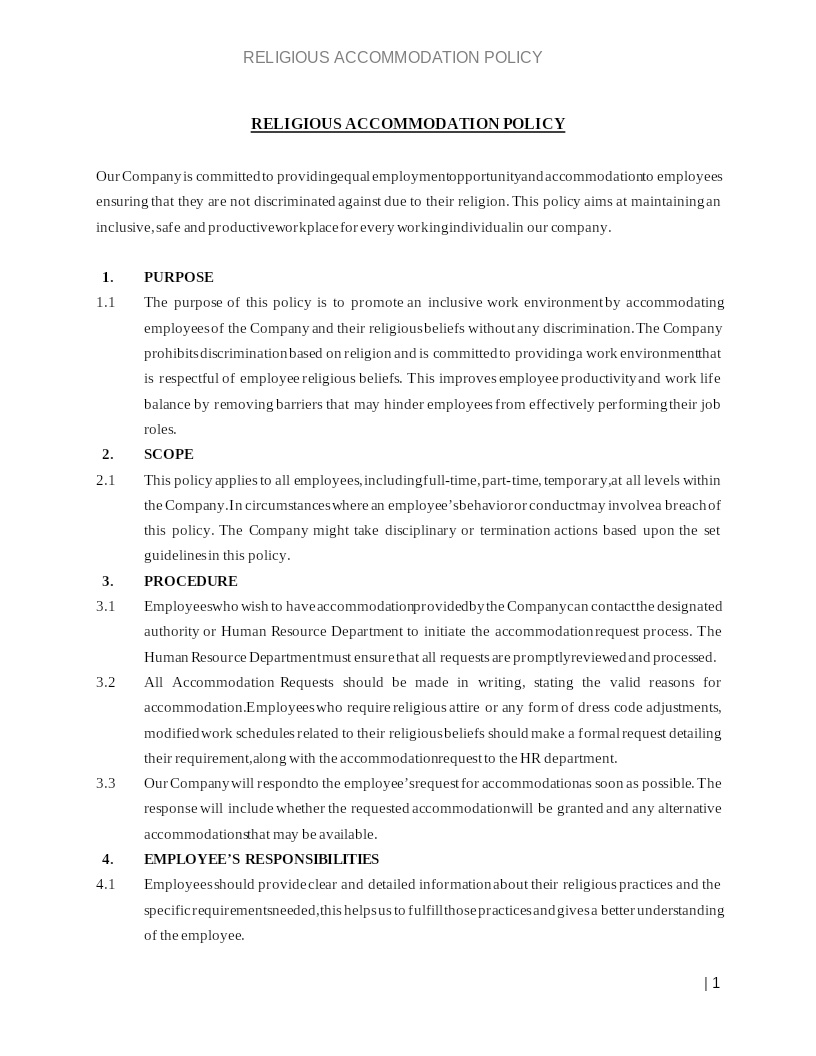
RELIGIOUS ACCOMODATION POLICY
How does it work?
1. Choose this template
Start by clicking on "Fill out the template"
2. Complete the document
Answer a few questions and your document is created automatically.
3. Save - Print
Your document is ready! You will receive it in Word and PDF formats. You will be able to modify it.
Supporting Employees’ Religious Rights in the Workplace
Employees often bring diverse religious beliefs, practices, and observances to the workplace. A Religious Accommodation Policy establishes a clear framework that explains how an organization will recognize, evaluate, and respond to accommodation requests related to religion including schedule adjustments, attire, grooming, holidays, prayer time, or other observances.
A well-defined policy fosters inclusivity and legal compliance by clarifying the organization’s responsibility to make reasonable accommodations under U.S. laws such as Title VII of the Civil Rights Act of 1964. It helps employees feel respected and supported while ensuring operational needs and safety requirements are maintained.
Where Religious Accommodation Policies Are Commonly Used
These policies are standard across a wide range of workplaces, including:
• Corporate offices and professional settings
• Customer service and retail environments
• Hospitals, clinics, and healthcare facilities
• Schools, universities, and educational institutions
• Manufacturing plants and industrial sites
• Government agencies and regulated sectors
• Hospitality, travel, and service industries
Different Types of Accommodations You May Encounter
- Scheduling Accommodations: Adjustments for religious holidays, weekly observances, or prayer times.
- Dress & Grooming Accommodations: Allowances for religious clothing, head coverings, beards, or hairstyles.
- Work Duties & Job Modifications: Reassignment of tasks that conflict with a sincerely held belief when feasible.
- Use of Space: Providing a quiet area for prayer or meditation when possible.
- Meal & Break Adjustments: Allowing flexibility for fasting, dietary restrictions, or observances.
When Legal Guidance Becomes Helpful
Most accommodation requests can be handled internally, but professional guidance is useful when:
• The request may impact safety, compliance, or essential job functions
• Multiple employees request differing accommodations for the same shifts
• A requested modification functions like a workplace exemption
• Potential conflicts arise between religious needs and uniform policies
• Documentation is required for disputes or investigations
• The employer needs clarity on what qualifies as an “undue hardship” under U.S. law
How to Work with This Template
• Identify the purpose and scope of the policy
• Explain what qualifies as a religious accommodation request
• Outline the step-by-step request process for employees
• Describe how managers should handle and review requests
• Clarify which laws apply and define “reasonable accommodation”
• Include examples of acceptable accommodations
• Set expectations for documentation and timelines
• Train supervisors on implementation procedures
• Allow electronic or written submission of requests
Frequently Asked Questions
Q1. What qualifies as a religious accommodation under U.S. law?
A religious accommodation is any adjustment to workplace policies or practices that allows an employee to follow their sincerely held religious beliefs. This may include schedule changes, attire exemptions, grooming modifications, or space for prayer.
Q2. Are employers legally required to provide religious accommodations?
Yes. Under Title VII, employers must provide reasonable accommodations unless doing so would create an undue hardship meaning significant cost, safety risk, or operational disruption.
Q3. Do employees need to provide proof of their religion?
Generally, no. Employers may ask for clarification if the request is unclear, but they cannot require documentation from clergy unless the situation is unusually complex or contradictory.
Q4. Can religious accommodation requests impact scheduling?
Yes, and that’s normal. Many requests involve shift swaps, flexible timing, or holiday observances. Employers must explore reasonable options that don’t cause undue hardship to staffing or operations.
Q5. Are dress code exceptions allowed?
Absolutely. Religious attire such as hijabs, turbans, yarmulkes, or modest clothing should be accommodated unless it conflicts with safety requirements (e.g., machinery risks).
Q6. What happens if an accommodation conflicts with company policy?
The employer should engage in an interactive dialogue with the employee to explore alternatives. Policies can be adjusted unless doing so compromises safety or essential business needs.
Q7. Can employers deny a religious accommodation request?
Yes, but only if the request creates an undue hardship. Denials must be based on legitimate business reasons, not personal disagreement with the belief.
Q8. Do remote workers also qualify for accommodations?
Yes. Religious practices may still need support remotely for example, flexible scheduling or adjusted meeting times.
Q9. Can employees be disciplined for requesting an accommodation?
No. Retaliation is prohibited. Employees must be able to make requests without fear of negative consequences.
Q10. Should supervisors receive training on religious accommodations?
Yes. Supervisor training is essential to ensure consistent decision-making, prevent discrimination claims, and maintain compliance with federal and state laws.