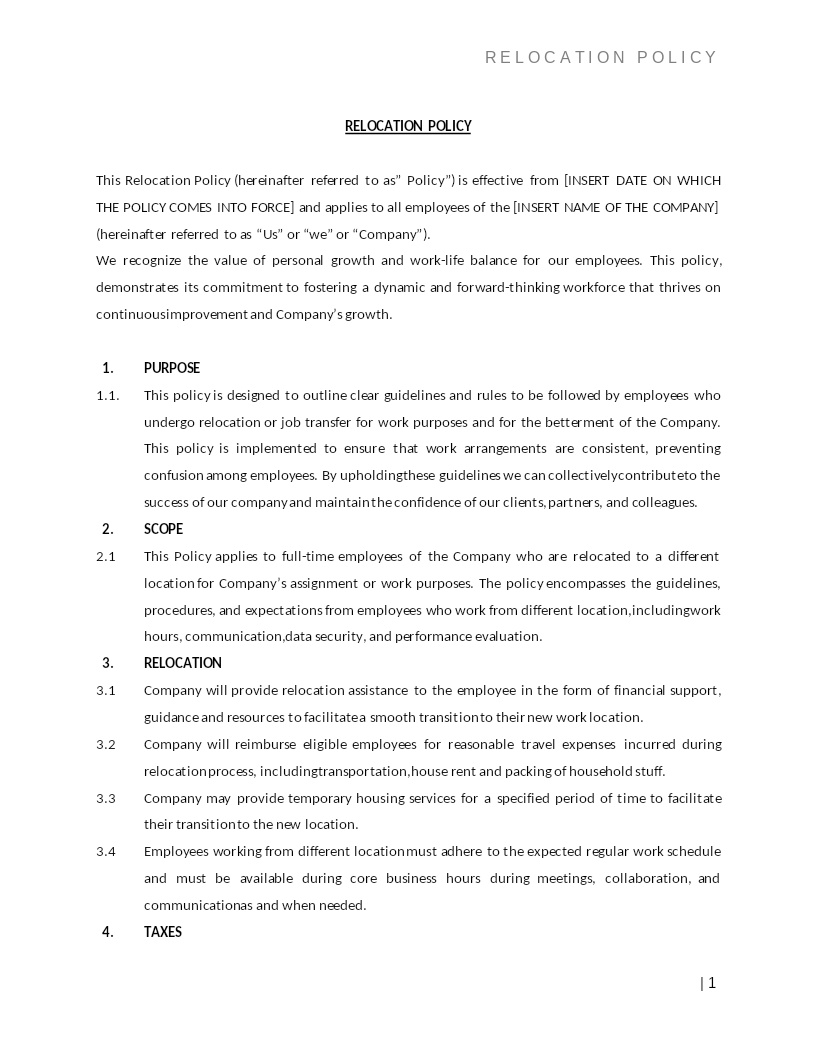
RELOCATION POLICY
How does it work?
1. Choose this template
Start by clicking on "Fill out the template"
2. Complete the document
Answer a few questions and your document is created automatically.
3. Save - Print
Your document is ready! You will receive it in Word and PDF formats. You will be able to modify it.
Supporting Employees Through Smooth Transitions
When an organization requires an employee to move to a new city, state, or country for work, having a clear Relocation Policy ensures transparency, fairness, and consistency. A Relocation Policy outlines what support the company provides, which expenses are covered, the approval process, timelines, and the employee’s responsibilities during the move.
A well-structured policy helps employees understand the benefits available to them such as travel costs, temporary housing, moving services, or family assistance while helping employers control costs and maintain fairness across departments.
A Relocation Policy creates clarity and reduces stress, enabling employees to focus on their new roles without worrying about logistical or financial uncertainties.
Where Relocation Policies Are Commonly Used
Relocation support is typically offered when:
• Employees are transferred to another branch, region, or office
• A new hire must move for their role
• Companies expand into new geographic markets
• Senior executives take up leadership roles in different locations
• Internal promotions require relocation
• Employees move temporarily for projects, training, or client assignments
Whenever an employee must move for work, a Relocation Policy sets clear expectations about what the company will and will not cover.
Different Types of Relocation Policies You May Encounter
- Full-Service Relocation Policy: Provides comprehensive support including moving services, temporary housing, travel, storage, and family assistance.
- Partial or Capped Relocation Policy: Offers relocation benefits up to a fixed financial limit.
- New-Hire Relocation Policy: Designed for new employees who must relocate before joining the organization.
- Temporary Relocation Policy: Used when employees relocate for short-term assignments or client projects.
- Executive Relocation Policy: Customized for senior leadership with enhanced benefits.
When Legal Guidance Becomes Helpful
Most relocations are straightforward, but legal advice may be useful when:
• The relocation crosses state or country borders
• Immigration, visas, or international tax compliance are involved
• The company offers home sale or lease-breaking assistance
• Reimbursement policies must comply with IRS or state tax rules
• The relocation includes school assistance or family benefits
• The company wants protection if an employee resigns shortly after relocating
While legal review isn’t mandatory, it reduces risk and ensures compliance with U.S. employment and tax laws.
How to Work with This Template
• Define which employees are eligible for relocation benefits
• Clearly list covered expenses (travel, movers, housing, etc.)
• Specify reimbursement rules and required documentation
• Outline timelines, approval processes, and relocation deadlines
• Clarify tax implications and whether benefits are taxable
• Choose the governing U.S. state law
• Add conditions for repayment if the employee leaves within a set period
• Review the policy with HR or legal if needed
• Share the policy with employees and obtain acknowledgement
This template aligns with common U.S. HR practices and can be issued electronically or in hard copy.
Frequently Asked Questions
Q1. What is a Relocation Policy and why is it important?
A Relocation Policy explains what financial and logistical support the company provides when an employee must move for work. It is important because it eliminates confusion, promotes fairness, and helps employees transition smoothly without unexpected expenses.
Q2. Are relocation benefits taxable in the United States?
Under current IRS rules, most employer-paid relocation expenses are considered taxable income unless the company structures them through a compliant relocation program. A clear policy helps employees understand any tax implications.
Q3. What expenses are typically covered under a Relocation Policy?
Policies may cover travel costs, moving services, temporary housing, storage, transportation of household goods, lease termination fees, and sometimes family relocation support. The exact benefits depend on the company’s guidelines.
Q4. Can new employees receive relocation assistance?
Yes. Many organizations provide relocation support to new hires when the position requires moving. This improves hiring flexibility and helps attract talent from a wider geographic area.
Q5. Does the company pay for the employee’s family to relocate?
Some policies include benefits for spouses, children, or dependents such as travel costs, temporary housing, or schooling assistance. The policy should clearly define which family-related expenses are eligible.
Q6. What happens if an employee resigns shortly after relocating?
Many employers include repayment or clawback provisions, requiring employees to reimburse relocation costs if they leave within a specified period commonly 6 to 24 months. This protects the company from unnecessary expenses.
Q7. Are employees required to submit receipts for reimbursement?
Usually yes. Most relocation benefits require documentation such as invoices, receipts, or travel confirmations. The policy outlines how to submit proof and the timelines for reimbursement.
Q8. Can employees choose their own movers or relocation vendors?
Some companies allow employees to select their own moving providers, while others use approved vendors for cost control and quality assurance. The policy clarifies any restrictions or required vendors.
Q9. Is temporary housing included in a relocation package?
Often, yes. Many relocation policies provide 30–90 days of temporary housing, especially when employees need time to secure long-term accommodation. Duration and budget limits are typically defined in the policy.
Q10. Can relocation support be customized for different roles?
Yes. Employers may offer enhanced benefits for executives or specialized roles. However, customization should still follow a consistent framework to remain fair, legal, and compliant with labor regulations.