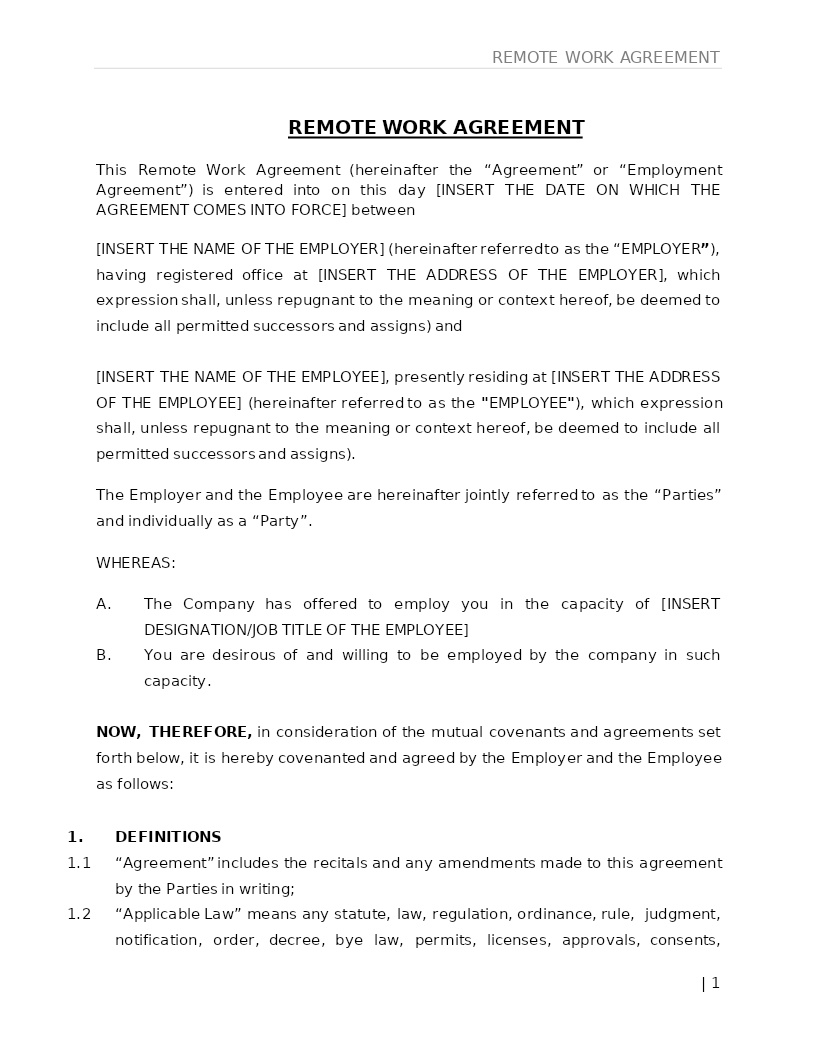
REMOTE WORK AGREEMENT
How does it work?
1. Choose this template
Start by clicking on "Fill out the template"
2. Complete the document
Answer a few questions and your document is created automatically.
3. Save - Print
Your document is ready! You will receive it in Word and PDF formats. You will be able to modify it.
Creating Clarity & Accountability in Remote Work Arrangements
As remote work becomes a core part of modern employment in the United States, companies must establish clear expectations and boundaries to ensure productivity, accountability, and legal compliance. A Remote Work Agreement sets out the terms under which an employee is permitted to work outside the traditional office environment. It defines responsibilities, communication standards, work hours, data security requirements, and the tools provided by the employer.
Putting a Remote Work Agreement in place ensures that both the employer and the employee understand their obligations, rights, and performance expectations. It promotes smoother operations, reduces potential disputes, and helps maintain a safe, secure, and productive remote work environment.
Where Remote Work Agreements Are Commonly Used
Remote Work Agreements are widely used across U.S. industries, particularly where employees regularly perform duties from home or alternate work locations. They are standard for full-time remote employees, hybrid workers, distributed teams, consultants, and staff handling confidential or regulated data. Companies implementing flexible work policies also use these agreements to set consistent guidelines across departments and to formalize remote work terms that comply with labor, tax, and safety laws.
Different Types of Remote Work Agreements You May Encounter
- Full-Time Remote Work Agreement: Used when an employee works entirely from a remote location.
- Hybrid Work Agreement: Covers employees who split their time between remote work and the office.
- Temporary or Emergency Remote Work Agreement: Implemented during emergencies, business closures, or short-term accommodations.
- Cross-Border or Multi-State Remote Work Agreement: Used when employees work from another state or country and must comply with additional legal requirements.
When Legal Guidance Becomes Helpful
Legal advice becomes important when remote work involves multi-state taxation, cross-border work, data-intensive roles, or compliance with federal and state labor laws. Attorneys can help clarify wage-and-hour obligations, data security requirements, confidentiality terms, and employer liabilities. They also assist in customizing agreements for regulated industries such as healthcare, finance, or technology, where additional privacy and compliance obligations exist.
How to Work with This Template
- Identify the employer and employee
- Define work hours, duties, and expectations
- Outline communication standards and reporting requirements
- Detail equipment provisions and security obligations
- Choose governing state law
- Review the terms together
- Sign electronically or in hard copy
The template follows standard U.S. employment contracting practices and is compatible with major e-signature platforms.
Frequently Asked Questions
Q1. What is a Remote Work Agreement and why is it important for U.S. employers?
A Remote Work Agreement is a formal contract that defines the rules and expectations for employees working outside the traditional office environment. It clarifies work hours, communication standards, performance expectations, security requirements, and employer-provided equipment. This agreement is important because it reduces uncertainty, ensures compliance with labor and safety laws, and creates a structured framework that protects both employer and employee. As remote work continues to grow in the U.S., having a clear agreement helps prevent miscommunication and supports productive workplace practices.
Q2. Does a Remote Work Agreement specify working hours and availability?
Yes. Most Remote Work Agreements clearly outline expected working hours, core availability windows, and requirements for attending virtual meetings or collaborating with team members. This helps prevent scheduling conflicts and ensures that the employee remains accessible when needed. By defining work hours upfront, employers create a balanced structure that respects both business needs and employee flexibility. It also helps ensure wage-and-hour compliance under U.S. employment laws.
Q3. What kind of equipment and technology does a Remote Work Agreement usually cover?
These agreements typically describe the tools and technology the employer will provide such as laptops, software, access credentials, or reimbursement for internet usage. They also outline the employee’s responsibilities for maintaining and securing those devices. By setting equipment standards, the agreement reduces operational risks and helps protect sensitive information. It also ensures the employee has the resources needed to perform their job effectively from a remote location.
Q4. How does a Remote Work Agreement address data security and confidentiality?
Data security is a key part of any Remote Work Agreement, especially in industries that handle sensitive or regulated information. The agreement usually requires the use of secure networks, VPNs, encrypted devices, and strong password protocols. It also reinforces the employee’s obligation to comply with company data-handling policies and applicable laws such as HIPAA or GDPR. These measures help prevent unauthorized access, data breaches, and security vulnerabilities associated with working from home.
Q5. Does a Remote Work Agreement affect compensation, benefits, or leave policies?
In most cases, remote work does not change an employee’s core salary, benefits, or eligibility for leave. The agreement clarifies that compensation and benefits remain consistent with in-office policies unless otherwise stated. It may also address reimbursement for remote work expenses, depending on company policy and state laws. By outlining this information clearly, employers help maintain transparency and avoid misunderstandings about entitlements or financial obligations.
Q6. What happens if an employee’s home workspace does not meet safety or ergonomic standards?
A Remote Work Agreement typically requires employees to maintain a safe, ergonomic workspace that meets basic health and safety guidelines. Employers may provide recommendations, checklists, or training to help employees set up an appropriate environment. If issues arise, such as unsafe furniture or equipment, they may be addressed through accommodation requests or workspace adjustments. This ensures that both parties uphold their responsibilities for workplace safety, even outside the office.
Q7. Can a Remote Work Agreement be modified, and under what circumstances?
Yes. Remote Work Agreements often include provisions allowing either party to request modifications based on operational needs, role changes, or performance issues. Employers may also revoke or adjust remote work privileges if necessary for business continuity, legal compliance, or productivity concerns. By outlining a clear modification process, the agreement provides flexibility while ensuring fairness and transparency during any changes.
Q8. Are electronic signatures valid for Remote Work Agreements in the U.S.?
Absolutely. Under the federal E-SIGN Act and UETA, electronic signatures are legally valid and widely accepted across all U.S. states. Employers and employees routinely sign Remote Work Agreements electronically for convenience and faster processing. Digital signatures also provide secure, time-stamped documentation that helps maintain accurate employment records. This makes electronic execution both practical and legally enforceable.
Q9. What happens if an employee violates the terms of the Remote Work Agreement?
If an employee fails to follow the agreement’s requirements such as ignoring security protocols, failing to meet performance expectations, or misusing company equipment the employer may take corrective action based on company policy. This may include additional training, revised work arrangements, or disciplinary steps depending on the severity of the violation. A well-drafted agreement outlines consequences clearly, helping avoid misunderstandings and ensuring consistent enforcement across the organization.
Q10. Can a Remote Work Agreement support employees working from different states or countries?
Yes, but additional legal considerations often apply. Multi-state or cross-border remote work may affect taxation, payroll, data privacy obligations, and compliance with state or international labor laws. A Remote Work Agreement helps address these issues by defining jurisdiction, tax responsibilities, security protocols, and working hours across time zones. Employers often consult legal counsel to ensure remote arrangements are compliant and properly documented.