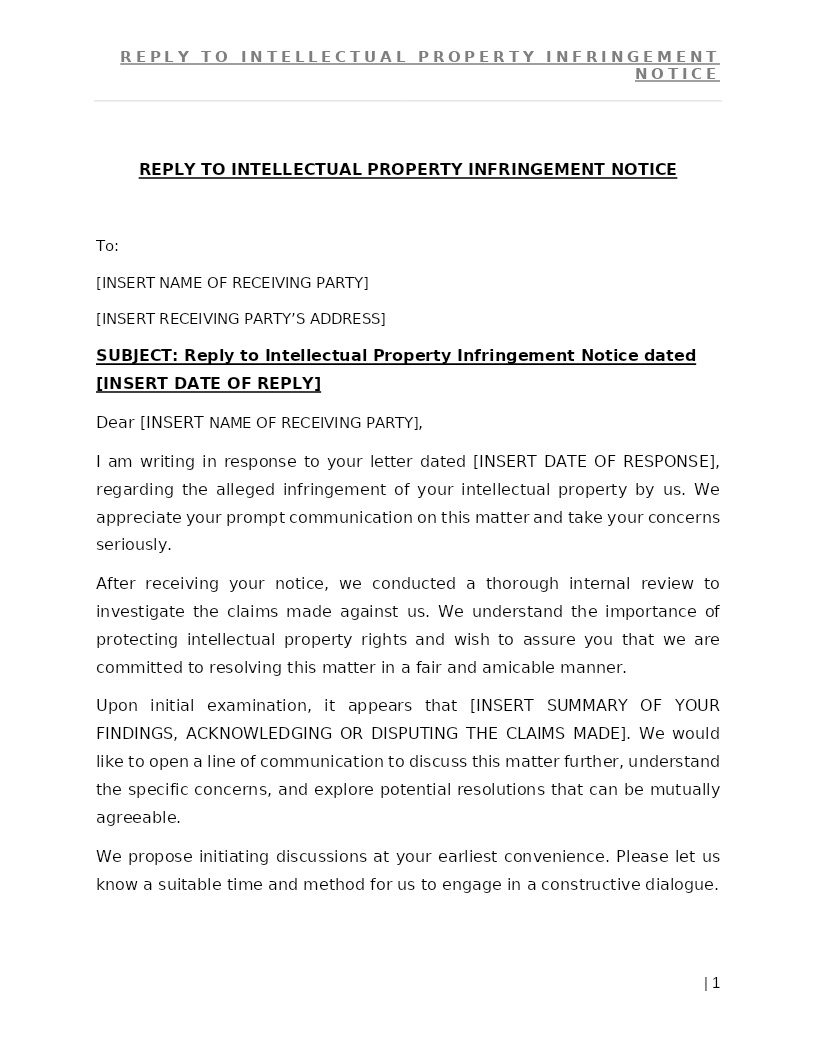
REPLY TO INTELLECTUAL PROPERTY INFRINGEMENT NOTICE
How does it work?
1. Choose this template
Start by clicking on "Fill out the template"
2. Complete the document
Answer a few questions and your document is created automatically.
3. Save - Print
Your document is ready! You will receive it in Word and PDF formats. You will be able to modify it.
Understanding a Reply to an Intellectual Property Infringement Notice
When your business receives an Intellectual Property (IP) Infringement Notice—whether related to copyright, trademark, patent, or digital content—it’s essential to respond professionally, clearly, and in compliance with U.S. law. A well-structured Reply helps you address allegations, present your position, request clarification if needed, and demonstrate good-faith compliance with federal IP regulations.
A Reply to an IP Infringement Notice is a formal communication that outlines your understanding of the claim, your evaluation of the alleged infringement, and any corrective steps you may take. This written response minimizes legal exposure, preserves evidence of cooperation, and may prevent escalation into litigation or takedown actions.
Where Reply Letters Are Commonly Used
Businesses and individuals issue reply letters to IP notices in scenarios such as:
• DMCA copyright takedown requests
• Trademark misuse or brand-confusion complaints
• Unauthorized use of images, text, software, or digital assets
• Patent infringement warnings or cease-and-desist letters
• Marketplace notices from Amazon, Etsy, eBay, Shopify, or social platforms
• Accusations involving advertising campaigns, branding, website content, or product designs
• Disputes involving third-party vendors, contractors, or user-generated content
Any time you receive a claim asserting IP misuse, a formal Reply sets the record straight and shows responsible action.
Different Types of IP Replies You May Need
- Acknowledgment & Clarification Reply: Used when you need more information about the allegation before taking action.
- Denial of Infringement Reply: Sent when you believe no infringement occurred based on your review.
- Compliance & Resolution Reply: Used when you agree to remove or modify the content to resolve the issue quickly.
- Counter-Notice (DMCA): Used to contest wrongful DMCA takedowns under U.S. Copyright Act Section 512.
- Third-Party Involvement Reply
- Used when the alleged infringing content came from a vendor, user, or subcontractor.
When Legal Guidance Becomes Helpful
Although many issues can be resolved by communicating clearly, legal support may be valuable when:
• The notice involves registered trademarks, patents, or copyrighted material
• The claim threatens litigation, statutory penalties, or marketplace account suspension
• The allegedly infringing content came from a contractor or third party
• You need to file a DMCA counter-notice to restore removed content
• The IP material is crucial to your product, website, or business model
• The claim affects multiple states or involves international IP law
Legal review helps prevent missteps that could escalate the situation or create liability.
How to Work with This Template
• Identify the sender of the infringement notice and the alleged IP issue
• Clearly state your position: acknowledgment, request for proof, denial, or corrective action
• Provide supporting details, timelines, or relevant documentation
• Specify steps you’ve taken or will take, if any
• Maintain a professional and factual tone avoid admissions not intended
• Choose the appropriate governing U.S. law and maintain compliance with DMCA or trademark rules
• Sign electronically or physically as accepted by the sender
This response format is compatible with major digital platforms, including marketplaces and hosting providers.
Frequently Asked Questions
Q1. Why is it important to reply to an IP infringement notice?
Responding promptly helps prevent escalation into lawsuits, takedowns, or account penalties. It also shows you are acting in good faith, which can influence how enforcement bodies or platforms treat your case.
Q2. Does replying mean I admit the infringement?
No. A reply simply acknowledges receipt of the notice. Your response can deny the claim, request clarification, or explain your position without admitting liability.
Q3. What if I believe the notice is incorrect or fraudulent?
You can request evidence, challenge the claim, or file a DMCA counter-notice if applicable. Many fraudulent notices are sent to pressure businesses proper documentation protects your rights.
Q4. How quickly should I respond to an infringement notice?
Platforms such as Amazon or YouTube may require responses within days. Quick replies help preserve your rights and prevent automatic account actions or content removal.
Q5. Can I remove content temporarily while reviewing the claim?
Yes. Temporary removal demonstrates good-faith compliance and may prevent further legal steps while you investigate the matter.
Q6. What should I include in a denial of infringement?
You should describe why the claim is incorrect, provide evidence (such as licenses, ownership documents, or timestamps), and request withdrawal of the complaint.
Q7. Do I need a lawyer to reply?
Not always. Many straightforward cases, such as misunderstandings or misidentifications can be handled directly. For complex IP disputes or valuable assets, legal review is recommended.
Q8. What is a DMCA counter-notice, and when should I file one?
A counter-notice is used to challenge wrongful copyright takedowns. Under U.S. law, platforms must restore content unless the complainant files a lawsuit within the required timeframe.
Q9. Can a reply protect me from damages or litigation?
While it doesn’t guarantee immunity, a professional reply demonstrates compliance and can significantly reduce the likelihood of legal escalation or penalties.
Q10. What if the issue involves content created by a contractor or third party?
You may forward the notice to them, request clarification, or revise content, but ultimately you must respond as the content publisher. Your reply should clarify the source and the steps being taken.