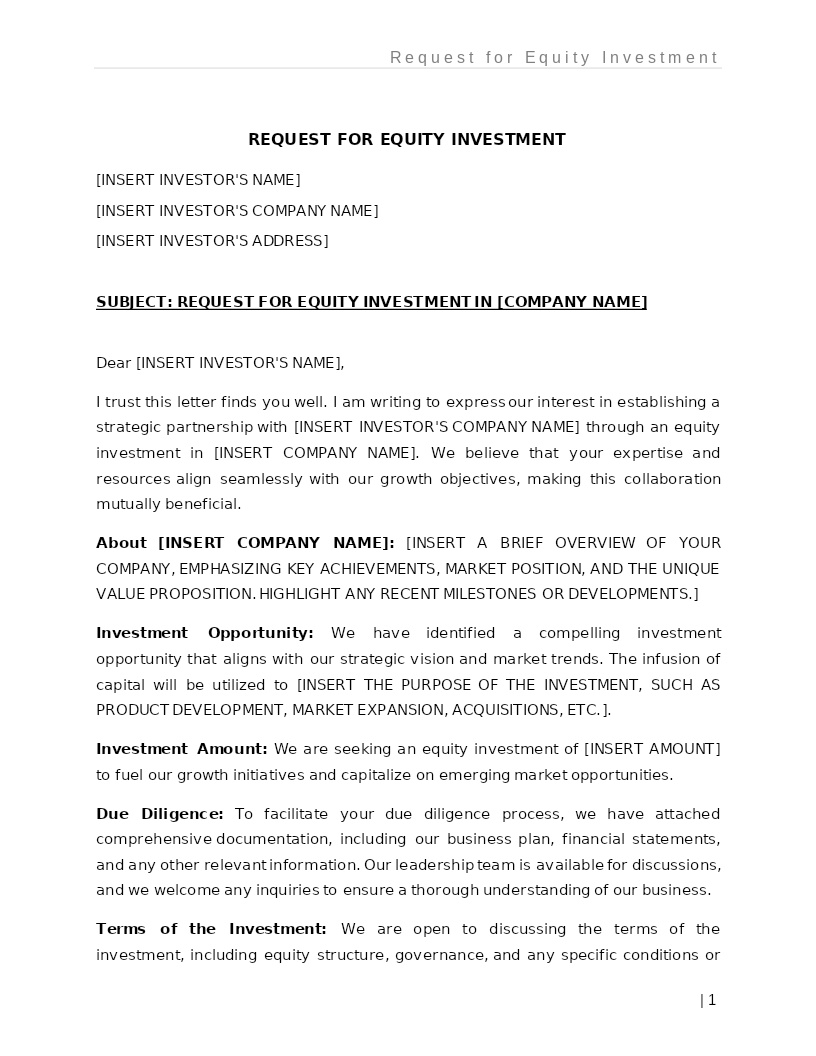
REQUEST FOR EQUITY INVESTMENT
How does it work?
1. Choose this template
Start by clicking on "Fill out the template"
2. Complete the document
Answer a few questions and your document is created automatically.
3. Save - Print
Your document is ready! You will receive it in Word and PDF formats. You will be able to modify it.
Understanding the Purpose of a Request for Equity Investment
When a business aims to grow, expand operations, or strengthen its financial foundation, it becomes essential to have a clear framework for presenting an investment opportunity. A Request for Equity Investment provides that structure. It outlines the nature of the investment, the percentage of ownership being offered, financial projections, and the strategic value the investor can expect.
By presenting this request formally, companies can communicate transparently, establish trust with potential investors, and demonstrate professionalism. This clarity helps investors evaluate the opportunity while ensuring that both parties align on the expectations and long-term vision for the business.
Where Requests for Equity Investment Are Commonly Used
These requests are widely used across industries and business stages, including:
- Startups seeking seed or Series-A funding
- Established companies preparing for expansion or new product launches
- Businesses undergoing restructuring or entering new markets
- Joint-venture opportunities requiring shared ownership
- Family-owned or private businesses transitioning to external investment
- Technology, manufacturing, real estate, and service-sector funding needs
Any time capital is exchanged for ownership, a formal request outlines the opportunity and sets clear expectations.
Different Types of Equity Investment Requests You May Encounter
- Seed or Early-Stage Investment Request: Used by startups that need initial funding to build products, hire teams, or validate their business model.
- Growth or Expansion Funding Request: Prepared by companies looking to scale operations, enter new markets, or increase production capacity.
- Strategic Investor Request: Targeted at investors who bring expertise, networks, or resources in addition to capital.
- Minority Equity Investment Request: Used when the business seeks funding without giving up controlling interest.
- Majority or Controlling Interest Investment Request: Involves offering investors a larger share for substantial capital contributions or turnaround support.
When Legal Guidance Becomes Helpful
While many businesses use standard templates or pitch materials, legal counsel becomes essential when:
- The investment involves complex ownership structures or multiple shareholders
- Securities laws, private-placement rules, or investor-accreditation requirements apply
- The company is offering preferred shares, convertible notes, or equity-linked instruments
- Cross-border or multi-jurisdictional investors are involved
- There are tax, compliance, or regulatory implications tied to the investment
- Negotiation of rights, voting power, or board representation is expected
- Disclosure obligations and risk statements must be prepared
Legal review ensures the investment request complies with applicable U.S. laws and accurately reflects obligations and expectations.
How to Work with This Template
- Identify the business seeking investment and describe its mission and model
- Specify the equity percentage offered and the capital amount requested
- Outline financial projections, target markets, and growth goals
- Highlight investor benefits, strategic advantages, and expected returns
- Attach supporting documents such as financial statements or pitch decks
- Review internally and collaborate with legal and financial advisors before issuing
This template follows widely recognized standards for equity fundraising in the United States and is suitable for startups, corporations, LLCs, and partnerships.
Frequently Asked Questions
Q1. What is a Request for Equity Investment and why is it important?
A Request for Equity Investment is a formal proposal seeking capital from investors in exchange for ownership in the business. It clearly outlines the funding needs, business potential, and strategic direction of the company. This helps investors evaluate risk and return accurately. A structured request improves credibility and increases the chances of securing investment.
Q2. How does equity investment differ from traditional loans?
Equity financing does not require repayment or interest, unlike business loans. Instead, investors receive a share of ownership and benefit from the company’s growth and value creation. This reduces financial pressure on the business and supports long-term scalability. For investors, it offers potential higher returns through dividends, appreciation, or exit events.
Q3. What information should be included in a Request for Equity Investment?
A strong request includes business goals, funding requirements, equity offered, financial projections, and details on how the capital will be used. Investors also expect information about market opportunity, competitive advantages, and management expertise. Including these elements builds trust and provides transparency. It helps investors make informed decisions aligned with their risk profile.
Q4. Can this request help attract strategic or value-adding investors?
Yes. A well-structured request not only secures capital but also attracts investors who can offer industry expertise, mentorship, and business connections. These strategic partners can accelerate growth by opening doors to new clients, markets, and resources. Highlighting mutual benefits strengthens the proposal. This often results in long-term, collaborative partnerships.
Q5. Is legal review necessary before submitting an equity investment request?
While not always mandatory, legal review is highly recommended. Equity investments involve securities laws, ownership rights, and long-term obligations that must be clearly defined. An attorney ensures compliance with state and federal regulations. This reduces risk for both the company and the investor and prevents future disputes.
Q6. How does equity investment support business growth and expansion?
Equity funding provides capital for product development, hiring, marketing, and scaling operations. Without the burden of loan repayment, businesses can reinvest profits into strategic growth areas. Investors may also contribute expertise that strengthens operations. This creates a solid foundation for sustainable expansion.
Q7. Can the equity investment request be customized for different types of investors?
Absolutely. Businesses can tailor proposals for angel investors, venture capital firms, private equity groups, or strategic corporate partners. Each type of investor has distinct expectations regarding risk, returns, and involvement. Customizing the request improves relevance and increases the likelihood of securing funding. This also demonstrates professionalism and preparation.
Q8. Does equity investment dilute ownership, and how can it be managed?
Equity investment does dilute ownership, but it also brings in capital and resources that can significantly increase company value. By carefully structuring share classes, voting rights, and investor terms, businesses can maintain strategic control. Transparent communication about ownership impact builds trust. Many companies balance dilution with long-term growth benefits.