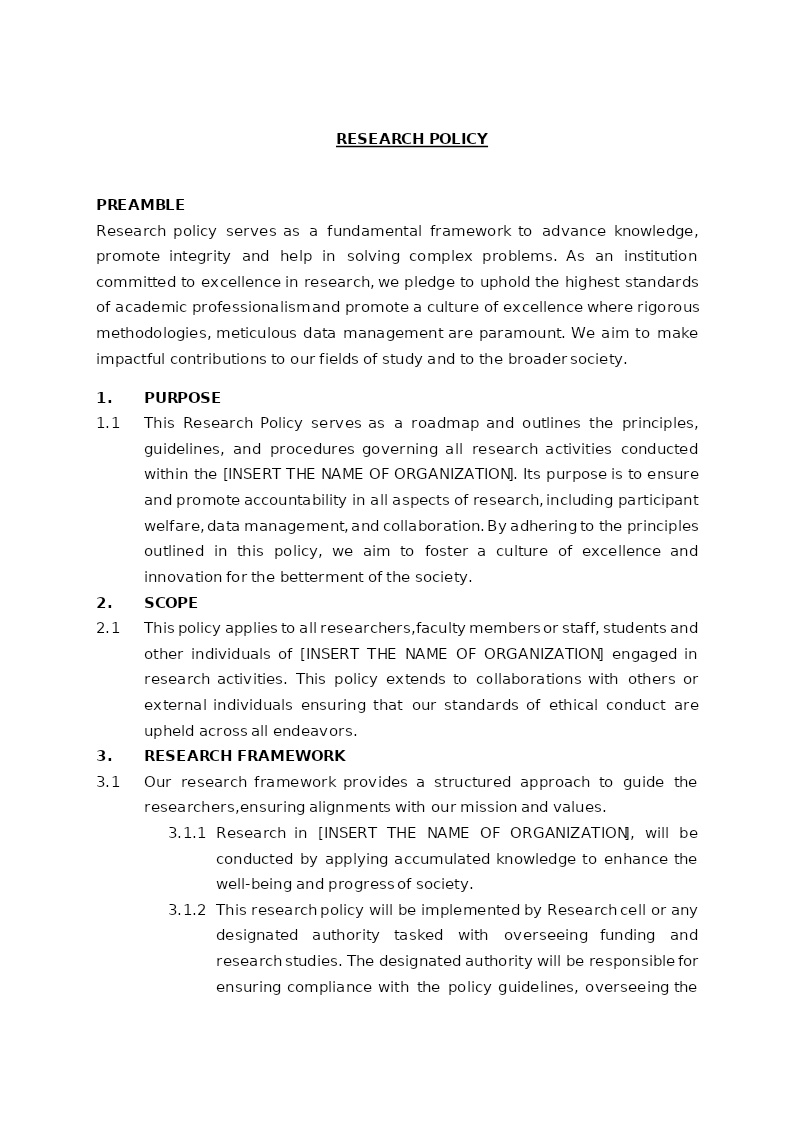
RESEARCH POLICY
How does it work?
1. Choose this template
Start by clicking on "Fill out the template"
2. Complete the document
Answer a few questions and your document is created automatically.
3. Save - Print
Your document is ready! You will receive it in Word and PDF formats. You will be able to modify it.
Understanding Research Policy In U.S.
A Research Policy is a formal framework that outlines the standards, procedures, and ethical guidelines governing research activities within an organization. It sets out the expectations for integrity, safety, compliance, and responsible conduct throughout all stages of research. This policy ensures that research is performed ethically, protects intellectual property, and adheres to U.S. laws such as federal research regulations, privacy rules, and data protection requirements. A well-structured Research Policy supports innovation, transparency, and accountability while safeguarding the interests of researchers, institutions, and the public.
Where a Research Policy Is Commonly Used
A Research Policy is essential in:
- Universities, colleges, and academic institutions
- Government research programs and federally funded projects
- Corporate R&D departments
- Healthcare, biotechnology, and pharmaceutical sectors
- Technology companies developing proprietary systems
- Nonprofits, think tanks, and scientific organizations
These environments rely on structured guidelines to ensure ethical, legal, and high-quality research execution.
Different Types of Research Policies
- Ethical Research Policy: Ensures researchers follow ethical standards, obtain consent, and protect human/animal subjects.
- Data Management & Security Policy: Governs how research data is collected, stored, processed, shared, and protected.
- Intellectual Property Policy: Defines the ownership, licensing, and commercialization rights of research outcomes.
- Collaborative Research Policy: Regulates partnerships between organizations, institutions, and external funding bodies.
- Funding & Grants Policy: Outlines rules for managing grants, reporting obligations, and financial accountability.
When Legal Guidance Becomes Necessary
Legal consultation is recommended when:
• Research involves human subjects and requires compliance with IRB (Institutional Review Board) rules
• Data collection involves sensitive, personal, or health-related information regulated by HIPAA or FERPA
• Research is funded by federal agencies requiring strict adherence to U.S. Code of Federal Regulations (CFR)
• Intellectual property rights, patents, or commercialization agreements are involved
• Collaborative research spans multiple institutions or jurisdictions
• Ethical concerns, misconduct allegations, or conflicts of interest arise
Lawyers help ensure the policy meets federal regulations, protects the organization, and supports enforceable research standards.
How to Work With This Research Policy
• Clearly define research approvals, review processes, and reporting requirements
• Establish ethical standards for researchers and participants
• Create data handling, confidentiality, and security guidelines
• Outline IP ownership for research outputs and publications
• Specify compliance with federal and state research regulations
• Document funding, budgeting, and grant management protocols
• Provide procedures for addressing misconduct or policy violations
• Maintain consistent training for all research personnel
A well-implemented Research Policy builds credibility, enhances safety, and maintains legal compliance.
Frequently Asked Questions
Q1. Why is a Research Policy important for U.S. institutions?
A Research Policy ensures compliance with federal regulations such as IRB guidelines, HIPAA, and data protection laws. It establishes consistent ethical and operational standards for researchers, reduces institutional risks, and provides a structured framework for conducting safe, transparent, and high-quality research activities.
Q2. Does a Research Policy apply to all types of research projects?
Yes. Whether the research is academic, scientific, corporate, or technology-based, the policy applies uniformly. It outlines expectations for ethical conduct, data management, confidentiality, and legal compliance across all research activities, regardless of project size or funding source.
Q3. How does a Research Policy protect intellectual property?
The policy sets out clear rules on ownership, licensing, patent rights, and publication guidelines. It ensures that organizations and researchers understand how innovations can be commercialized, shared, or protected, preventing disputes and safeguarding proprietary information.
Q4. What laws must U.S. research policies comply with?
Research policies must align with federal regulations such as the Common Rule (45 CFR 46), FDA regulations for clinical research, HIPAA for medical data, FERPA for student data, and data protection laws. Compliance ensures ethical practices and protects institutions from legal penalties.
Q5. How does a Research Policy manage data privacy and security?
It provides detailed procedures for collecting, storing, and processing data securely. This includes encryption standards, access controls, retention timelines, and disposal requirements. These measures help protect sensitive information from unauthorized access or breaches.
Q6. Can a Research Policy cover collaboration with external partners?
Yes. It outlines the guidelines for joint research projects, data sharing agreements, funding allocations, and IP ownership. Clear rules support successful partnerships while preventing conflicts or miscommunication between collaborating parties.
Q7. What happens if a researcher violates the Research Policy?
Violations may lead to disciplinary action, loss of funding, suspension of research privileges, or legal consequences depending on severity. The policy includes procedures for reporting, investigating, and resolving misconduct, ensuring fairness and accountability.
Q8. How does a Research Policy benefit researchers and institutions?
It creates a transparent and structured research environment, promotes ethical standards, and supports compliance with regulations. This reduces legal risks, enhances the quality of research outcomes, protects intellectual property, and boosts the institution’s reputation for credible and responsible research.