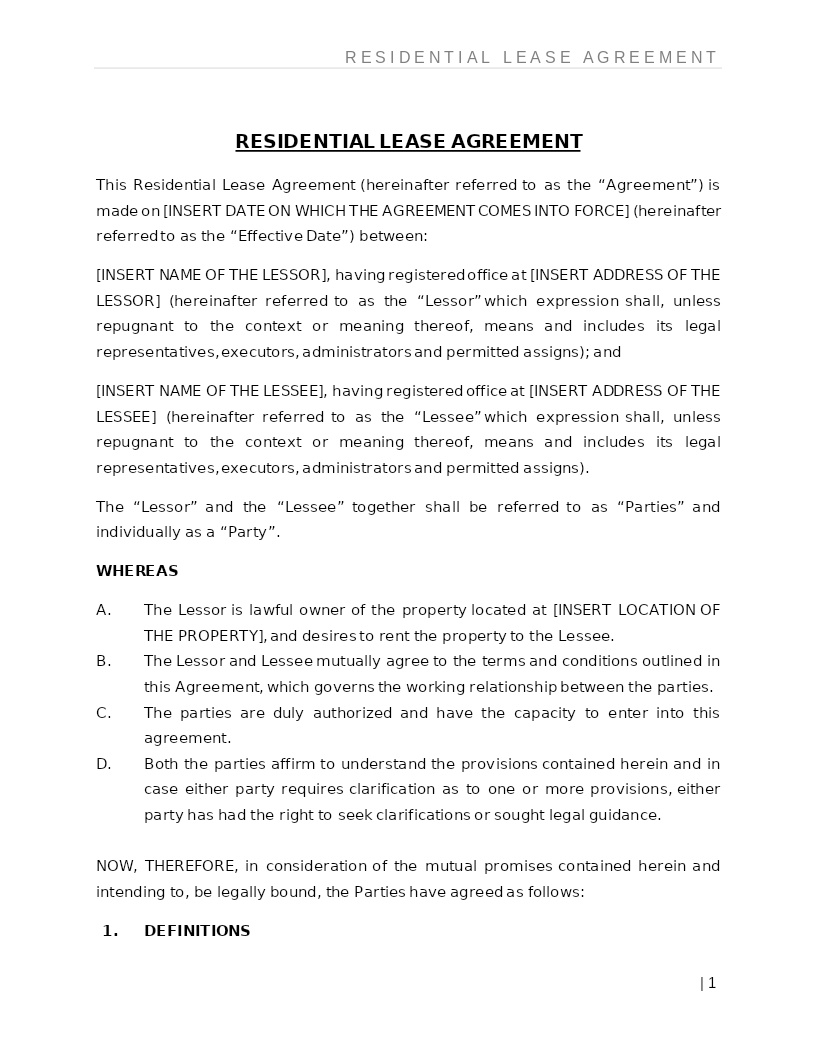
RESIDENTIAL LEASE AGREEMENT
How does it work?
1. Choose this template
Start by clicking on "Fill out the template"
2. Complete the document
Answer a few questions and your document is created automatically.
3. Save - Print
Your document is ready! You will receive it in Word and PDF formats. You will be able to modify it.
Establishing Residential Tenancy Rights in Lease Arrangements
When parties enter into a housing arrangement under which a tenant is granted the right to occupy residential premises in exchange for rent, it is essential to establish a detailed contractual framework governing the parties’ obligations. A Residential Lease Agreement fulfills this purpose. It sets forth the terms under which a landlord leases residential property to a tenant, establishing rights, responsibilities, payment obligations, and use restrictions, all in accordance with U.S. landlord-tenant laws, applicable state statutes, and local housing regulations.
By executing a Residential Lease Agreement, the parties create a legally enforceable record of the tenancy. This enables both landlord and tenant to understand their rights and duties regarding occupancy, rent, property maintenance, security deposits, utilities, and termination procedures. A properly drafted lease minimizes disputes, provides stability, and ensures that the tenancy complies with federal fair housing rules and state-specific legal requirements.
Where Residential Lease Agreements Are Commonly Used
Residential lease arrangements are utilized in numerous housing and rental situations, including:
- Leasing apartments, houses, duplexes, townhomes, and condominiums
- Rental of accessory dwelling units (ADUs), basements, or in-law suites
- Short-term or long-term residential occupancy arrangements
- Multi-tenant or shared housing rentals
- Student housing, room rentals, and co-living arrangements
- Single-family investment property leasing
- Corporate housing and employee accommodation agreements
Any time a property owner permits a tenant to occupy residential premises for rent, a Residential Lease Agreement establishes the governing legal structure.
Different Types of Residential Lease Agreements You May Encounter
- Fixed-Term Residential Lease: Covers a defined tenancy period (e.g., twelve months) with a predetermined expiration.
- Month-to-Month Residential Lease: Automatically renews monthly until terminated by either party with proper notice.
- Short-Term Residential Lease: Typically used for seasonal, transitional, or furnished rental arrangements.
- Room or Shared Housing Lease: Governs occupancy of individual rooms or co-living spaces within shared premises.
- Sublease Agreements: Used when an existing tenant leases part or all of the property to another occupant, subject to the landlord’s approval.
When Legal Guidance Becomes Helpful
Legal assistance may be advisable when:
- The rental involves multi-unit properties or complex utility arrangements
- Local or state housing rules impose specific disclosure requirements
- Rent control, eviction protections, or security-deposit statutes apply
- The Landlord intends to impose usage restrictions or house rules
- The Tenant requires reasonable accommodations under fair housing laws
- The lease concerns high-value, luxury, or corporate housing
- The parties anticipate potential disputes regarding maintenance, access, or termination
Legal review helps ensure compliance with state and municipal housing codes and enhances the enforceability of the lease’s provisions.
How to Work With This Template
- Identify the Landlord, Tenant, and property address
- Specify the lease term (fixed-term or month-to-month)
- Set forth the rent amount, payment schedule, and late-fee provisions
- Describe utilities, maintenance duties, and rules governing property use
- Detail the security deposit amount and refund conditions
- Include all disclosures required under federal and state law (e.g., lead-based paint)
- Select governing law and jurisdiction
- Review the lease for accuracy and applicable state requirements
- Execute the agreement electronically or in writing
The template aligns with generally recognized U.S. residential leasing practices and is compatible with major e-signature platforms.
Frequently Asked Questions
1. What is a Residential Lease Agreement, and why is it necessary?
A Residential Lease Agreement is a legally binding contract outlining the terms under which a landlord leases residential property to a tenant. It is necessary because it defines rent, responsibilities, occupancy rules, and termination procedures, ensuring compliance with U.S. landlord-tenant laws and reducing the risk of misunderstandings.
2. Is a residential lease enforceable without being in writing?
While some states recognize oral leases for short periods, a written Residential Lease Agreement is strongly recommended especially for tenancies exceeding one year to ensure clear terms and legal enforceability.
3. How is rent determined and documented in the lease?
Rent amounts, due dates, acceptable payment methods, and late-fee provisions are documented directly in the lease. Clear rent terms help prevent payment disputes and support enforcement under state landlord-tenant statutes.
4. What disclosures are required under U.S. law?
Federal law mandates lead-based paint disclosures for housing built before 1978. Many states require additional disclosures, such as mold, pest treatment, flooding risk, radon, smoking policies, and utility billing methods. These disclosures must be incorporated into the lease.
5. Can the landlord increase rent during the lease term?
In a fixed-term lease, rent typically cannot be increased until renewal unless explicitly agreed otherwise. In a month-to-month tenancy, rent increases are generally allowed with proper written notice, subject to local rent-control regulations.
6. What is a security deposit, and how is it regulated?
A security deposit is a sum paid by the tenant to cover damages or unpaid rent. Many states regulate the maximum deposit amount, required handling of the funds, inspection procedures, and deadlines for returning the deposit after move-out.
7. Can a tenant sublease the property?
Subleasing may be permitted or prohibited depending on the lease terms and state law. Many leases require the landlord’s written consent before subleasing to another occupant.
8. What happens if the tenant violates the lease?
Violations such as nonpayment of rent, unauthorized occupants, or property damage may result in notices to cure, lease termination, or eviction proceedings. Procedures must comply with state-specific eviction laws.
9. Are electronic signatures valid for residential leases?
Yes. Residential leases can be executed electronically under the U.S. ESIGN Act, provided both parties consent to the use of electronic signatures.
10. Can the landlord enter the property during the tenancy?
Landlords must typically provide reasonable advance notice before entering the premises, except in emergencies. State laws differ on the required notice period, so compliance with local regulations is essential.
11. Is renters insurance required?
Some landlords require tenants to maintain renters’ insurance to cover personal belongings and liability. Whether mandatory or optional, renters’ insurance provides valuable protection for the occupant.
12. How can the lease be terminated?
Termination depends on whether the lease is fixed-term or month-to-month. Fixed-term leases end upon expiration unless renewed. Month-to-month leases require statutory notice. Termination rules must comply with state and local housing laws.