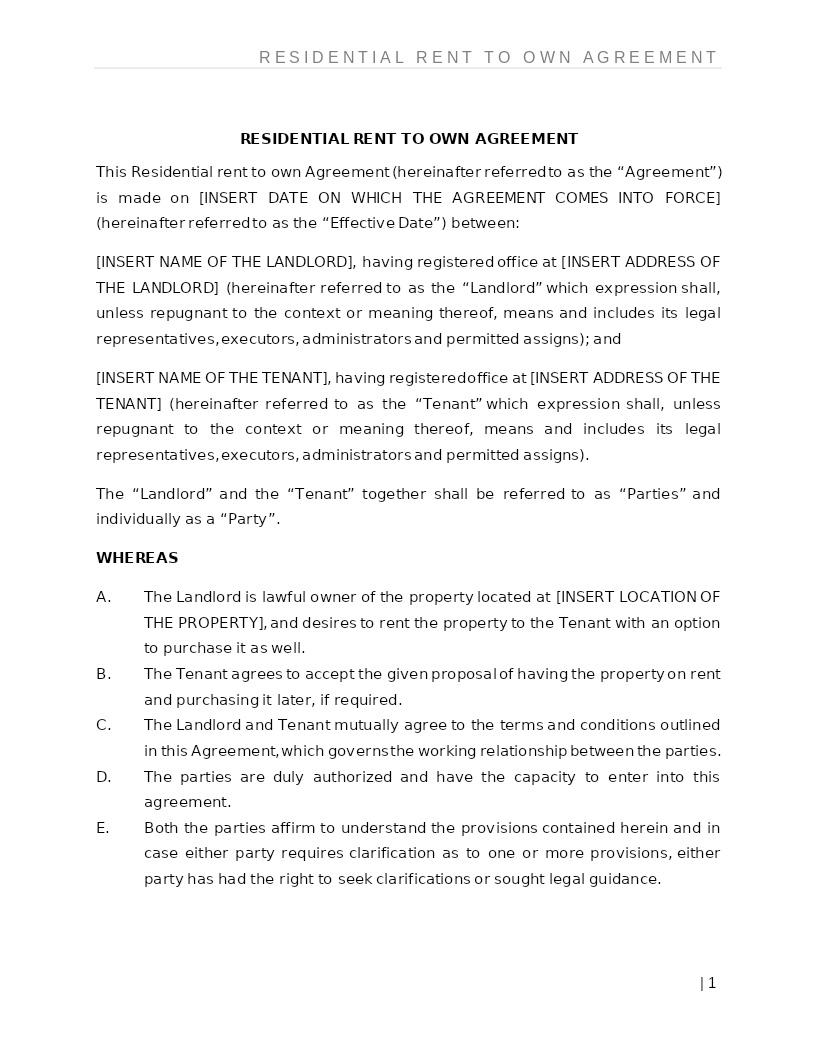
RESIDENTIAL RENT TO OWN AGREEMENT
How does it work?
1. Choose this template
Start by clicking on "Fill out the template"
2. Complete the document
Answer a few questions and your document is created automatically.
3. Save - Print
Your document is ready! You will receive it in Word and PDF formats. You will be able to modify it.
Establishing Hybrid Tenancy and Purchase Rights Through a Residential Rent-to-Own Agreement
A Residential Rent-to-Own Agreement is a specialized legal instrument that combines elements of a traditional residential lease with an option or obligation to purchase the property at a later date. This agreement grants the tenant the right often exclusive to buy the home after a defined rental period while simultaneously outlining the tenant’s rights and responsibilities as an occupant. It is drafted in accordance with U.S. real estate law, landlord-tenant regulations, consumer-protection statutes, financing guidelines, and state-specific rent-to-own requirements, ensuring lawful structure and enforceability.
A well-crafted Rent-to-Own Agreement addresses critical terms such as option fees, rent credits, purchase price determination, maintenance obligations, payment schedules, compliance with habitability standards, and consequences of default. It safeguards both parties by clarifying the hybrid nature of the arrangement: the tenant gains a pathway to homeownership, while the property owner obtains rental income and a committed potential buyer. By memorializing these rights in a written contract, the parties avoid ambiguity, regulatory violations, and disputes concerning occupancy or future purchase rights.
Where Residential Rent-to-Own Agreements Are Commonly Used
Residential Rent-to-Own Agreements are widely used in residential real estate contexts, including:
- Individuals seeking homeownership but requiring time to strengthen credit or financing eligibility
- Sellers looking to secure long-term, reliable occupants while preparing for future sale
- Families needing transitional housing with an eventual purchase option
- Property owners wishing to market homes competitively in slower sales cycles
- Investment property holders offering tenant-buyer programs
- Situations where buyers require time to save down-payment funds
- Markets where traditional mortgage qualification is challenging
- Lease-option or lease-purchase arrangements tailored to state housing laws
Such agreements provide flexibility for buyers and stability for property owners.
Different Types of Residential Rent-to-Own Agreements
1. Lease-Option Agreements: Grant tenants the right but not the obligation to purchase the home during or at the end of the lease term.
2. Lease-Purchase Agreements: Commit the tenant to purchase the home at the end of the lease term, subject to fulfillment of contractual conditions.
3. Rent-Credit Agreements: Apply a portion of monthly rent toward eventual purchase, helping tenants accumulate equity.
4. Option-Fee Agreements: Require an upfront, non-refundable payment securing the tenant’s exclusive right to purchase.
5. Installment-Sale Rent-to-Own Agreements: Blend rental payments with contractual purchase installments, subject to state financing rules.
When Legal Guidance Becomes Helpful
Legal assistance is strongly recommended when:
- The agreement includes high-value option fees, rent credits, or complex purchase structures
- State laws impose additional disclosures for lease-option or installment-sale arrangements
- The property is subject to liens, mortgages, HOA restrictions, or title complications
- The purchase price depends on appraisal adjustments or formula-based valuation
- The tenant faces financing challenges requiring contingencies or protections
- Local landlord-tenant regulations impose habitability or notice requirements
- The arrangement resembles a financing contract subject to lending regulations
- Either party requires protection against default, eviction, or forfeiture risks
Legal review ensures the agreement complies with state rent-to-own laws, consumer-protection rules, and real-estate regulations.
How to Work with This Template
- Identify the property, landlord/seller, and tenant/buyer with full legal names
- Define the lease term, monthly rent, and allocation of rent credits (if any)
- Specify the option fee, purchase price, or methods for price calculation
- Address maintenance duties, repairs, utilities, and habitability requirements
- Clarify default procedures, termination rights, and forfeiture rules
- Include governing law, disclosures, inspection rights, and environmental requirements
- Explain what happens to option fees or rent credits if the purchase does not occur
- Provide timelines for exercising the option, completing inspections, and closing
- Execute the agreement electronically or in writing in accordance with U.S. e-signature laws
This template aligns with standard U.S. real estate and landlord-tenant practices, making it suitable for landlords, buyers, property managers, and real-estate professionals.
Frequently Asked Questions
Q1. What is a Residential Rent-to-Own Agreement, and why is it important?
A Residential Rent-to-Own Agreement is a contract that allows a tenant to lease a property with the option or obligation to buy it later. It is important because it provides a structured pathway to homeownership while protecting both parties with clear legal terms.
Q2. Does rent-to-own guarantee the tenant will buy the home?
Not always. In lease-option agreements, the tenant may choose not to purchase. In lease-purchase agreements, the tenant is typically required to complete the purchase at the end of the lease term.
Q3. Are option fees refundable?
Option fees are usually non-refundable unless the contract states otherwise. They compensate the seller for granting exclusive purchase rights.
Q4. Are rent credits applied toward the purchase price?
Yes, if included in the agreement. Rent credits reduce the eventual purchase price or closing costs but must be clearly documented for legal enforceability.
Q5. Does a rent-to-own arrangement require disclosures?
Yes. Some states mandate written disclosures for lease-option or installment arrangements to protect consumers from deceptive housing practices.
Q6. Who is responsible for maintenance under a rent-to-own agreement?
Responsibility depends on the contract. Many agreements shift some maintenance duties to the tenant because of their potential ownership interest.
Q7. Can the tenant lose the option if they miss payments?
Potentially. Failure to pay rent or option fees on time may result in forfeiture of the purchase right, depending on the agreement’s terms.
Q8. Are electronic signatures valid for rent-to-own agreements?
Yes. Under ESIGN and UETA, electronic signatures are fully enforceable for real-estate lease and option agreements.
Q9. Does rent-to-own affect the tenant’s ability to secure a mortgage later?
It may help, as timely rent payments and rent-credit accumulation can improve financial readiness. However, mortgage qualification still depends on creditworthiness and lender guidelines.
Q10. What happens if the tenant chooses not to buy the home?
If allowed under the agreement, the tenant may walk away, though option fees and rent credits may be forfeited depending on contract terms. The landlord may then re-lease or sell the property to another party.